Story code: ST-000832
Part 4: The Fragile Baseline
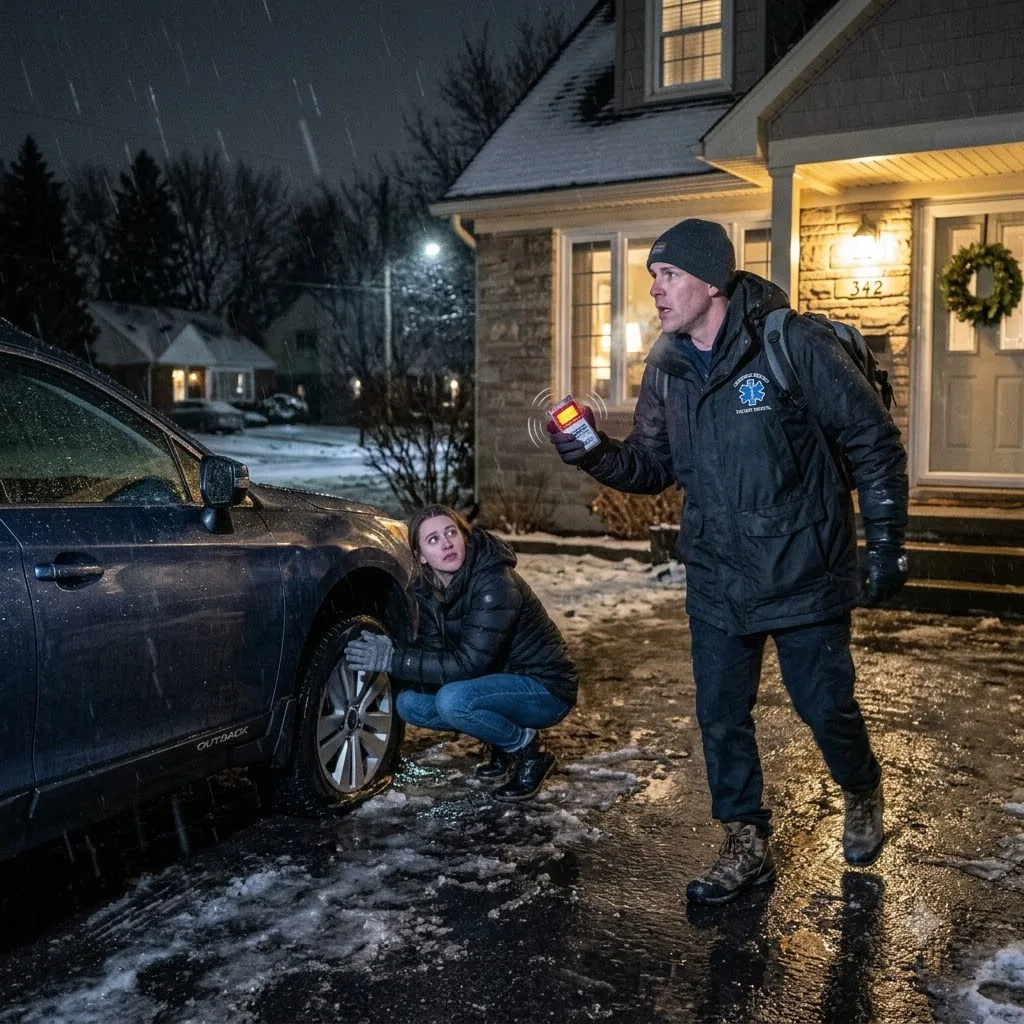
The steel jaws of the handcuffs snapped open. The sudden release of pressure on Marcus’s wrists sent a sickening wave of pins and needles up his forearms. Officer Miller didn’t offer an apology, only a grim, tight-jawed grimace as he hauled Marcus to his feet.
“Get your bag,” Miller ordered, his voice clipping through the freezing rain. He turned his broad shoulders toward the secondary officer, who was currently wrestling the trench-coated woman against the side of the second cruiser. “Cuff her. Put her in the back. Now.”
“You can’t do this!” she shrieked, her voice stripping its gears as the metal clicked around her own wrists. “I was just being careful! I live two streets over! I was just being careful!”
Marcus didn’t look at her. He couldn’t. He grabbed the heavy red canvas bag from the passenger seat of his ruined SUV, his left shoulder screaming in protest where the joint had been violently wrenched. He checked his watch, wiping the sleet from the glass face with a trembling thumb. Twenty-two minutes. Twenty-two minutes had evaporated since his pager first went off. In pediatric trauma, twenty-two minutes was the difference between a pulse and a morgue toe tag.
“Get in,” Miller said, opening the rear door of his cruiser. “We’re taking you.”
Marcus practically fell into the plastic-molded back seat. The cruiser’s tires spun violently on the icy grass before finding traction, tearing a deep, muddy rut across his front lawn as Miller threw the vehicle into drive. The siren wailed a deafening, continuous scream, but Marcus tuned it out. He unzipped the trauma bag, his fingers slipping clumsily on the brass teeth. He pulled out the shortwave radio, turning the dial to the hospital’s emergency frequency.
“Memorial ER, this is Hayes,” Marcus said, his voice ragged, his breath fogging the plexiglass divider. “I am in transit. Two minutes out. Give me a status.”
The radio crackled. “Dr. Hayes, it’s Chen. We had to crack the chest. We’ve clamped the descending aorta, but we can’t isolate the bleeder. He’s hypotensive. We are losing him.”
“Pack the cavity and hold pressure. Do not move your hands until I am standing next to you,” Marcus barked back, staring at the flashing red and blue strobes bouncing off the passing suburban houses.
The cruiser didn’t even come to a complete stop at the ambulance bay. Marcus kicked the door open and sprinted through the sliding glass doors, leaving the police officers behind in the freezing rain. He hit the swinging doors of Trauma Bay 1 at a dead run.
The room was a chaotic blur of bloody drapes, discarded sterile packaging, and the relentless, terrifying beep of a heart monitor barely holding onto a rhythm. Marcus didn’t bother changing out of his soaked, freezing sweatpants. He threw off his winter jacket, shoved his arms into a sterile gown held up by a wide-eyed circulating nurse, and plunged his gloved hands directly into the open chest cavity of the eight-year-old boy on the table.
For the next two hours, the world outside the surgical theater ceased to exist. Marcus operated purely on muscle memory and sheer, desperate adrenaline. He pushed through the throbbing ache in his back where the officer’s knee had ground into his spine. He ignored the sharp stinging on his cheek where the icy concrete had torn his skin. He focused only on the tiny, fragile vessels beneath his fingers, suturing, clamping, and willing the child’s heart to keep beating.
When they finally closed the chest, the boy’s vitals had stabilized. The monitor chirped with a steady, rhythmic reassurance. Dr. Chen stepped back, exhaling a long, shuddering breath. “Nice work, Dr. Hayes. We really thought we lost him before you walked in.”
Marcus nodded once, unable to speak. He backed away from the table, peeling off his bloody gloves and dropping them into the biohazard bin.
He walked blindly out of the trauma bay and pushed his way into the nearest staff restroom. The heavy wooden door swung shut, cutting off the noise of the emergency department. He stood in front of the stainless steel sink, bracing his hands against the cold porcelain.
He looked up at the mirror. His scrub top was soaked with sleet and sweat. A jagged, ugly red abrasion covered his left cheekbone. His wrists, visible beneath the short sleeves, were ringed in dark, swelling purple bruises from the handcuffs.
He turned on the faucet, letting the scalding water run over his trembling hands. The adrenaline that had sustained him through the surgery was rapidly crashing, leaving him hollowed out, exhausted, and profoundly cold. He closed his eyes, but he couldn’t shut out the scene in the driveway. The blinding halogen spotlights. The crushing weight on his spine. The absolute certainty in the police officers’ eyes that he was a monster, simply because a stranger had pointed a finger and spun a lie.
*I was just being careful.*
The woman’s defensive, screeching justification echoed relentlessly in his head. She had nearly cost a child his life. She had nearly gotten Marcus shot in his own driveway. And she had done it all wrapped in a blanket of absolute, weaponized entitlement, believing her irrational fear gave her the right to destroy him.
Marcus shut off the water. The restroom was dead silent. He stared at his own reflection, a chief of surgery, a man who had spent a decade saving lives, realizing with a sickening, heavy dread just how easily it could all be stripped away by a single phone call.