Story code: ST-001873
Part 3: The Containment Protocol
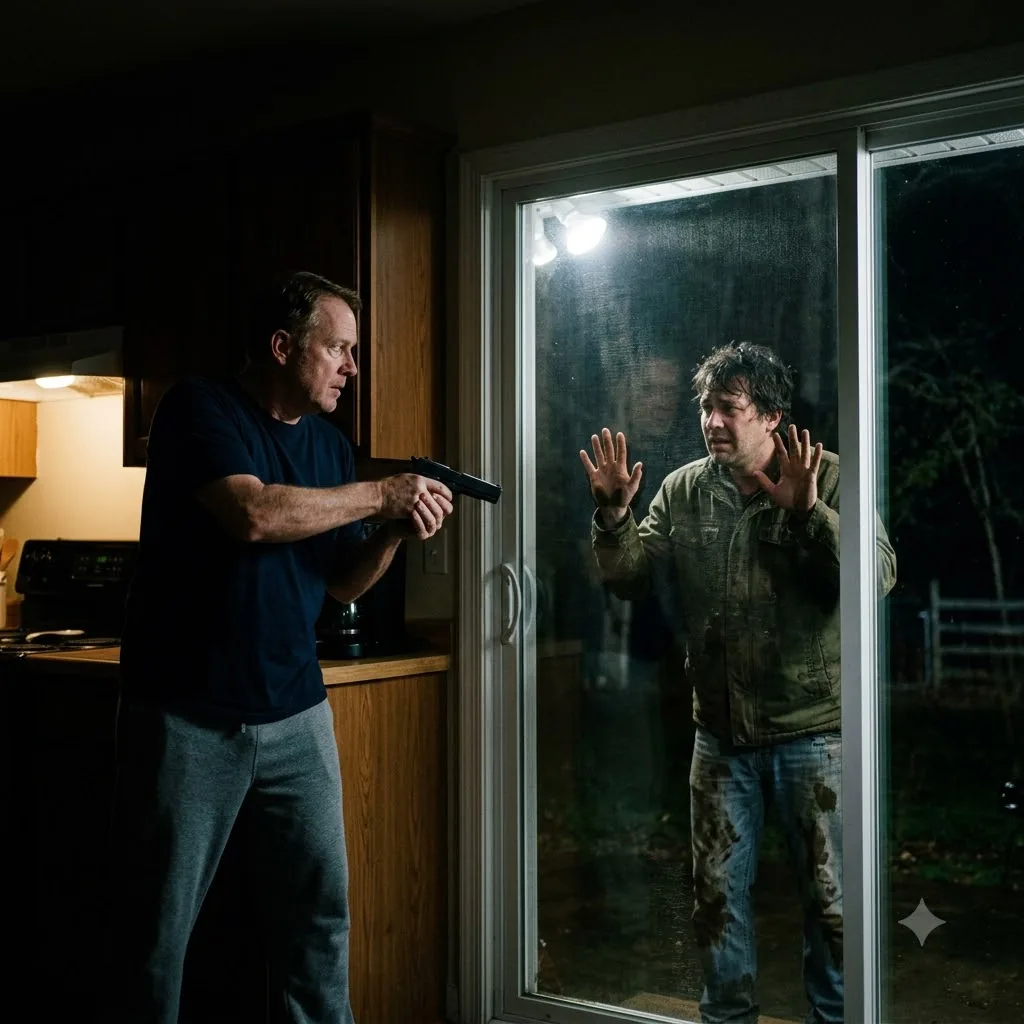
The second halogen floodlight extinguished with a sickening, metallic crunch. Glass rained onto the concrete patio in a heavy shower, followed by the immediate, suffocating embrace of pitch darkness in the backyard.
The man on the floor shrieked, curling himself into a fetal position against the wooden door.
Greg did not flinch. His tactical training isolated the panic and discarded it, forcing his brain to analyze the raw data of the room. He pressed the pressure switch on his pistol’s under-barrel rail. A blinding, 500-lumen cone of LED light punched through the darkness, pinning the intruder against the door frame.
In the stark white beam, the horrific state of the man finally made sense. The toxic, metallic reek that Greg had previously identified as blood and hydraulic fluid suddenly clarified in his sinuses. The copper tang wasn’t blood, and the ozone wasn’t electrical fire. It was the sharp, lung-searing burn of anhydrous ammonia, mixed with the sickeningly sweet scent of melting industrial polymer.
Greg’s beam traced the man’s ruined shirt, stopping at the center of his chest. A rectangular plastic card dangled from a half-melted, heavy-duty lanyard. The plastic was warped and discolored, but the bold red logo of the Apex Chemical Processing Plant-located just three miles down the highway-was unmistakable. Below the logo, smeared with black sludge, was a photo and a name: *Mateo Velez. Night Shift Operator.*
“You’re not bleeding,” Greg said, his voice dropping to a cold, steady register. “That’s chemical sludge. You’re from the Apex plant.”
Mateo squeezed his eyes shut against the tactical light, shivering violently. “They’re going to kill us. The lights are gone. It’s coming.”
“Look at me,” Greg snapped, keeping the beam locked on Mateo’s chest while his mind rapidly assembled the pieces. The jammed cell signal. The rhythmic, subterranean tremor. The exploding floodlights.
“That is not a monster out there,” Greg said, stepping slightly sideways to keep his back to the solid wall. “That low-frequency vibration? That’s the idle of a high-torque diesel engine, likely an armored transport. The signal jammer is a localized corporate disruptor. And that floodlight didn’t crush itself. That was a heavy-grain subsonic round from a suppressed rifle. Someone is shooting out my perimeter lights.”
Mateo’s breath caught in his throat. He opened his bloodshot eyes, staring blindly into the glare of Greg’s flashlight. The terrifying mysticism of his panic began to recede, instantly replaced by a bleak, crushing reality.
“Talk,” Greg ordered. “Right now. What happened at the plant?”
“Line four ruptured,” Mateo choked out, his voice a ragged wheeze. He looked at his own shredded hands, the black polymer coating his skin like a second pair of gloves. “We were doing a pressure flush. The gauges were wrong. A hundred gallons of caustic polymer blew out of the manifold in ten seconds. It was raining liquid fire.”
Mateo swallowed hard, a fresh wave of tremors wracking his body. “We ran for the emergency bulkheads. Me and six other guys. We hit the alarms and sprinted for the fire doors leading to the admin sector. But they wouldn’t open.”
Greg frowned, keeping his weapon perfectly still. “Automated lockdown?”
“No,” Mateo sobbed, wiping a mixture of tears and chemical sludge from his cheek. “Manual override. I saw him through the reinforced glass. The night foreman. He was standing on the other side of the bulkhead. He looked right at me, punched in his security code, and locked the fire doors. He sealed us inside the hazard zone to keep the spill from reaching the corporate offices.”
Greg stared at the man, the sheer cruelty of the act sinking in. “He trapped you inside with a chemical blowout.”
“Seven guys,” Mateo whispered, his voice hollowing out into absolute devastation. “I could hear them screaming as the polymer hit the floor. It eats through the protective suits in seconds. I didn’t stay. I grabbed a pry bar and shoved myself up into the maintenance ventilation shaft. I had to squeeze through the pressure valves. It tore my clothes off. It crushed my arms. But I got out to the tree line.”
Greg understood the uniform bruising now. The deep, symmetrical trauma on Mateo’s arms wasn’t from a monster’s grip; it was the result of a man violently forcing his own body through a mechanical grate meant only for air flow.
Suddenly, the low-frequency vibration shifted. The rhythmic tremor faded from the backyard, wrapping around the side of Greg’s property. The sound of heavy tires crushing gravel echoed through the walls.
“They aren’t here to rescue you,” Greg stated, his tactical mind instantly calculating the new angles of attack.
“They’re the company fixers,” Mateo panicked, trying to scramble backward against the unyielding door. “The plant’s internal security team. They have thermal optics. They track the heat and the chemical signature. They can’t afford a Level 1 breach hitting the news, and they definitely can’t afford a surviving witness who saw the foreman murder a whole shift.”
Bright, piercing beams of white light suddenly swept across the front of Greg’s house. The high beams of multiple large vehicles sliced through the gaps in the living room blinds, casting long, frantic shadows across the kitchen linoleum.
Greg snapped his weapon light off, plunging the kitchen into darkness, illuminated only by the ambient headlights leaking in from the front room. He moved silently to the edge of the hallway, peering around the corner toward the front window.
Two matte-black SUVs and a massive, armored hazard-response truck were parked aggressively across his front lawn and driveway, effectively blocking any route to the highway. The heavy diesel engines idled with a menacing, deep rumble.
Four vehicle doors opened in unison. Through the narrow slats of his blinds, Greg watched five men step out into the cold night air. They were not dressed as police officers. They wore unmarked tactical gear, heavy chemical respirators, and night-vision goggles strapped to reinforced helmets. Every single one of them was carrying a suppressed short-barreled rifle, sweeping the perimeter of Greg’s house with practiced, military precision.
Greg looked back at Mateo, who was weeping silently in the dark. The threat assessment had drastically changed. Greg wasn’t defending his home from a burglar, and he wasn’t harboring a madman fleeing a monster. He was standing squarely between a ruthless corporate hit squad and the only living evidence of their crimes, and the heavy thud of combat boots was already advancing onto his front porch.