Story code: ST-001354
Part 2: Dead Zone
Miller flattened his spine against the freezing brick, sliding inches away from the jagged hole in the glass. The rhythmic thud of the footsteps stopped right at the window boundary. He held his breath, his lungs burning as the icy air trapped inside them grew stale.
A blinding shaft of cold, bluish-white light punched through the broken window, sweeping across the frosted grass where Miller had been standing seconds before. It was a high-lumen, weapon-mounted tactical light. The beam cut through the darkness with predatory precision, tracing the exact path of Miller’s footprints on the icy ground, stopping just short of the deep shadow where he was currently pressing himself into the wall.
A gloved hand, wrapped in hard-knuckle carbon fiber, rested on the broken windowsill. A heavy, metallic clunk resonated as the intruder set something down on the brick ledge. It was a matte-black rectangular device, roughly the size of a paperback book, flanked by four stubby antennas. A single, dull amber light pulsed on its top panel, accompanied by a faint, high-pitched electronic whine that set Miller’s teeth on edge. The realization hit him like a physical blow. It was a portable radio frequency jammer, military grade. That was why dispatch hadn’t answered. That was why his cell phone was a useless brick. The silence wasn’t a malfunction; it was a cage. They had dropped a localized dead zone over the entire school campus before breaking in.
The tactical light swept away from the window, and the heavy footsteps retreated back into the depths of the library. Miller exhaled a slow, trembling breath, watching the plume of vapor quickly dissipate. He risked a slow pivot, angling his head just enough to peer over the corner of the shattered window frame.
Inside, the vast expanse of the high school library was a ruined landscape. Heavy oak reading tables had been shoved aside, creating a clear, direct path toward the back of the room where the secure administrative archives were located. Through the gloom, Miller could make out two distinct silhouettes. They weren’t desperate teenagers looking for electronics to pawn, and they weren’t local junkies looking for copper wire. They moved with a terrifying, synchronized efficiency. Both figures were clad in heavy tactical armor, their faces completely obscured by the bulky, multi-lens optics of panoramic night-vision goggles.
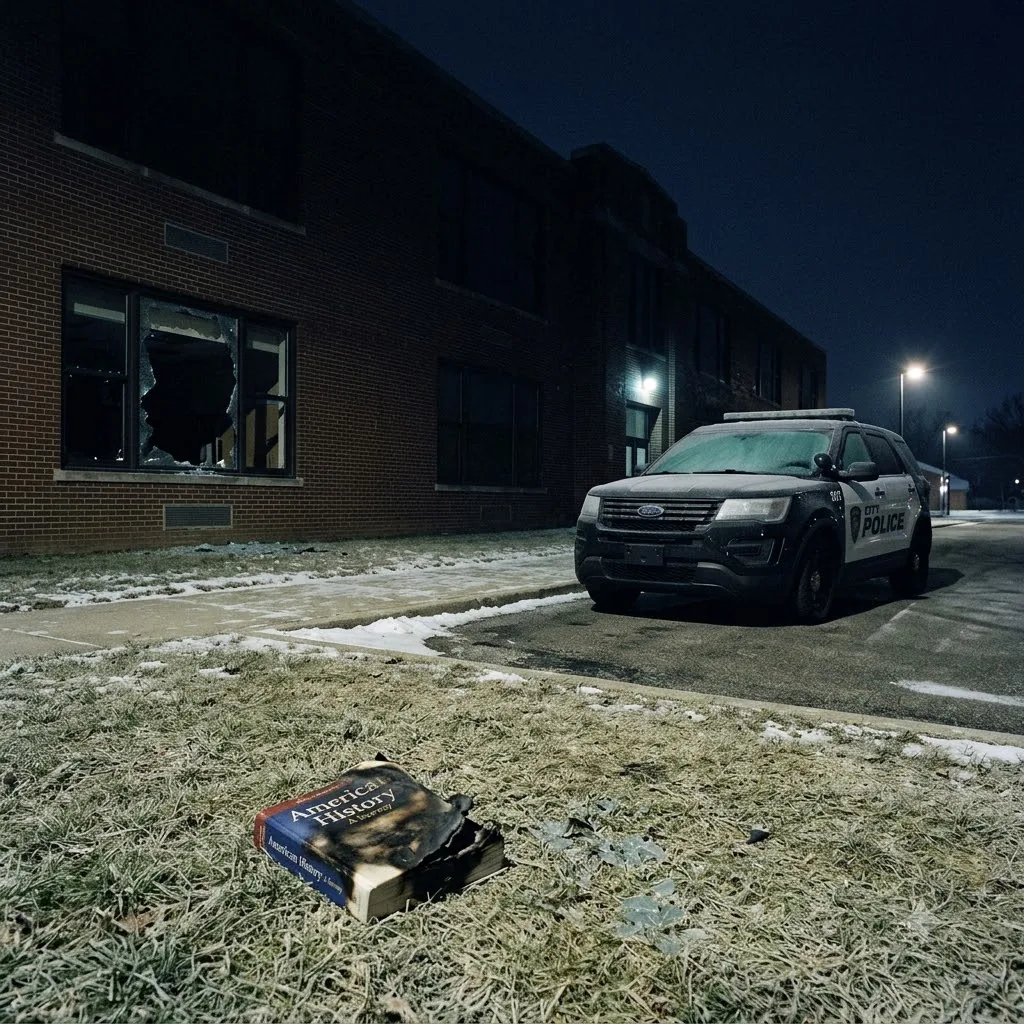
Near the heavy steel door of the archive room, a blinding cascade of white-hot sparks suddenly erupted, illuminating the space with a harsh, flickering glare. One of the intruders was operating a portable exothermic breaching torch-a thermal lance. The intense heat radiated all the way to the window, carrying the acrid, choking stench of vaporized metal, melted insulation, and scorched paper. The charred textbook resting on the dirt outside hadn’t been a bizarre clue; it was simply a piece of trash, collateral damage that had gotten too close to the nozzle when they tested the lance outside.
Miller gripped his department-issue 9mm Glock, his thumb resting heavily on the slide. He had one magazine loaded, fifteen rounds of standard hollow points. Against two armored operatives wielding short-barreled rifles and thermal breaching gear, he was hopelessly outgunned. Standard procedure demanded he pull back, establish a perimeter, and wait for SWAT. But there was no perimeter to establish, and SWAT wasn’t coming. If he sprinted back to his cruiser and tried to drive out of the jammer’s radius, they would hear the engine start. They would either shoot him through the windshield or finish cutting the vault, take whatever they were after, and vanish into the night long before he could guide a tactical team back to the campus.
He had to find a way to get a message out without leaving the building. The RF jammer only blocked wireless signals. The school’s internal landline network ran on physical, subterranean copper wires. If he could reach a hardline phone, he could dial out directly to the county dispatch center. The closest administrative phone was in the principal’s office, down the main corridor in the central wing.
Miller holstered his weapon to free both hands, moving away from the library window with agonizing slowness. He kept his footsteps synchronized with the roaring hiss of the thermal lance, masking his retreat. He hugged the perimeter wall, navigating the icy patches on the walkway until he reached the school’s eastern faculty entrance. He fumbled with the heavy leather key-keeper on his duty belt, extracting the master ring he kept for late-night building checks. His hands were shaking from the biting cold and the massive dump of adrenaline, making the brass keys rattle together like wind chimes. He clamped his palm over the ring, silencing them, and blindly guided the master key into the heavy brass cylinder of the glass door.
He turned the key and pulled. The heavy door yielded with a soft, hydraulic hiss. Miller slipped inside, letting the door close gently behind him until the latch clicked. The air inside the school was stiflingly warm and smelled of floor wax and stale cafeteria food. The sudden temperature shift made his frozen skin ache intensely. He drew his Glock again, snapping off the thumb safety. The hallway was a tunnel of absolute darkness, illuminated only by the faint, greenish glow of emergency exit signs hanging from the ceiling.
He moved methodically down the corridor, placing the heel of his boot down first to muffle his footsteps on the polished linoleum. As he passed the intersecting hallway that led back to the library’s interior doors, he could see the strobe-like flashes of the thermal lance reflecting off the rows of metal lockers. They were still occupied.
Miller reached the heavy wooden door of the principal’s office. It was locked, but the master key worked again. He slipped inside, closing the door behind him and dropping into a low crouch behind the massive wooden desk in the center of the room. His hands blindly swept across the smooth desktop until his fingers bumped against the cold plastic base of the multi-line office phone.
He snatched the receiver and pressed it to his ear, his thumb hovering over the keypad to dial out.
There was no dial tone.
Instead, a hollow, rhythmic clicking echoed through the earpiece. Panic flared in Miller’s chest. He used his free hand to trace the coiled cord from the back of the phone base down to the wall. He found the plastic faceplate of the data jack. It was hanging loose, completely unscrewed from the drywall. He hooked his fingers into the hole and pulled the thick bundle of telecommunications cables out into the open. The entire bundle had been sheared clean in half. The ends of the colored copper wires were neatly snipped.
The intruders hadn’t just relied on the RF jammer. They had located the external telecom junction box outside the school and physically severed the main trunk lines before they even broke the window. The isolation was absolute.
Before Miller could let go of the severed wires, the distinct, metallic squeak of a heavy combat boot pivoting on the polished linoleum echoed from the hallway just outside the office. The sound was deliberate, unhurried, and moving directly toward the closed door.