Story code: ST-001670
Part 2: The Three-Dollar Fare
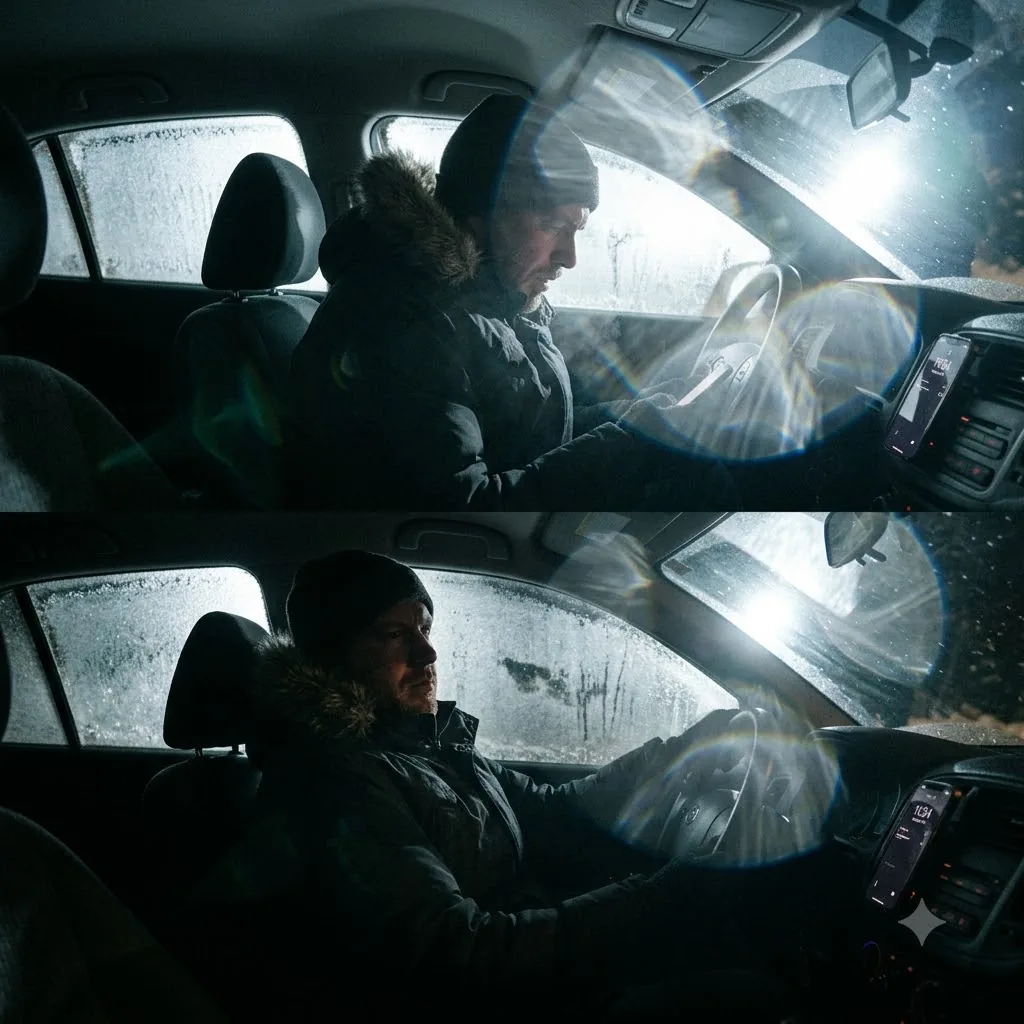
The impact against the driver’s side window sent a violent, shuddering vibration through the plastic door panel, traveling straight up Elias’s left arm. The tempered glass held, but the shockingly loud, hollow thud echoed inside the freezing cabin like a gunshot. Elias squeezed his eyes shut, his entire body seizing into a rigid, breathless ball as he pressed his face hard into the icy vinyl of the seat cushion.
“I see you in there!” a male voice barked. It was muffled by the heavy weather seals and the thick layer of frost, but the tone was unmistakable. Deep, entitled, and brimming with hostile adrenaline. “Don’t even try to move!”
The blinding white beam of the flashlight scraped frantically across the frosted glass, searching for a gap in the crystalline ice. Elias kept his mouth tightly shut, terrified that even the soft sound of his own breathing, or the pale plume of vapor it created in the freezing air, would betray his exact position to the harsh light.
Down on the passenger seat, muffled against the upholstery, the gig app finally ceased its frantic buzzing. A single, bright notification chimed into the suffocating silence.
Elias risked opening one eye. He reached out with a stiff, agonizingly cold hand, his joints protesting as he dragged the phone back toward him across the seat. He kept the glowing screen tilted carefully away from the window. The digital map illuminated his trembling palm.
*Pickup confirmed,* the screen read in its relentlessly cheerful green font. *You are at the location. Wait for the rider.*
Elias stared at the GPS display. The glowing blue arrow representing his vehicle was perfectly superimposed over the bouncing green pin that marked his passenger. The address at the very top of the screen read *42 Oakwood Court*. He risked a desperate, terrified glance upward. Through a spiderwebbed patch of thin frost at the top edge of the windshield, bathed in the peripheral spill of the flashlight’s beam, he could just make out the brass numbers bolted to the stone pillar of the driveway: *42*.
A sick, icy dread settled in the pit of his empty stomach, colder than the dead air trapped inside the car.
The man outside wasn’t a private security guard. He wasn’t a roaming neighborhood watch vigilante. He was Elias’s three-dollar fare.
The heavy boots crunched on the ice, stepping back from the door. “Yeah, dispatch? He’s still here,” the muffled voice said. The man was speaking into a phone now, the flashlight beam dipping slightly as he shifted his weight. “Dark gray sedan. Covered in dirt. Yeah, there’s a guy hiding inside. Looks like another vagrant sleeping in it. He was probably casing the garage before I came out.”
Elias stared blankly at his screen. The countdown timer for the ride was quietly ticking down in the corner. Four minutes and twelve seconds left until the app would allow him to cancel the ride without a penalty. But to wait four minutes meant waiting for the police.
If the police arrived, they would immediately run his plates. They would see his expired registration and his mountain of unpaid parking tickets. They would tow the car. The car was his home, his livelihood, his only shelter against the brutal winter. Losing it meant freezing on the concrete.
But if he put the key in the ignition and drove away right now, the app would register it as a driver cancellation. His acceptance metric would instantly drop to eighty-nine percent. The algorithm would ruthlessly and automatically demote him from the priority tier. He would lose access to the lucrative morning airport runs. He wouldn’t make the forty dollars he desperately needed by tomorrow night to keep his cellular data plan active. Without a data plan, the app wouldn’t work. The outcome was exactly the same: total ruin.
The boots marched toward the front bumper. The flashlight beam swept aggressively over the hood, lingering on the front grille. “Hold on, I’m getting the license plate number right now,” the passenger told the dispatcher.
Elias felt a surge of pure, suffocating panic. He had to stop this. He had to let the man know he was just his driver. But how? If he rolled down the window and confessed, this angry, terrified homeowner would immediately report him to the app’s safety division. *My driver was sleeping in a freezing car outside my house, lurking in the dark.* The automated safety system would suspend Elias’s account pending an investigation that would take weeks. He didn’t have weeks. He had twelve hours of gas money left.
The man outside began reciting Elias’s license plate numbers, loud and clear into the freezing night air. Every spoken digit felt like a physical blow.
Elias looked down at the app. A new prompt had appeared, glowing brightly in the dark footwell. *Let the passenger know you’ve arrived! Send a message.*
His numb thumb hovered over the generic pre-written text: *I’ve arrived.* If he sent it, the man’s phone would ping. The man would look at his screen, see the make and model of his ride, and realize he was calling the police on his own designated driver. Would he calm down? Or would he be even more disgusted and furious that the ‘vagrant’ in his driveway was the person trusted to drive him?
The flashlight beam snapped back to the windshield, blinding Elias all over again. The heavy metal casing slammed hard against the hood of the car, leaving a permanent dent in the cheap metal.
“Cops are three minutes out!” the man yelled, stepping around to the driver’s side door again, his dark silhouette looming monstrously large. “Don’t even think about trying to start this piece of junk!”
Suddenly, the screen in Elias’s hand changed. The digital map vanished entirely, replaced by a flashing incoming phone call screen. The passenger, impatient for his ride to the airport, was using the app’s anonymized system to call his missing driver.
At the exact same moment, Elias heard a faint, distinct ringing tone emanating from the man’s phone on the other side of the frosted glass.
Elias panicked. He scrambled to hit the red ‘Decline’ button to silence his device, but his fingers were rigid blocks of ice, entirely devoid of feeling or dexterity. The phone slipped from his clumsy grasp, bouncing off his knee and tumbling down into the dark footwell.
It landed face up on the rubber floor mat. Because Elias drove with a broken Bluetooth headset, his phone was permanently set to auto-answer all incoming gig app calls on speakerphone.
A sharp, electronic click echoed loudly in the silent cabin as the timer expired and the call automatically connected.
“Hello?” the man’s voice demanded.
The sound came twice. Once, muffled and angry, bleeding through the icy glass of the window. And a microsecond later, loud, metallic, and perfectly synchronized, echoing out of the tiny phone speaker near Elias’s frozen boots.