Story code: ST-000800
Part 4: The Ecosystem Survives
The heavy, reinforced door of the municipal police cruiser slammed shut, sealing Marcus inside a stifling, air-conditioned vacuum. The sharp bite of the steel handcuffs dug mercilessly into his wrists, pinning his arms awkwardly behind his back against the slick vinyl seat. He tasted copper and dry dust in the back of his throat. Outside the smudged, wire-reinforced glass, the amber lights of the private security SUV had been entirely eclipsed by the blinding, chaotic strobe of red and blue from three actual city patrol cars. It was over. The loud, desperate explosion of his anger had bought him nothing but a direct ticket to a felony possession charge.
Marcus pressed his forehead against the cool glass, his breathing shallow and ragged, and watched the wealthy suburban ecosystem aggressively repair its shattered illusion. On the manicured expanse of the front lawn, the real police had completely taken control of the scene. One uniformed officer was carefully dropping the torn vacuum-sealed packages of amber pill bottles into a massive, clear evidence bag. Every hollow rattle of plastic dropping into that bag was another nail in Marcus’s coffin. The four hundred dollars he was promised for completing the delivery was a ghost. It didn’t exist anymore.
Just beyond the evidence collection, sheltered beneath the grand brick portico of house number 402, stood the Patterson family. Arthur had already changed out of his liquor-soaked linen shirt. He now wore a crisp navy polo, his arm wrapped tightly, protectively, around the sloping shoulders of his son, Tyler. Tyler looked exactly like the affluent, sheltered teenager he was-pale, hollow-eyed, wearing expensive designer sweatpants and staring intently at his bare feet. A blonde woman, presumably Arthur’s wife, stood on Tyler’s other side, clutching the boy’s hand and dabbing her eyes with a tissue.
Through the thick glass of the cruiser, Marcus couldn’t hear the exact words being spoken to the nodding police lieutenant, but the choreography was unmistakable. Arthur was pointing a rigid, accusatory finger directly at the police car holding Marcus. Tyler was nodding meekly, shrinking into his father’s embrace. They were rewriting the narrative in real-time. Tyler wasn’t a willing, desperate customer funding a massive weekend opioid habit. Tyler was a victim. He was a naive, vulnerable child targeted and harassed by a predatory, violent street dealer who had stalked him all the way to his family’s front door.
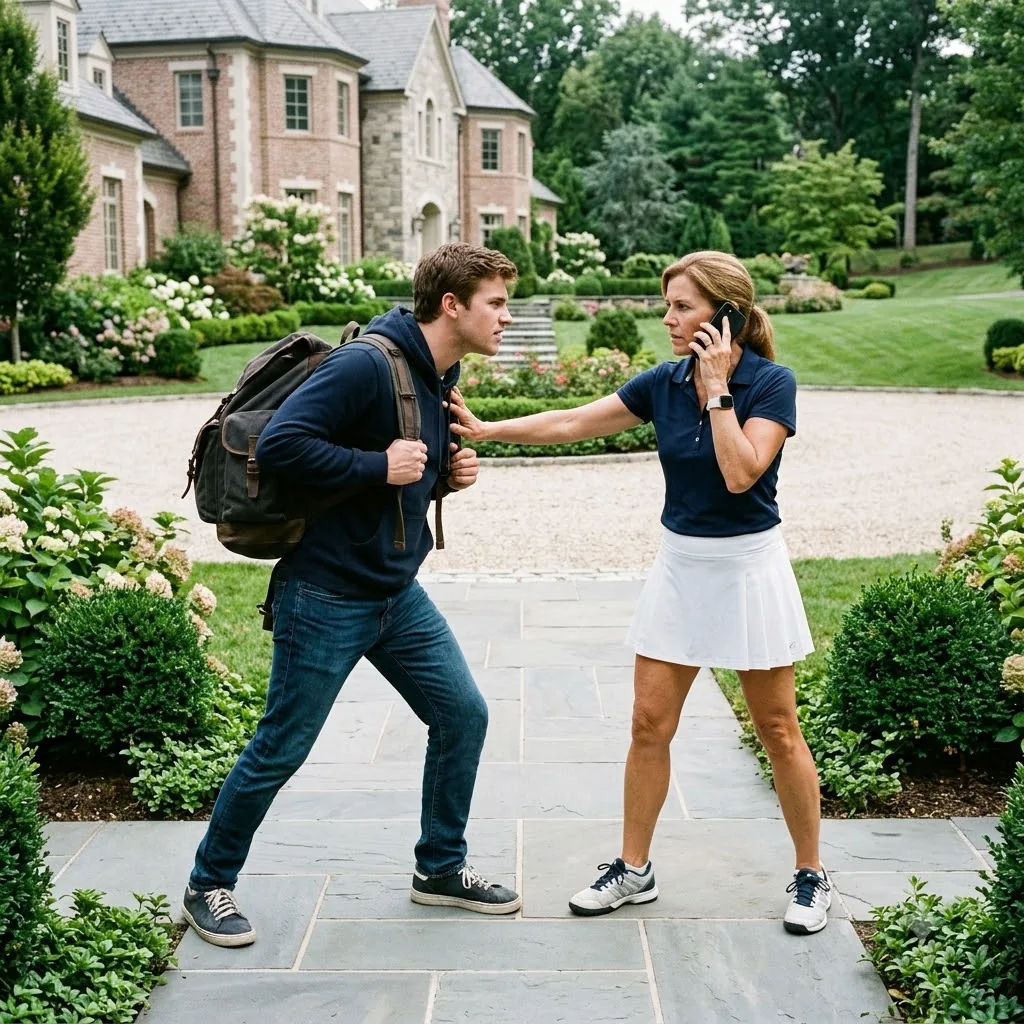
Even Susan, standing at the edge of her own driveway with her arms firmly crossed, was nodding in solemn agreement with the police lieutenant. She knew exactly what Marcus had screamed from the porch. She knew the truth about Arthur’s golden boy. But the truth was ugly, and this neighborhood only dealt in pristine facades. The predator-and-victim story preserved the property values. It absolved the parents. It meant the gates still worked.
Marcus twisted his head away from the window, staring blankly at the thick metal cage dividing the front and rear seats of the cruiser. The digital clock mounted on the dashboard glowed in harsh green numbers: 5:14 PM.
The deadline had passed.
At the outpatient clinic across town, the receptionist had already called his mother’s name. Marcus pictured her sitting in the cheap plastic waiting room chairs, her worn purse empty on her lap, waiting for a son who was never going to walk through those double glass doors with the cash envelope. The required dialysis payment was completely doomed. Because he had failed, she would be denied the machine today. Her spot would be given to the next person in line, and her body would be left to slowly, painfully poison itself over the coming weeks while he rotted in a county holding cell.
He closed his eyes as the police cruiser’s engine shifted into gear, a heavy vibration humming through the floorboards. The crushing weight of absolute defeat settled into his bones. As the car rolled slowly forward, pulling away from the pristine hydrangeas and the smiling neighbors, Marcus finally understood the reality of the subdivision. The towering wrought-iron gates at the front of the neighborhood were never really built to keep danger out. They were built to lock the blame inside with anyone poor enough to walk through them.