Story code: ST-000880
Part 4: The Hollow Sanctuary
The silence under the white canopy was absolute, heavy, and suffocating. The only sound was the hiss of burger grease hitting the hot charcoal on the grill behind the buffet table. Arthur stood frozen, his eyes locked on the gold foil seal of the Bronze Star citation. The manufactured grief he had been projecting moments ago evaporated, leaving only a pale, slack-jawed panic.
Sarah did not move to comfort him. She did not break the tension. She let the weight of the moment crush the air out of the cul-de-sac.
The scrape of a folding chair on asphalt echoed like a gunshot. Mrs. Gable, the HOA secretary, stepped out from the front row. She didn’t look at Sarah. She looked entirely at Arthur, her face contorted in a mix of horror and profound embarrassment.
“Arthur,” Mrs. Gable said, her voice thin and wavering. “You didn’t tell the board she was a… you didn’t tell us this.”
“She violated the height ordinance,” Arthur stammered, his fingers twitching toward the microphone but stopping short. “The bylaws are clear. We all agreed-”
“We agreed to fine a nuisance,” a man’s voice cut in. It was one of the neighborhood watch volunteers in the neon vest. He wouldn’t meet Arthur’s eye, staring instead at his own white sneakers. “We didn’t agree to bankrupt a combat medic over some shade. I’m done with this, Art.”
The man unvelcroed his neon vest, let it drop onto his folding chair, and walked away down the street. It was the permission the rest of the neighborhood needed. The Memorial Day barbecue dissolved not with a dramatic confrontation, but with a quiet, deeply uncomfortable retreat. Families gathered their Tupperware. Parents ushered their children toward their driveways. No one spoke to Arthur.
But more tellingly, no one spoke to Sarah.
As the crowd dispersed, a wide berth opened around her. Neighbors kept their eyes fixed firmly on the ground as they hurried past the podium. A few offered tight, nervous nods, but none stopped. They didn’t offer to help her pick up her papers. They didn’t ask about her shifts or her sleep. They just wanted to escape the awkwardness of the reality she had dragged into their pristine afternoon.
Sarah carefully gathered her discharge papers and the Bronze Star citation, sliding them back into the manila envelope. She left the stack of orange notices and the $7,900 invoice sitting on the podium. Arthur was still standing there, his shoulders slumped, watching his meticulously organized community fracture and abandon him. His clipboard sat forgotten by the potato salad.
By Tuesday afternoon, the problem was quietly erased.
Sarah woke up at 3:00 PM to find an unmarked white envelope taped to her front door. Inside was a single sheet of HOA letterhead. It stated that due to a “clerical error regarding architectural guidelines,” all fines and demolition fees had been permanently dismissed. The intent to place a lien was nullified. There was no apology. There was no signature from Arthur.
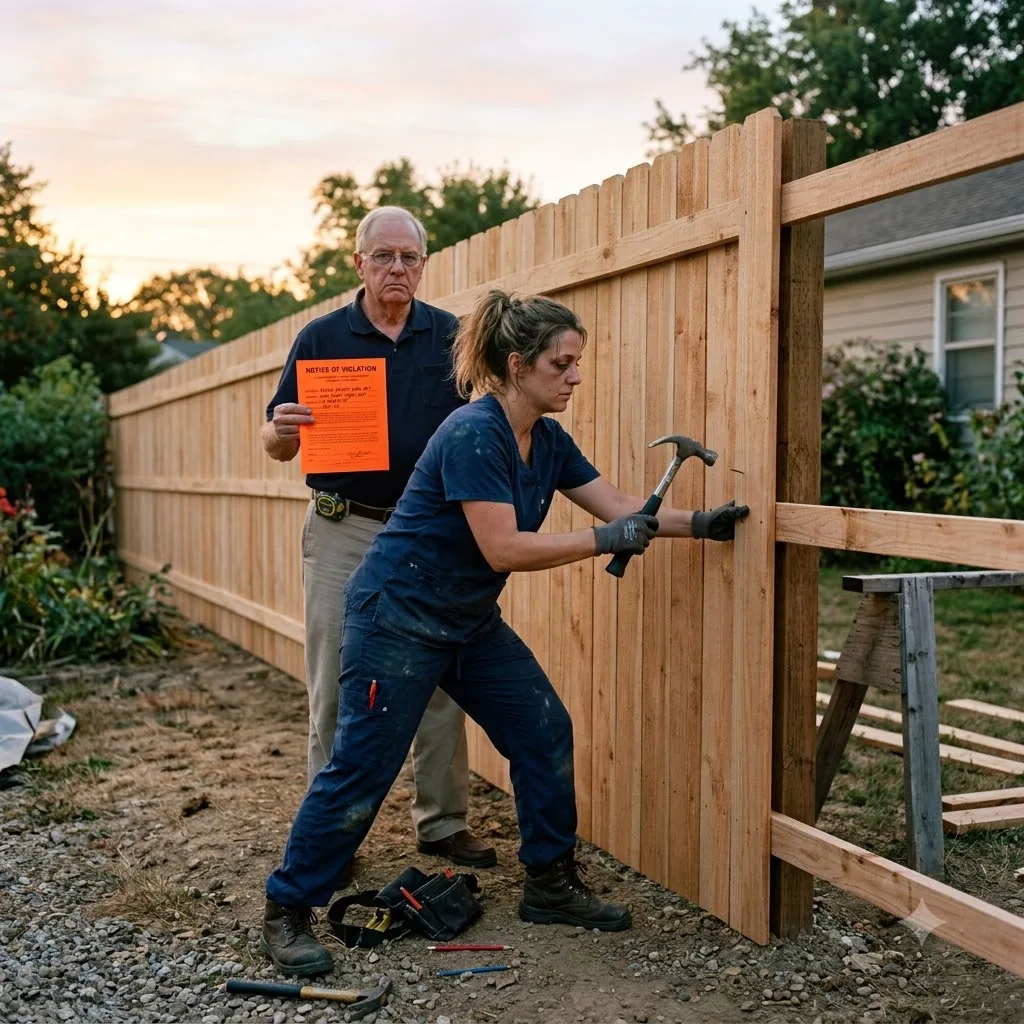
An hour later, a professional fencing company arrived. They didn’t speak to her either. They simply unloaded fresh, eight-foot cedar panels and quickly set to work. By the time the sun began to set, the privacy wall was perfectly reconstructed, casting a long, uninterrupted shadow over her bedroom window. The bill had been paid in full by an anonymous cashier’s check, presumably drawn from the HOA contingency fund by a panicked board desperate to avoid a local news scandal.
Sarah had won. She had her shade, her house, and her silence.
But as the weeks ground on, the silence morphed into something heavier. The escalating war with Arthur had been exhausting, but the peace was utterly barren.
When Sarah checked her mail, the street would empty. If Mrs. Gable was watering her petunias, she would suddenly find a reason to drag the hose into her backyard. If the neighborhood watch patrolled past her property, they sped up, their eyes locked straight ahead. Even Arthur, stripped of his HOA presidency in a closed-door vote, sat silently on his porch, stripped of his flags, refusing to look in her direction.
Standing on her porch one morning after another brutal shift at the hospital, Sarah watched a neighbor quickly cross the street to avoid walking past her driveway. The realization settled into her chest, cold and hollow.
They had turned on Arthur because he violated their sanitized image of patriotism. They liked the idea of the military. They liked the folded flags, the somber speeches, and the neatly packaged heroism that demanded nothing of them. But they didn’t like her. She was the messy, uncomfortable reality. She carried the actual trauma, the exhaustion, and the jagged edges of a life they preferred to keep safely on their television screens.
She had used her uniform as a weapon to save her home, and it had worked. But in doing so, she had shown them the person inside it. And that person made them want to look away.
Sarah turned her back on the empty, pristine street. She walked inside, locked the door, and went into her bedroom. She pulled the blackout curtains closed behind the new eight-foot fence. The room plunged into absolute, pitch-black darkness. It was quiet. It was cool. She finally had exactly what she asked for, and she had never felt more alone.