Story code: ST-001443
Part 3: Primary Sources
The heat in the main gymnasium was stifling, smelling of old floor varnish, damp winter coats, and nervous sweat. Sarah sat in the front row of the folding chairs, her heavy canvas tote bag anchored firmly between her feet. The bleachers were packed to the rafters with parents, students, and local reporters holding notepads. At the front of the room, a long folding table draped in blue bunting served as the school board panel. Arthur Vance sat dead center. He wore a crisp navy suit, perfectly tailored, his gold fountain pen gleaming under the harsh halide lights as it rested in his breast pocket. He was smiling warmly, shaking hands with the current board president, radiating the relaxed confidence of a man who already owned the room.
Sarah dug her fingernails into her palms until the skin stung. Her phone was powered off, but she could still clearly picture the desperate text she had sent her sister an hour ago, begging for a forty-dollar transfer just so David could buy Lily’s specialized formula before the pharmacy closed. The frozen bank account had choked all the air out of her home. Now, she was supposed to breathe her last professional breath. Inside her tote bag sat a single sheet of printer paper containing the exact concession speech Vance had demanded: a full retraction of her curriculum, a public apology for its divisive nature, and her immediate resignation.
Principal Davis stepped to the lone microphone stand in the center of the basketball court. His voice echoed thinly off the cinderblock walls as he announced the public comment portion of the evening, specifically calling on Sarah Jenkins to address her proposed American History syllabus.
Sarah stood. Her legs felt like lead, heavy and fiercely uncooperative. She picked up her canvas tote bag, ignoring the polite smattering of applause from a few of her former students in the upper bleachers. She walked to the center of the court, the rubber soles of her sensible shoes squeaking faintly against the polished hardwood. The microphone stand was cold steel. She adjusted it downward, the metal joint whining in the sudden quiet. She placed her tote bag on the floor and pulled out the single sheet of printer paper.
She looked at the paper. Then she looked up, past the glaring stage lights, directly at Arthur Vance. He subtly adjusted his silk tie, giving her a slow, expectant nod. He was waiting for his victory. He was waiting for the verbal transaction that would release his cashier’s check.
Sarah’s gaze drifted to the faces in the bleachers. She saw parents who had chaperoned field trips. She saw students who had stayed late in Room 204, struggling to understand the complex, messy realities of the Civil Rights movement. She thought of her meticulously mapped whiteboard, and then she thought of the terrifying red zeroes on her banking app.
Sarah pushed the typed resignation letter aside. It fluttered quietly to the hardwood floor.
“Good evening,” Sarah said. Her voice boomed through the PA system, startling a few people in the front row. She took a deep breath, dropping her register into the firm, authoritative tone she had honed over twelve years in the classroom. “As many of you know, I teach American History here. And since the core of tonight’s debate centers on the value of historical accuracy, I thought we might conduct a brief, practical lesson.”
Arthur Vance’s smile faltered slightly. He leaned forward, narrowing his pale blue eyes. Principal Davis half-stood from his folding chair, his face suddenly drained of color.
“My sophomore classes are currently preparing to study the Gilded Age,” Sarah continued, projecting from her diaphragm, claiming the cavernous space just as she claimed Room 204. “It is an era defined by rapid industrialization, but also by profound political corruption. We study the concept of the political machine. Specifically, how men in power maintained their authority not through democratic consensus, but through targeted extortion.”
A low murmur rippled through the bleachers. The gymnasium was suddenly charged, the air thick with sudden, confused tension.
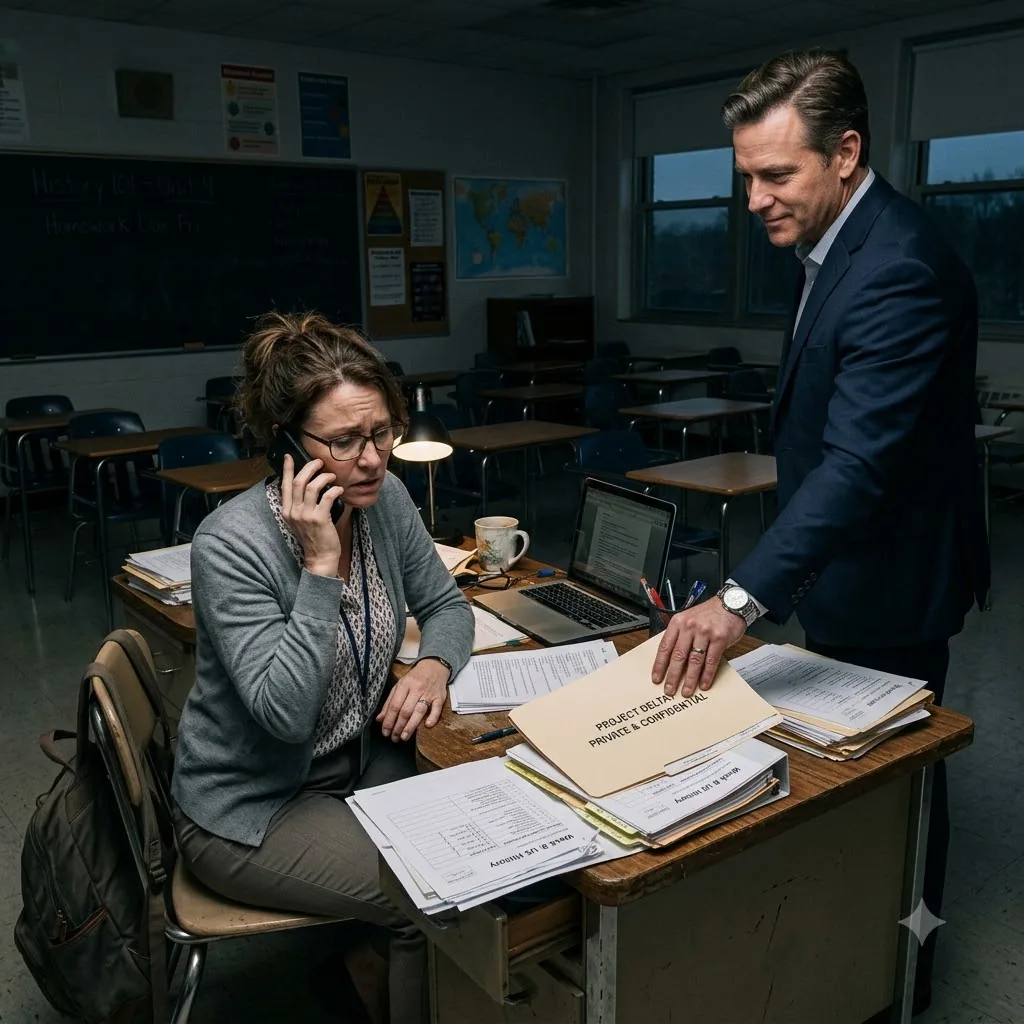
“Historians do not rely on sanitized fables to understand this corruption,” Sarah said, her voice steady, slicing cleanly through the rising whispers. She reached down into her tote bag. She did not pull out another speech. She pulled out the thick, overstuffed manila folder Arthur Vance had dropped on her desk twenty-four hours ago. She slapped it onto the small wooden podium attached to the microphone stand. The heavy thud echoed through the speakers. “We rely on primary sources.”
She flipped the folder open.
“If we wanted to understand how a political machine operates in practice, right now, we would examine how they generate leverage,” Sarah said, looking directly down the center aisle at Vance. “They would not use street violence. They would use connections. For example, a powerful candidate might use an associate on the financial board of Westways Memorial Hospital to illegally bypass HIPAA protections and access a public school teacher’s private medical debt.”
The murmur in the crowd vanished entirely. It was replaced by a stunned, breathless silence. The only sound in the enormous room was the low hum of the overhead lights.
Sarah did not blink. She kept her eyes locked on Vance. “This hypothetical candidate would locate a sixty-two thousand dollar balance for a premature infant’s stay in the Neonatal Intensive Care Unit. They would orchestrate a hard freeze on that family’s checking account, ensuring the parents could not purchase specialized infant formula.”
Someone in the second row gasped loudly. A reporter in the back stood up, fumbling in his jacket for a digital recorder.
“Then,” Sarah’s voice rang out, hard and unyielding, “that candidate would bypass school security, corner the teacher in an empty classroom, place a heavy gold fountain pen on those stolen medical records, and offer to wipe the sixty-two thousand dollar debt to zero. All on the explicit condition that she stand at a microphone exactly like this one, publicly censor her own curriculum, and resign.”
Arthur Vance was no longer smiling. His face was a mask of rigid, horrified shock. He gripped the edge of the folding table, his knuckles bone-white, his mouth opening and closing as his brain scrambled for a political pivot that did not exist. Principal Davis was staring at the floor, sweating profusely, actively shrinking into his chair.
“But history requires evidence,” Sarah said. She picked up the top sheet of paper from the manila folder. She held it high in the air, the harsh lights illuminating the stark black block letters and the hospital’s official letterhead. “This is a primary source. This is a highly detailed, internal printout of my daughter’s NICU billing codes, obtained without my consent, handed to me yesterday afternoon by Arthur Vance.”
She dropped the paper back onto the podium. She gripped the microphone stand, feeling the solid, grounding metal beneath her palms.
“The assignment for tonight,” Sarah commanded, her voice echoing over a crowd that was now erupting into shouting, pointing, and flashing phone cameras, “is to evaluate the source.”
Arthur Vance stood up abruptly, his chair scraping violently backward across the stage, but the microphone on the panel table was completely dead. He stared down at Sarah, his chest heaving, stripped entirely of his practiced armor, standing utterly exposed under the blinding gymnasium lights with no clean answer to give.