Story code: ST-001736
Part 2: The Synergy of Ruin
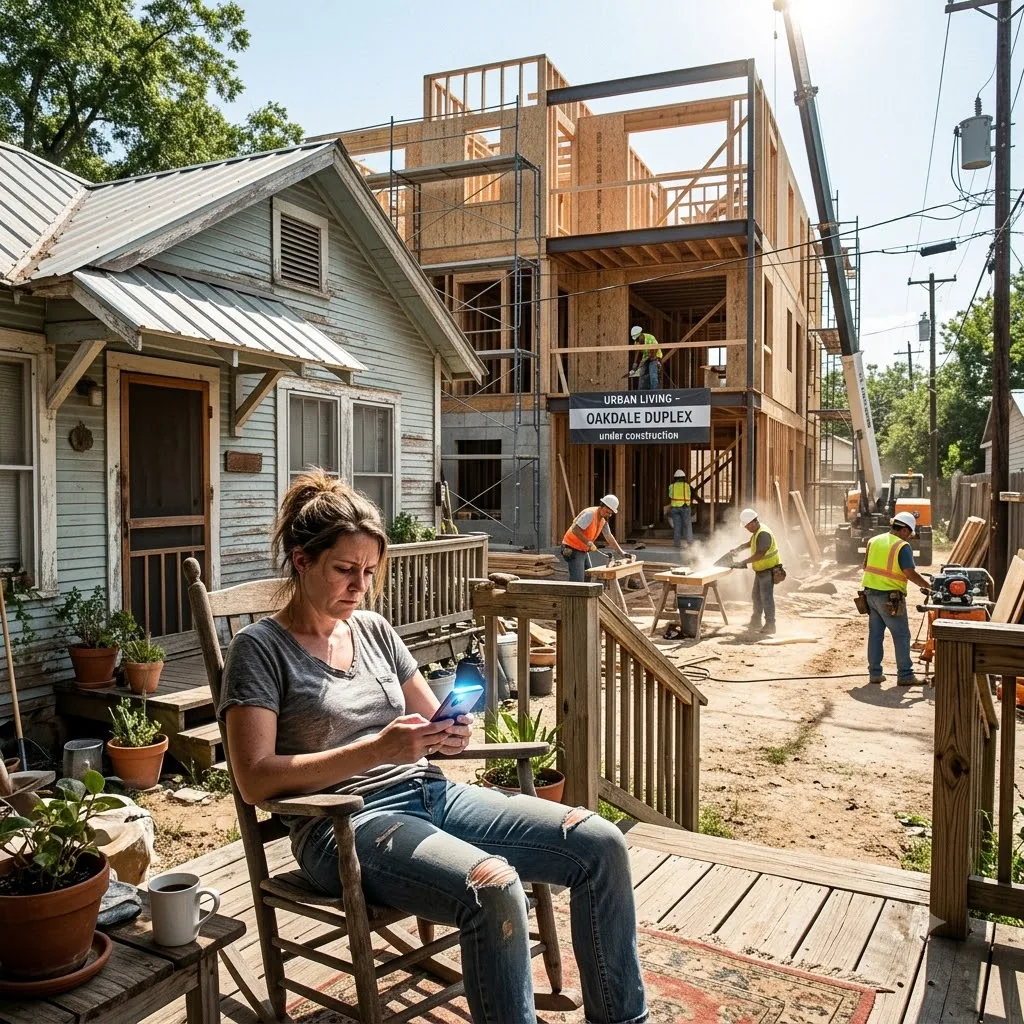
Martha’s gaze snaps up from her cracked screen, her heart hammering a frantic, irregular rhythm against her brittle ribs. She scans the chaotic street, her eyes darting past the idling yellow backhoe and the towering scaffolding of the duplex next door. The dusty sidewalk is empty of pedestrians. There is no sinister figure in a trench coat, no menacing stranger loitering by her mailbox. There is only a crew of roofers shouting over the deafening mechanical roar of an air compressor, and a sleek, silver sedan parked illegally next to the fire hydrant down at the corner.
She looks back down at the photograph. The image is terrifyingly sharp, capturing the exhausted slump of her shoulders and the exact pattern of the rust spreading across her screen door. She pinches the screen, zooming in with a trembling thumb. Based on the angle of the porch railing and the framing of the overgrown oak tree in her front yard, the picture was not snapped by someone casually walking past. The sightline points diagonally across the asphalt, originating directly from the temporary, air-conditioned sales trailer parked at the end of the cul-de-sac. The polished modular unit had been dropped there three months ago by the duplex developers, wrapped in a glossy vinyl banner advertising “Luxury Living at the Summit.”
A cold dread pools in her stomach. “Apex Asset Recovery.” The developers currently bulldozing the neighborhood were called Apex Capital Partners.
Martha forces herself up from the aluminum chair. Her knees pop loudly, the joints stiff and protesting, an enduring physical legacy of the chemotherapy that had saved her life but hollowed out her bones. She braces her hand against the peeling paint of the porch column, waiting for a wave of gray dizziness to pass. She desperately needs her bankruptcy lawyer. She dials the legal aid clinic’s number from memory, pressing the phone to her ear as she steps down onto the uneven concrete walkway.
The automated voice on the clinic’s line cheerily informs her that the office is closed for a mandatory staff retreat until Monday morning. The recording directs her to a website she cannot access because she canceled her home internet to afford her electric bill. She ends the call, the sudden silence in the receiver amplifying the deep, suffocating isolation of her reality. She is entirely alone, standing in a localized cloud of drywall dust, clutching a phone that suddenly feels like a weapon pointed at her own chest.
She begins the short walk down the street. It is barely two hundred yards to the corner, a distance she used to jog every morning before school without breaking a sweat, but today, every step requires a conscious, agonizing negotiation with her own lungs. The late July heat radiates off the fresh blacktop, baking the chemical smell of wet concrete and diesel into the heavy air. She passes the towering skeletal frames of the new construction, the massive, lot-line-to-lot-line structures that have systematically swallowed the modest ranch homes of her former neighbors. The street she has lived on for thirty-five years feels utterly alien, a hostile canyon of Tyvek house-wrap and raw plywood.
As she approaches the silver sedan parked near the sales trailer, the tinted driver’s side window hums down. Cold, heavily conditioned air spills out onto the sweltering sidewalk, carrying the faint, expensive scent of peppermint and leather.
A man sits behind the steering wheel, wearing a crisp, pale blue dress shirt with the collar unbuttoned. He has a sleek wireless earpiece tucked into his left ear and a tablet resting on the center console. He is young, perhaps thirty, with the smooth, untroubled face of someone who has never had to skip a meal or ration a prescription. He taps the steering wheel in time to a muted jazz track playing from the car’s speakers.
He looks at Martha, his eyes casually dropping to her faded housedress and the swollen, arthritic joints of her fingers gripping the phone. He smiles. It is a thin, practiced expression that does not reach his eyes.
“Martha,” he says, his voice carrying the exact same flat, scraped cadence she had just heard through her phone speaker. “I didn’t expect you to make the trek down here. It’s pretty hot out for someone in your precarious condition.”
Martha stops, her chest heaving. The sheer audacity of his physical presence, lounging in a luxury sedan at the end of her own street, steals the remaining breath right out of her lungs. “You took that picture,” she rasps, her voice barely carrying over the distant whine of a circular saw.
“I’m establishing a documented timeline of communication,” Vance replies smoothly, picking up a thick manila folder from the passenger seat. He steps out of the car, towering over her. He doesn’t look like a gritty debt collector; he looks like a junior partner at a wealth management firm. “Apex Capital bought a portfolio of distressed municipal medical debt last month. We look for synergy. Why hire an external eviction team when our real estate acquisition department is already in the neighborhood?”
He speaks of ruining her life as if he is discussing a minor clerical efficiency. He steps onto the sidewalk, closing the distance between them, and presses the heavy manila folder directly against her chest. Instinctively, her frail arms come up to trap it before it falls.
“That’s the motion to vacate your bankruptcy protection, filed at the county courthouse at eight o’clock this morning,” Vance says, tapping the thick envelope with a manicured fingernail. “The judge signed the expedited review because your debt is now classified as a localized real estate encumbrance. You have forty-eight hours to vacate the premises, Martha, or the bulldozer currently digging the foundation next door is going to accidentally clip your load-bearing wall.”
Vance turns his back on her, reaching for the door handle of the sales trailer. “I’d start packing. The commercial dumpsters fill up fast around here.”