Story code: ST-000921
Part 3: The Frictionless Narrative
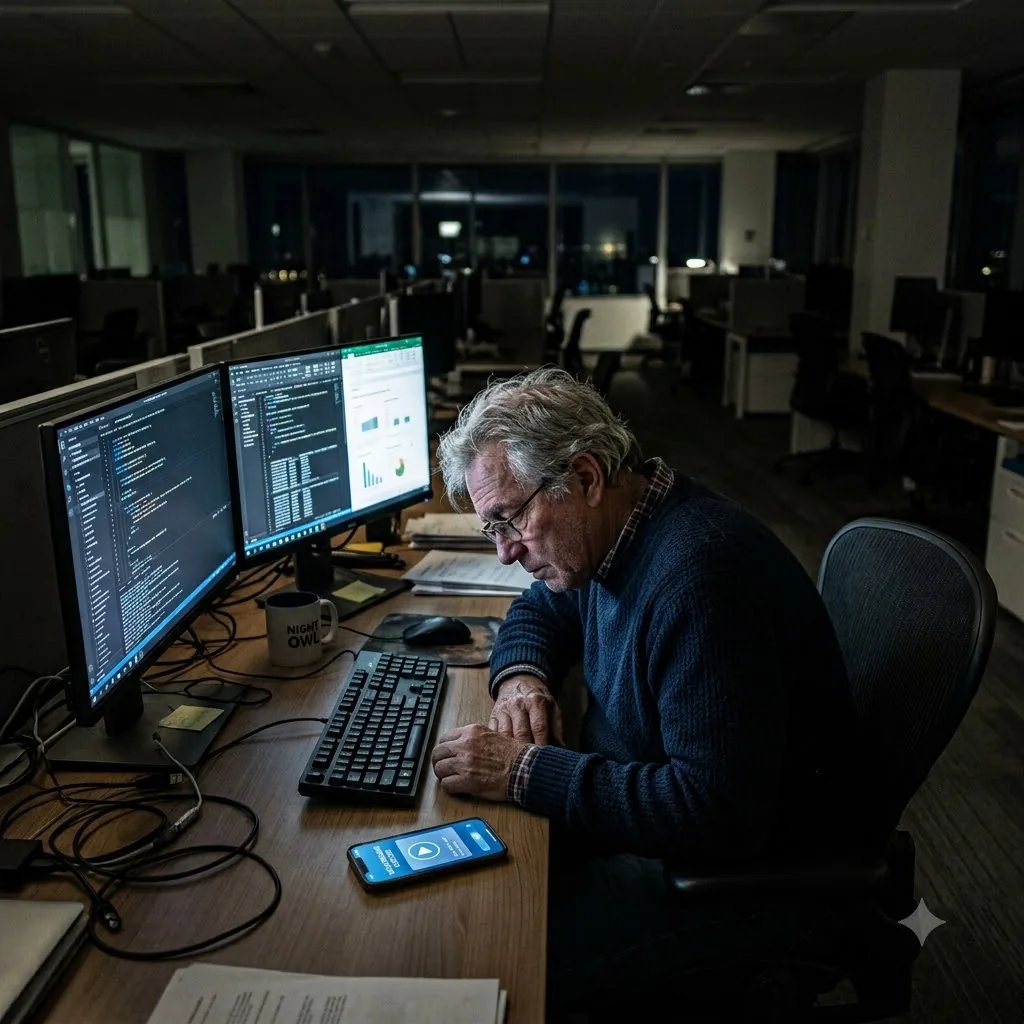
Monday morning sunlight bleached the neon pink “Hustle Harder” sign into a pale, sickly white. Arthur had not left his ergonomic chair in fifty-eight hours. His mouth tasted of pennies and stale coffee. His joints felt filled with crushed glass. On his primary monitor sat a fragile, duct-taped monstrosity of a user interface-a fake front-end shell mimicking a “hyper-fluid AI graph,” wired to absolutely nothing. It was a parlor trick, just enough smoke and mirrors to survive the nine o’clock Zoom call with Wired magazine and the Benchmark investors.
Underneath that flimsy shell, the secondary monitor glowed with the steady, unblinking amber lights of the core production servers. The real database remained exactly as Arthur had left it on Friday night: entombed in unbreakable RSA encryption.
At eight forty-one, the glass doors of the office swung open. Julian breezed in, smelling of eucalyptus body wash and expensive espresso. He was wearing a fresh pair of limited-edition sneakers that squeaked rhythmically against the polished concrete.
“Morning, team!” Julian shouted to the entirely empty floor. He spotted Arthur and jogged over, beaming. “Artie! Look at you. Absolute machine. Did you sleep here?”
Arthur stared at the twenty-eight-year-old. Julian looked vibrant, glowing with the careless vitality of someone who had slept a full eight hours for three consecutive nights. He hadn’t even brought his laptop.
“I built the shell,” Arthur said, his voice a dry rasp. He pointed a trembling, arthritic finger at the monitor. “It doesn’t actually process data, but it will simulate the graph nodes for the Wired demo at nine. It’s all I could do in two days.”
Julian leaned over Arthur’s shoulder, squinting at the screen. His bright smile slowly dissolved into a mask of mild distaste. “Graph nodes? Artie, what is this?”
“The AI-driven graph structure,” Arthur said, a cold spike of adrenaline piercing his exhaustion. “The pivot. The one you mandated on Friday night before you tweeted it to our investors.”
“Friday?” Julian laughed, a sharp, dismissive sound. “My guy, that was an eternity ago. Did you not see my Slack on Saturday afternoon? I listened to a new episode. AI graphs are completely saturated. The host had this guy on who explained everything. We are pivoting to decentralized blockchain verification. The whole platform needs to be a web3 trustless ledger.”
Arthur’s vision swam. The edges of the monitors blurred. “You… you tweeted about the AI graph. You promised Benchmark a live demo.”
“And now I’ll promise them something better,” Julian said, waving his free hand as if swatting away a gnat. He tapped his phone screen. “I already deleted the Friday tweet. It’s called agile iteration, Arthur. We pivot until we find the frictionless narrative. So, let’s scrap this fake graph thing. Pull up the root directory and spin up a blockchain ledger node. We have fifteen minutes before the journalist logs on. I just need a spinning 3D cube and some terminal text to show them.”
Arthur looked at the framed photograph of his daughter. *Plane landed. Guess you really couldn’t make it.* He had traded his flesh, his blood, and the last shred of his family’s respect for a whim that hadn’t even survived the weekend.
“I can’t,” Arthur whispered.
“Can’t?” Julian sighed, stepping back and crossing his arms. The frat-house charm evaporated, revealing the petulant child beneath. “Look, I know you’re older, Arthur, but you have got to stop being such a legacy thinker. You’re entirely too attached to the work. You need to be fluid. Delete this UI, open the terminal, and build the ledger.”
“I can’t delete the work, Julian,” Arthur said. His voice was no longer rasping. It was suddenly very clear, and very quiet. “Because I didn’t delete the database on Friday.”
Julian frowned, his perfectly groomed eyebrows knitting together. “What are you talking about? I saw the CPU spikes. You ripped out the floorboards.”
“I applied a mathematical lockdown,” Arthur said, turning his chair to face the founder. “The relational database is still there. Six months of my life. The system that actually works. It is completely intact, perfectly stable, and entirely encrypted. I locked it down so you couldn’t destroy it.”
Julian stared at him, the silence stretching out beneath the hum of the air conditioning. Slowly, the reality of the situation seemed to penetrate the buzzwords. “You… locked it? So unlock it. If you didn’t build the blockchain UI, we’ll just show them the old platform. We’ll tell them the ledger is working in the background. Unlock it now.”
“The protocol requires a sixty-four-character RSA decryption key,” Arthur said.
He turned back to his keyboard. He opened his encrypted password manager. At the very top of the vault was the string of alphanumeric characters he had generated on Friday night. The only key in existence.
Julian leaned in close, his voice dropping to a frantic, breathless hiss. “The Zoom lobby is pinging, Arthur. Benchmark is in the waiting room. Unlock the database.”
Arthur highlighted the sixty-four characters. He didn’t look at Julian. He looked at the terminal window, waiting for an input that would never come.
“You called me a legacy thinker,” Arthur said softly. “You’re right. I think actions should have a legacy. I think choices should leave a trace.”
“Arthur, stop being dramatic and hit copy!”
Arthur pressed the delete key.
The password manager prompted him with a glaring red warning box: *Are you sure you want to permanently delete this entry? This action cannot be undone.*
“What are you doing?” Julian’s voice cracked, pitching upward into genuine panic. “Arthur, what is that?”
Arthur looked up into Julian’s wide, terrified eyes. He saw the exact moment the young founder realized he was standing in an empty room, holding a dead platform, with a journalist waiting on the line and absolutely nothing left to pivot toward.
Arthur clicked *Yes*.