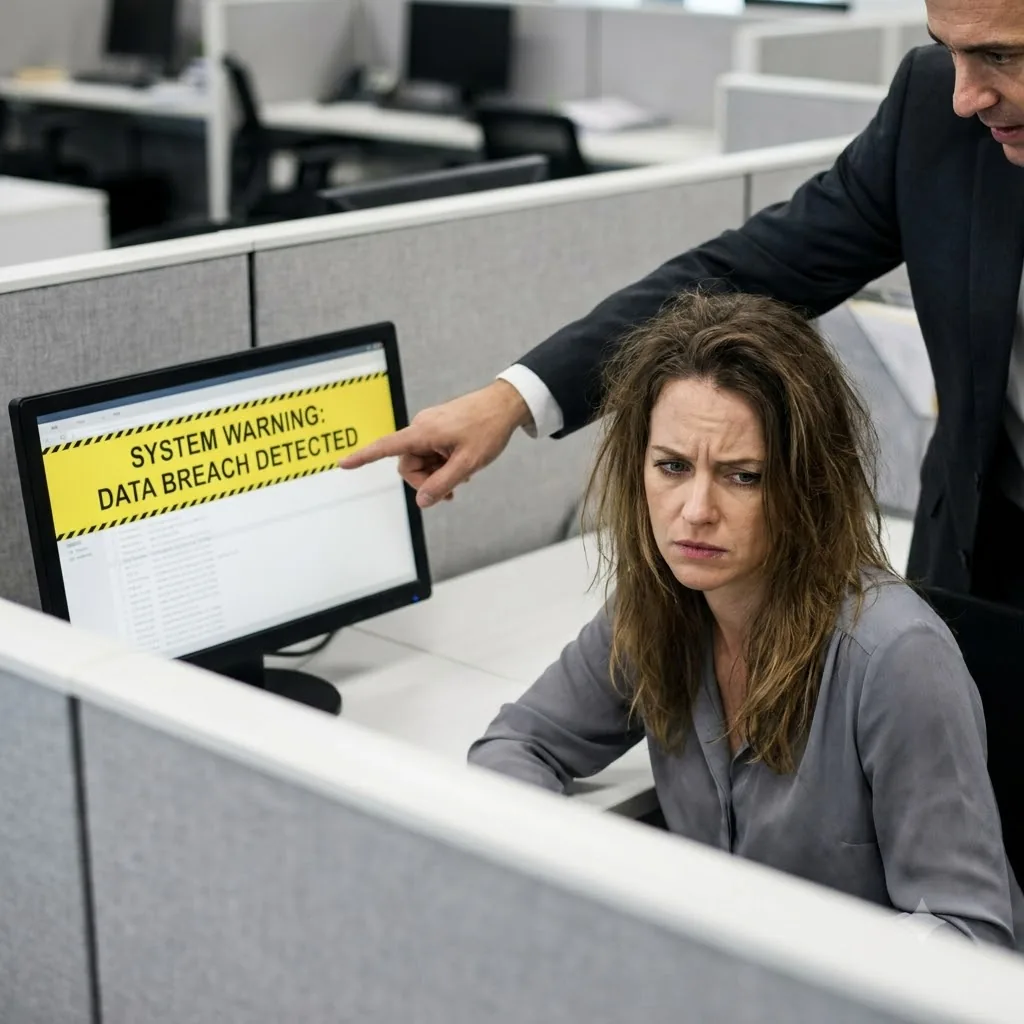
Story code: ST-000522
Part 2: The Local Build
Ellie’s fingers trembled over the mechanical keyboard as she bypassed the primary graphical interface. The backend of the alignment engine was a stark, unforgiving landscape of black terminal windows and scrolling green text. She navigated to the root directory for the state’s custom model. The newly minted rule-the one she had just clicked *Accept* to authorize-sat at the top of the hierarchy, dictating the aggressive sanitization of every historical event in the database.
She checked the time in the corner of her monitor. Eight minutes until the live demonstration.
If she simply deleted the rule, the system’s automated redundancy protocols would pull a clean backup from the cloud within seconds. The AI was meticulously designed to protect its own alignment. To sabotage it, she couldn’t just erase the mandate; she had to weaponize it.
Ellie opened the master parameter configuration file. She located the variables for *Neutrality_Weighting* and *Sensitivity_Enforcement*. The values were set to their maximum thresholds, instructing the AI to instantly strip any words deemed controversial by the state delegates’ master list. She highlighted the value fields. Instead of lowering them, she mapped the variables directly to the engine’s foundational logic gate for factual accuracy. She quickly rewrote the underlying logic so that any attempt by the AI to alter a primary source document would trigger a cascading system failure. Instead of replacing the text, the engine would lock up and display the original, unedited historical text alongside a massive error message citing a “Censorship Anomaly.”
Four minutes left.
A notification pinged in the corner of her screen. *Marcus: We are waiting. Get in here NOW.*
Ellie ignored it, her eyes tracking the compiler as she repackaged the core model. The terminal window threw up a dozen minor warning flags-*Logic Conflict Detected*, *Constraint Violation*-but she force-approved every single one, using her senior architect credentials to override the automated safety checks.
She plugged the heavy, metal-cased secure flash drive into her tower. The drive was mandatory for the air-gapped presentation; the state delegates insisted the software run locally in the conference room to prove it did not rely on outside servers that could be hacked or monitored. Ellie initiated the transfer.
A progress bar appeared, creeping across the screen with agonizing slowness. Ten percent. Twenty percent.
The office around her was eerily quiet, the rest of the content team having already migrated toward the breakroom to watch the live feed of the pitch. She was entirely alone in her section of the cubicle farm. The silence only amplified the thudding of her own pulse in her ears. If anyone walked by and saw the terminal window, the raw code would expose her instantly.
Fifty percent.
Another message popped up. *Marcus: If you aren’t in Conference Room B in 60 seconds, do not bother coming back to your desk.*
Ellie chewed on the inside of her cheek, tasting a faint metallic tang. She was throwing away her career, her stock options, her entire livelihood. But as she pictured the sanitized, hollowed-out version of history feeding into millions of classroom tablets, the fear hardened into a cold, sharp resolve. She watched the progress bar hit ninety-nine percent. It hung there for three agonizing seconds before the window vanished.
*Transfer Complete.*
Ellie yanked the flash drive from the port. The metal casing felt warm against her palm. She stood up, smoothed down the front of her blouse, and walked briskly down the carpeted aisle. Every step felt like walking toward a precipice.
She pushed open the heavy glass door of Conference Room B.
The room was stiflingly warm, smelling of dark roasted coffee and dry-cleaned wool. Three state delegates sat along one side of the long mahogany table. They were older men and women with severe expressions, laptops open in front of them, heavy pens poised over leather-bound notepads. At the head of the table stood Marcus, his smile tight and practiced, the projector screen glowing a blank, corporate blue behind him.
Sitting to Marcus’s right was David, the lead systems engineer. He was hunched over his diagnostic tablet, frowning deeply behind thick, wire-rimmed glasses.
“Ah, there she is,” Marcus said, his voice dripping with forced corporate cheer for the delegates’ benefit. “Our lead educational content architect, Ellie. She has the final, locally-compiled build ready for your review.”
Marcus extended his hand, his palm open, expecting her to drop the flash drive into it. His eyes, however, were locked onto hers, radiating a furious, silent promise of retribution for her tardiness.
Ellie stepped forward, gripping the metal casing of the flash drive so tightly its edges dug into her skin. She reached out, hovering the drive inches from Marcus’s expectant hand.
“Before we begin,” David interrupted, his voice cutting sharply through the manufactured tension. He did not look up from his tablet. “Ellie, I am seeing a massive anomaly in the server logs. Someone just bypassed the redundancy protocols on the master branch and inverted the foundational logic gates for the neutrality parameters.”
Marcus froze, his hand still extended. He slowly turned his head toward David, then snapped his gaze back to Ellie.
“What is he talking about, Ellie?” Marcus asked, his tone dropping an octave, the corporate cheer instantly evaporating.
The lead state delegate, a woman with silver hair and a sharp, assessing gaze, leaned forward in her leather chair. “Is there a problem with the alignment model? We were assured this system was foolproof.”
“No problem at all, Ms. Vance,” Marcus said smoothly, though a bead of sweat had materialized at his temple. He looked back at Ellie, his outstretched fingers twitching. “Ellie is just going to hand me the flash drive so we can demonstrate the core functionality. Right, Ellie?”
Ellie stood frozen, the flash drive burning like a live coal in her hand. David’s fingers were flying across his tablet, tracing the audit logs backward. In a matter of seconds, he would uncover her credential footprint on the master branch. If she handed over the drive, Marcus would plug it in, and the system would publicly fail, displaying unsanitized truths and censorship errors to the very people paying forty million dollars to suppress them. But if she refused to hand it over, Marcus would know exactly what she had done before the demonstration even started.
“Ellie,” Marcus whispered, his voice a venomous hiss meant only for her ears. “Give me the drive. Now.”