Story code: ST-000900
Part 2: The Decryption Ultimatum
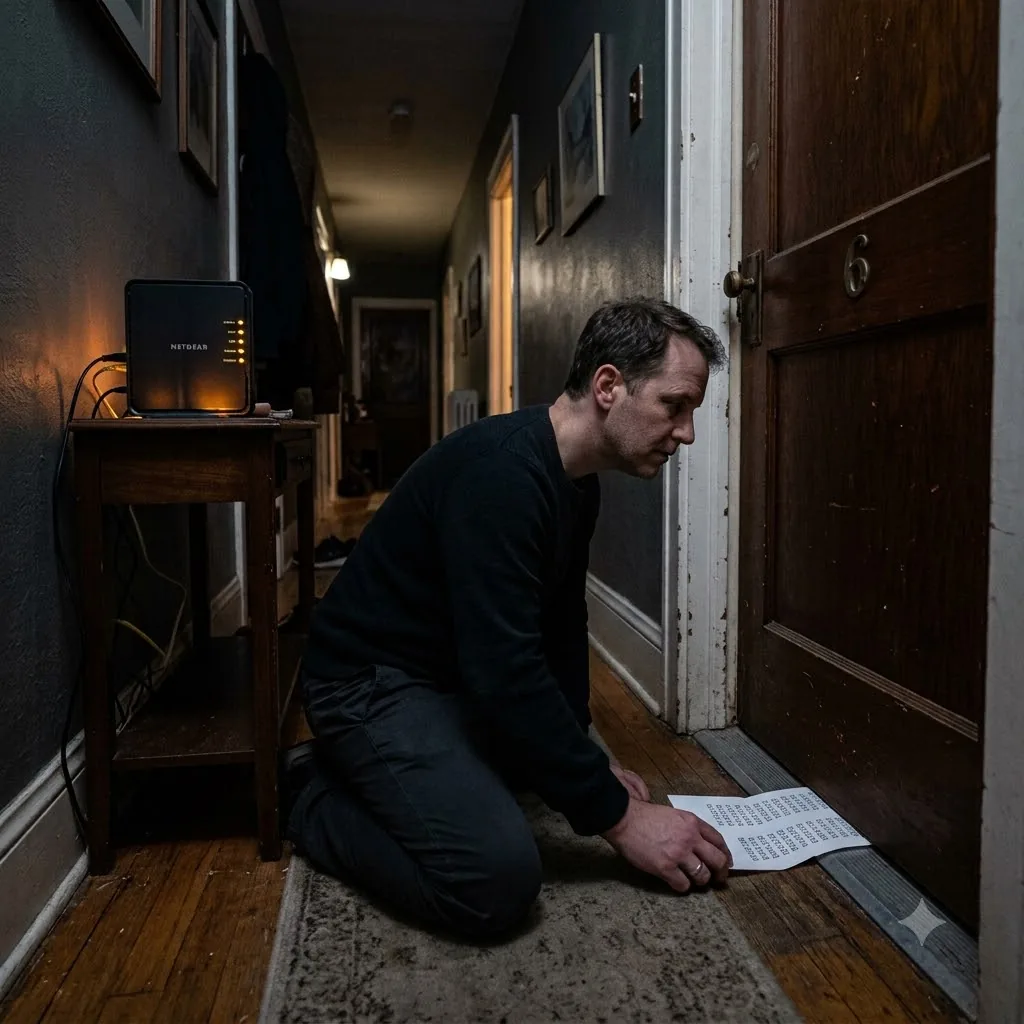
The crisp white paper felt unnaturally heavy. Chloe did not reach for it immediately. She stared at the sharp crease dividing the sheet, listening to the heavy, ragged breathing on the other side of the wood. The shadow of her father’s slippers did not move. He was waiting for her to pick it up. He was waiting for the collapse, the tearful confession, the identical repetition of her brother’s downfall.
She reached out, her fingers trembling slightly, and dragged the paper across the carpet. She unfolded it.
The printed spreadsheet was a meticulously organized ledger of her digital existence. Row after row of timestamps, port numbers, and packet sizes. He had highlighted certain lines in neon yellow. Chloe’s eyes scanned the highlighted IP addresses. Her chest tightened. She recognized the routing nodes. They were not dark web drug markets. They were the encrypted pathways she used to access the secure message boards. They were the servers hosting the telehealth portals, the support groups, the private servers where people called her by her true name.
“I know what that much encrypted traffic means, Chloe,” her father’s voice rasped through the door. It was low, strangled by a horrifying mix of triumph and despair. “It’s exactly the same pattern. The same proxy servers. The same late-night data spikes. You think hiding it behind a VPN makes it invisible?”
Chloe pressed her palm against her mouth. She could not speak. If she spoke, her voice would shake, and he would take that as guilt.
“Your brother thought he was a ghost, too,” the voice continued, dropping to a near-whisper that easily pierced the thin wood. “He thought I didn’t understand onion routing. He thought I was just an old man who didn’t know how the dark nets operated. I learned. I spent the last two years learning everything.”
She looked down at the paper. She traced the neon yellow lines with her thumbnail. Every highlighted row was a lifeline. The data bursts he thought were illicit transactions were actually hours spent in video calls with a counselor who finally made her feel sane. The massive downloads he flagged as encrypted contraband were PDFs of medical journals and legal name-change documents she was terrified to print. Her father had successfully mapped the exact shape of her secret, but he had filled the silhouette with his own nightmares. He saw a drug syndicate; he saw the poison that had stopped her brother’s heart. He was hunting a ghost, completely unaware he was about to rip the mask off his surviving child.
“Open the door, Chloe.”
“Dad, please,” she managed to say, her voice cracking. “It’s not what you think. It’s not…”
“It’s not drugs?” he cut her off, his fist slamming against the door frame. The wood rattled. Chloe flinched, scrambling backward until her shoulders hit the edge of her mattress. “Then what is it? Tell me! Tell me what requires AES-256 encryption at two in the morning! Tell me what you’re buying that you need to hide from me!”
She hugged her knees to her chest. The phone was still a dead brick in her hand, cut off from the cellular network by the jammers in the attic, cut off from the home router. She could just unlock it. She could open the door, hand him the screen, and let him scroll through the crisis chat she had just finished with the emergency dispatcher. She could let him see the support group boards. She could prove, instantly, that she wasn’t buying synthetic opioids.
But handing over the device meant handing over the only space where she actually existed. He would see the photos. He would read the panicked, deeply personal messages about her dysphoria, her fears, her plans for the future. He would see the name she used. A man who had built a surveillance state to protect his family was not a man who would process a sudden, reality-altering truth with grace. He would see it as another infection. He would quarantine it. He would lock down her life just as tightly as he had locked down the network. She would be safe from the drugs she wasn’t taking, but she would be entirely erased.
“I can’t,” she whispered.
“You can’t,” he repeated. The anger in his voice gave way to a cold, mechanical resolve. “Fine. You want to play the same game he played. I told you, I learned from my mistakes. I am not waiting for a package to arrive in the mail.”
Chloe heard a metallic clink. She watched the shadow at the bottom of the door shift. A small, silver object was pushed under the gap, catching the dim moonlight filtering through her window.
It was a USB drive.
“I am not playing detective anymore, Chloe,” her father said, his voice completely devoid of emotion. “That drive has a payload on it. You are going to plug it into your phone using the adapter on your desk. You are going to unlock your device, and that script is going to clone your entire encrypted partition to the drive.”
She stared at the little silver rectangle resting on the carpet. It looked like a bullet.
“If you don’t slide that drive back under this door in five minutes,” he continued, the sound of his heavy footsteps shifting as he leaned his weight against the wood, “I am taking the hinges off this door. And if I have to do that, I’m taking the phone, and I am sending you to the inpatient facility in the morning. I already have the paperwork drawn up. I won’t lose you, too.”
Chloe stopped breathing. The isolation was absolute. She was trapped in a ten-by-twelve room with a dead phone, a jammer overhead, and a father willing to institutionalize her to save her from a phantom addiction. She looked at the USB drive, then up at the locked door. The digital clock on her nightstand ticked forward. Four minutes and fifty-nine seconds left.