Story code: ST-001186
Part 1: The Rejected Run
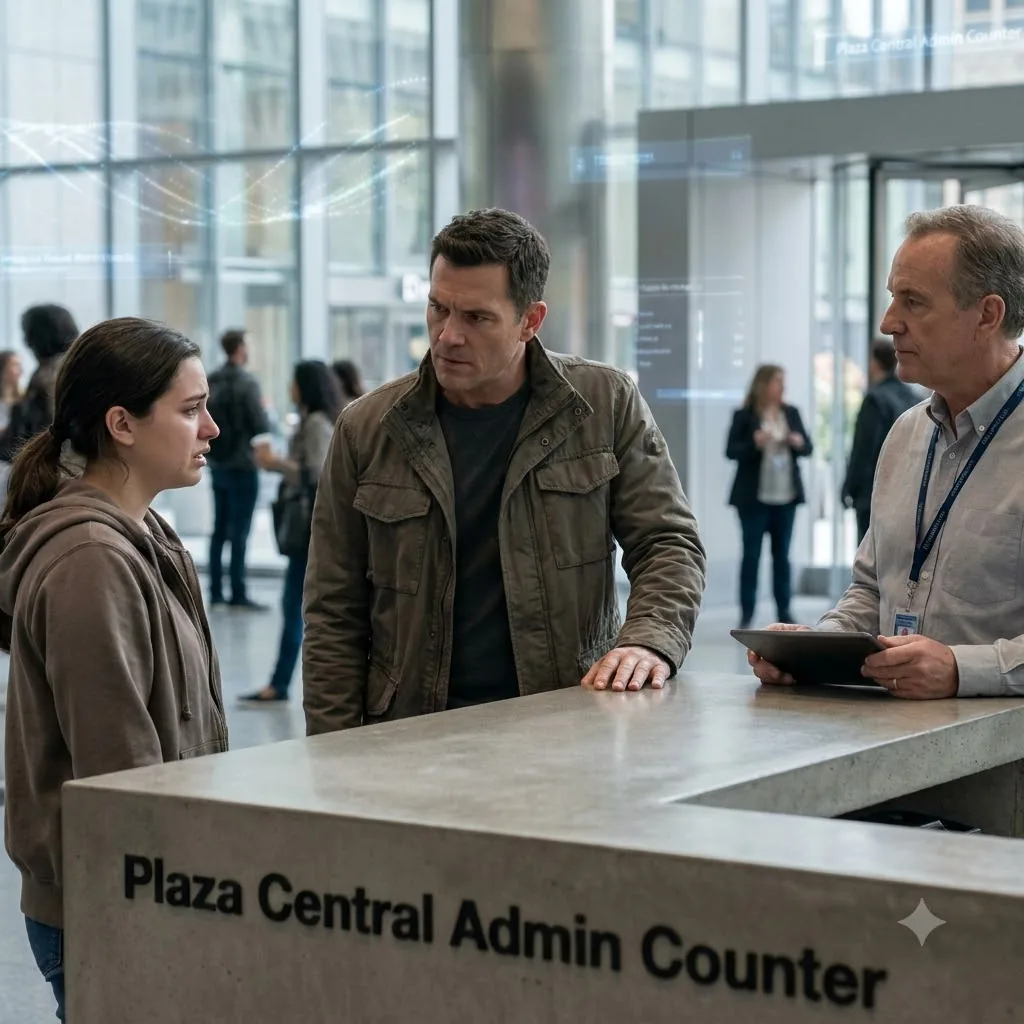
At the Plaza Central Admin Counter of the Neon-Grid Plaza, lead filter designer Marcus Vance used official plaza safety regulations to wipe his own sister Elena’s record-breaking run, claiming her gameplay sequence was technically impossible. Elena stood before the flashing neon scoreboards, clutching her Chrono-Sight AR Glasses, while Marcus pointed aggressively at his developer interface tablet to declare her run void. As a forensic systems auditor, my diagnostic terminal was already pulling the Master Sequence Database Logs, and the initial system packet showed a contradiction that Marcus had not planned for. Around the counter, the ordinary activity of the AR game plaza continued. Players in haptic vests dodged imaginary lasers, their neon trails flashing orange and purple in the dim, reflective room. Plastic tokens clinked at the prize booths, and the high-frequency whine of charging VR headsets hummed in the background.
Elena pointed to the public scoreboard, where her name had just been replaced by a flashing red system error. “The screen showed my score, Marcus. I hit the final node at zero-point-two seconds. The system registered it, and then you manually scrubbed it from the board.”
Marcus Vance did not look up from his developer interface tablet. He wore the neat blue uniform of the plaza technical staff, his movements mechanical and swift as he tapped the administrative counter. “Section 4.2 of the Plaza Code is absolute, Elena,” Marcus said, his voice flat and controlled. “Any gameplay sequence featuring out-of-order execution packets is flagged as a rendering exploit. The server logged your final three hits in a sequence that physical limitations prevent. It is mathematically impossible.”
“I didn’t exploit anything,” Elena said. She held out her worn-in custom AR glasses, the lenses scratched from years of competitive play. “Look at the hardware logs on my device. They match the physical display on the floor.”
“The local device log is unverified,” Marcus replied, gesturing to a security guard standing near the counter. “The plaza master database is the only source of truth. If the packets arrived out of order, the run is void. The rule is there to protect the integrity of the leaderboard, not to cater to family.”
I stepped forward, plugging my standard diagnostic terminal into the counter’s master interface. The public scoreboard flickered, temporarily displaying the system diagnostic screen. To reconstruct this event, we had to look at the exact timing of the packets. Marcus’s posture stiffened. His fingers tapped a rapid rhythm against the edge of his tablet.
“We’ll verify the timeline,” I said, opening the Master Sequence Database Logs. Marcus’s role as the lead filter designer meant his custom software filters were actively running on the plaza’s main rendering pipeline. If there was a glitch, it would show up here.
On my diagnostic terminal screen, the timestamp log for Elena’s final run materialized. I scrolled past the initial lobby check-ins and the mid-game node completions. Then, I stopped. The timestamp order in the logs made Marcus’s official claim completely impossible. The master database recorded Elena’s final target hit at 14:02:35.400, but the target activation signal from the server was timestamped at 14:02:35.800. According to the official log, Elena had hit a target that did not exist for another four hundred milliseconds-an anomaly that defied the laws of physics.
At the Plaza Central Admin Counter of the Neon-Grid Plaza, lead filter designer Marcus Vance used official plaza safety regulations to wipe his own sister Elena’s record-breaking run, claiming her gameplay sequence was technically impossible. Elena stood before the flashing neon scoreboards, clutching her Chrono-Sight AR Glasses, while Marcus pointed aggressively at his developer interface tablet to declare her run void. As a forensic systems auditor, my diagnostic terminal was already pulling the Master Sequence Database Logs, and the initial system packet showed a contradiction that Marcus had not planned for. Around the counter, the ordinary activity of the AR game plaza continued. Players in haptic vests dodged imaginary lasers, their neon trails flashing orange and purple in the dim, reflective room. Plastic tokens clinked at the prize booths, and the high-frequency whine of charging VR headsets hummed in the background.
Elena pointed to the public scoreboard, where her name had just been replaced by a flashing red system error. “The screen showed my score, Marcus. I hit the final node at zero-point-two seconds. The system registered it, and then you manually scrubbed it from the board.”
Marcus Vance did not look up from his developer interface tablet. He wore the neat blue uniform of the plaza technical staff, his movements mechanical and swift as he tapped the administrative counter. “Section 4.2 of the Plaza Code is absolute, Elena,” Marcus said, his voice flat and controlled. “Any gameplay sequence featuring out-of-order execution packets is flagged as a rendering exploit. The server logged your final three hits in a sequence that physical limitations prevent. It is mathematically impossible.”
“I didn’t exploit anything,” Elena said. She held out her worn-in custom AR glasses, the lenses scratched from years of competitive play. “Look at the hardware logs on my device. They match the physical display on the floor.”
“The local device log is unverified,” Marcus replied, gesturing to a security guard standing near the counter. “The plaza master database is the only source of truth. If the packets arrived out of order, the run is void. The rule is there to protect the integrity of the leaderboard, not to cater to family.”
I stepped forward, plugging my standard diagnostic terminal into the counter’s master interface. The public scoreboard flickered, temporarily displaying the system diagnostic screen. To reconstruct this event, we had to look at the exact timing of the packets. Marcus’s posture stiffened. His fingers tapped a rapid rhythm against the edge of his tablet.
“We’ll verify the timeline,” I said, opening the Master Sequence Database Logs. Marcus’s role as the lead filter designer meant his custom software filters were actively running on the plaza’s main rendering pipeline. If there was a glitch, it would show up here.
On my diagnostic terminal screen, the timestamp log for Elena’s final run materialized. I scrolled past the initial lobby check-ins and the mid-game node completions. Then, I stopped. The timestamp order in the logs made Marcus’s official claim completely impossible. The master database recorded Elena’s final target hit at 14:02:35.400, but the target activation signal from the server was timestamped at 14:02:35.800. According to the official log, Elena had hit a target that did not exist for another four hundred milliseconds-an anomaly that defied the laws of physics.