Story code: ST-000282
Part 4: The Ghost in the Machine
The silence stretched between them, heavy and suffocating under the buzzing neon sign of the Eastside Youth Center. Marcus watched the realization ripple across Detective Trent’s face. The smug, bureaucratic mask dissolved, replaced by a flush of raw, uncalculated panic that crept up the detective’s neck. Trent wasn’t a master strategist; he was a middle-manager with a badge who had accidentally pressed the wrong button on a spreadsheet, crashing his own system.
Marcus didn’t back down. He kept his feet planted firmly on the freezing concrete, letting the weight of the truth press into the space between them. “You played the algorithm,” Marcus said softly, his breath pluming in the icy air. “But you pushed it too hard. And now the machine is going to strip this block bare, and you along with it.”
Trent’s eyes darted frantically, mapping the empty street, the quiet bus stop, and finally snapping back to Marcus. The logic was inescapable, and that cornered desperation ignited something violent in the detective.
Without a word of warning, Trent lunged. He slammed both hands into Marcus’s chest with staggering force.
The violent shove caught Marcus entirely off guard. His boots slipped on the frosted concrete of the steps, and he fell hard, his shoulder slamming into the rusted metal handrail. Pain flared hot and sharp down his left side, stealing the breath from his lungs. He hit the ground, the freezing pavement biting into his palms as he braced his fall.
Trent stood over him, breathing heavily, his hand dropping instinctively to the heavy black baton strapped to his duty belt. He took a threatening step forward, the leather of his boots squeaking in the quiet night. The bureaucratic cop was gone; this was a man whose livelihood had just been threatened, acting on pure, instinctual aggression.
Marcus didn’t raise a hand to defend himself. He knew the rules of the street and the rigid conditions of his parole. If he fought back, if he even raised a fist to block a strike, the body camera on Trent’s chest would log it as an assault on a law enforcement officer. Marcus froze, locking his jaw, bracing for the crack of the baton.
But the blow never came.
Trent stopped mid-stride. His chin tilted upward, his gaze snagging on something directly above Marcus’s head.
Marcus followed the detective’s eyeline. Mounted just below the flickering neon sign, housed in a cheap plastic dome, was the gym’s exterior security camera. Its tiny red recording light blinked steadily in the darkness. It was a low-resolution, seventy-dollar unit Marcus had installed after a string of graffiti incidents last spring.
To Trent, it was an unblinking, objective witness. It was unverified data he couldn’t control.
The sight of the red light acted like a bucket of ice water. Trent’s hand slowly fell away from his baton. The violent posture drained out of his shoulders, replaced by the rigid, mechanical stiffness of a man remembering he was a measurable asset on the clock. He took a slow, calculated step backward, creating immediate distance.
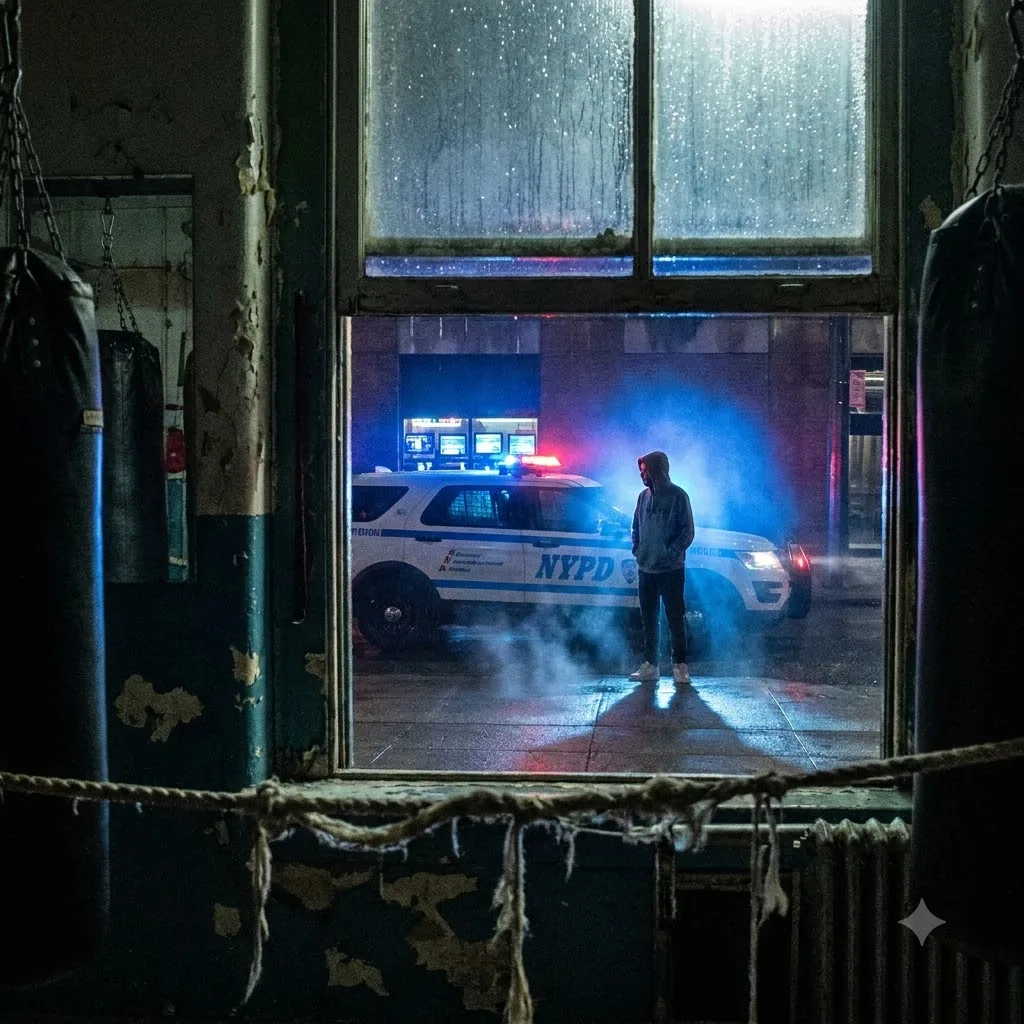
Trent didn’t say a single word. He didn’t issue a threat, and he didn’t offer a compromise. He simply turned on his heel, the heavy fabric of his tactical vest rustling in the cold, and walked back to his idling cruiser. He climbed into the driver’s seat, pulled the door shut with a heavy metallic thud, and threw the vehicle into drive. The tires gripped the freezing asphalt as the cruiser sped away, its taillights bleeding into the darkness until it disappeared around the concrete corner.
Marcus remained on the cold sidewalk, his breath coming in ragged, painful gasps. He leaned against the metal handrail, slowly pulling himself up to his feet. His shoulder throbbed with a dull, heavy ache, but he was alive. He hadn’t triggered a parole violation. He had backed the detective into a corner and survived. For a fleeting second, the quiet alley felt like a victory. Trent would have to reverse the data flow. Trent would have to find a way to manually appeal the threat metrics to save his own data farm, which meant the youth center’s funding might just survive the week.
Then, deep inside his coat pocket, his phone vibrated.
It wasn’t a standard text message. It was the sustained, mechanical pulse of an automated system alert.
Marcus pulled the phone out with trembling fingers. The cracked screen illuminated his face with a harsh, sterile glow. It was a new notification from the City Grants Portal.
*NOTICE: Algorithmic reassessment initiated for Eastside Sector. Secondary cascading risk factors detected in neighboring municipal grids. Funding hold remains active pending mandatory ninety-day automated review. Do not reply to this auto-generated message.*
Marcus stared at the glowing pixels until his vision blurred. The cold of the evening finally seeped through his coat, settling deep into his bones.
He had beaten Trent. He had used human logic to outmaneuver a corrupt cop. But the cop was just a single, flawed node in a massive, unthinking network. Trent’s temporary retreat didn’t stop the machine. The predictive policing software was still running on servers miles away, still churning historical data, still drawing invisible red lines around Marcus and the kids playing basketball inside.
There was no human left to reason with, no corrupt detective to easily outsmart. The system didn’t sleep, it didn’t feel shame, and it didn’t care about context. Marcus stood alone under the buzzing neon light, the phone heavy in his hand, consumed by the quiet dread that he was now fighting an endless war against a sleepless algorithm.