Story code: ST-001505
Part 3: The False Bottom
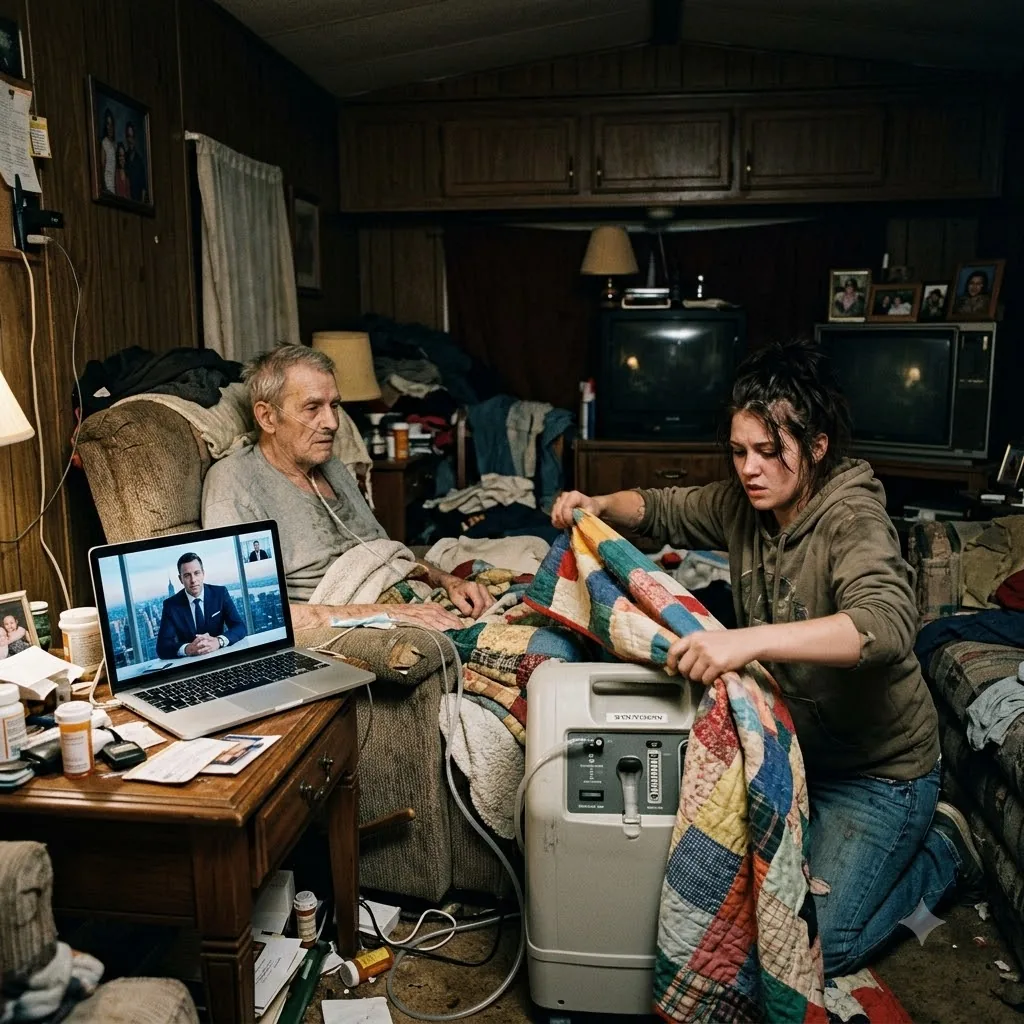
The wail of the sirens grew louder, vibrating against the thin, corrugated aluminum walls of the trailer. Vance’s chalky fingers dug into Nora’s wrist. His grip trembled as he dragged in a wet, rattling breath through his plastic nasal cannula. He shook his head, his sunken eyes wide with terror, silently begging her to let the detonator go. On the battered laptop screen, the red recording icon of the federal deposition feed pulsed with steady, rhythmic indifference.
Richard Sterling sat comfortably in his mahogany-paneled office, his smirk fixed into a monument of corporate invulnerability. In the corner grid, the silk-tied lawyer checked his watch, loudly advising Nora that the county sheriff’s deputies were turning onto the gravel access road. He instructed her to step away from the explosives and place her hands flat on her head.
Nora looked at the mechanical blasting cap resting in her palm. The copper wire remained wrapped tightly around the oxygen concentrator’s high-pressure intake. Sterling was right. Detonating the shaft would only trigger his comprehensive terrorism insurance policy, absolving the mining company of all financial losses while she rotted in federal prison. The legal game was perfectly insulated, designed to win even when it lost.
She gently placed the blasting cap down on the peeling laminate of the table.
On the screen, Sterling let out a soft, dismissive exhale and reached for his crystal tumbler. The lawyer immediately began dictating a brisk statement for the official record, noting that the hostile party had disarmed the device and was awaiting law enforcement.
But Nora didn’t raise her hands. She turned her back to the laptop and looked at the heavy steel shift box sitting on the kitchenette counter. Vance hadn’t just smuggled out commercial explosives during the violent labor strikes of the late nineties. He was a deeply paranoid man who never trusted the company, guarding this dented metal container for three decades. The Tovex couldn’t be his only insurance policy.
Nora plunged her hands deep into the bottom of the box, pulling aside the remaining coal-stained shop rags. Beneath them, wedged tightly into a shallow false bottom, lay a bound bundle wrapped in brittle, yellowed plastic grocery bags. The plastic crackled sharply as she pulled it free, a harsh sound that silenced the corporate lawyer’s triumphant dictation.
She peeled the decaying plastic away. Inside was a small, black ledger. Its rigid spine was heavily bound in cracked electrical tape, the cover smeared with decades-old soot and permanent thumbprints of coal dust. In the recliner, Vance let out a sharp, panicked wheeze, his hand dropping from her wrist as he recognized the book.
Nora flipped the ledger open under the harsh glare of the overhead bulb. The pages were dense with her father’s blocky, cramped handwriting-daily shift logs meticulously detailing methane levels and structural shifts in the Blackwood seam. But tucked into the center crease of the notebook was a folded piece of heavy stock paper. It bore the faded, blue-ink watermark of Blackwood Mining Operations, the corporate predecessor to Sterling’s current empire.
She carefully unfolded the document. It was an internal safety directive dated twenty-two years ago, during the aggressive expansion of the lower seam. Nora scanned the typewritten text. The directive explicitly ordered the shift foremen to bypass the federally mandated air-filtration scrubbers during peak drilling hours. It cited the excessive diesel fuel costs required to run the auxiliary generators, mandating that the secondary vents remain sealed to artificially inflate the primary shaft’s draw. It was a calculated, highly illegal maneuver that guaranteed maximum production speed while forcing the miners to breathe concentrated silica and coal dust for twelve-hour shifts.
Nora’s eyes tracked to the bottom of the page. There, signed in thick, aggressive blue ink, was the final authorization. It wasn’t signed by a faceless shift boss. It was signed by the former Vice President of Operations: Richard Sterling.
Nora stepped back in front of the laptop. She held the heavy stock paper flat against the webcam lens, ensuring the high-definition feed captured every typewritten word and the glaring blue signature at the bottom.
The lawyer narrowed his eyes, leaning close to his monitor. He immediately began shouting over the feed, declaring the document a gross forgery and threatening her with further federal charges for fabricating corporate records.
Nora pulled the paper back just enough to reveal her own face. She ignored the attorney entirely and spoke directly to Sterling. She kept her voice dangerously calm, the words slicing through the hissing mechanical rhythm of the oxygen concentrator. She read the directive’s alphanumeric code aloud. She read the exact date. Then, she read Sterling’s name.
Sterling’s crystal tumbler froze halfway to his mouth. The smug, predatory satisfaction vanished from his features in an instant, replaced by a sudden, rigid pallor. The ice clinked loudly against the glass as his hand began to tremble.
Nora explained the new reality of his insurance loophole. She acknowledged that an armed bomb would indeed trigger the terrorism clause. But she pointed out that if the county sheriff arrived to find an explosive device, it would trigger a mandatory, full-scale federal investigation. The FBI, the Department of Justice, and the Mine Safety and Health Administration would descend on the trailer. And the very first piece of evidence they would bag would be the ledger. They wouldn’t just find a disgruntled daughter; they would find twenty years of documented, premeditated corporate manslaughter directly linking the CEO to the respiratory destruction of his entire workforce.
“The preexisting condition clause is dead,” Nora stated flatly into the microphone. “Your insurance payout is dead. You won’t just lose the mining company. You’ll lose your freedom.”
Outside the thin trailer walls, the heavy crunch of tires on gravel echoed loudly. The flashing red and blue strobes of the sheriff’s cruisers began painting the cramped, stale room through the broken window blinds. The police had arrived, exactly as Sterling had ordered.
On the screen, the lawyer stammered, looking frantically to the main video feed for instructions. He asked Sterling what they should tell the dispatch officer.
Sterling didn’t answer. The CEO stared at the soot-stained ledger in Nora’s hands, his mouth opening and closing without making a sound. The flawless legal trap he had so perfectly engineered had just clamped shut around his own throat. And as heavy, authoritative fists began pounding violently on the trailer’s aluminum door, the video feed remained frozen in absolute, terrified silence.