Story code: ST-001085
Part 3: The Engagement
The heavy engine of the matte-black SUV idled with a rhythmic, vibrating hum that rattled the loose gravel in the parking lot. Helen stood her ground, clutching the heavy clay brick in her right hand. The bitter wind whipped her cardigan against her side. She braced herself for the tinted windows to drop, fully expecting a team of tactical operatives or shadowy political fixers to step out onto the asphalt.
Instead, the passenger-side window glided down with a soft, electronic whir.
The driver wasn’t a menacing operative. It was a middle-aged woman wearing a puffy North Face jacket. A Bluetooth earpiece blinked with a tiny blue light on her ear, and she was casually holding a large iced coffee.
The woman leaned over the center console, peering out into the freezing morning air. She looked at Helen, then glanced at the lifted pickup truck. Finally, she spotted the tip of Greg’s tactical boots protruding from behind the rear tire.
“Gregory Miller?” the woman called out, her voice loud and profoundly bored.
Greg didn’t move. He stayed curled in a tight, terrified ball behind the rubber tread.
“I can see your boots, Greg,” the woman sighed, taking a sip of her iced coffee. “I’m not playing hide and seek with you in the freezing rain.”
She reached across the passenger seat and tossed a thick manila envelope out the open window. It slapped heavily against the wet asphalt.
“Consider yourself served,” she announced.
The tinted window glided back up. The SUV accelerated, smoothly rolling over the yellow speed bump before turning right onto the main road, its taillights bleeding into the gray morning fog.
Helen slowly lowered the brick. She walked over to the envelope lying face-up in a shallow puddle. Through the clear plastic address window, the bold, black text was entirely legible.
*URGENT: NOTICE OF DEFAULT AND FORECLOSURE SALE – First National Bank.*
Helen stared at the legal document. She looked over at the truck. Greg slowly dragged himself out from behind the tire. He didn’t look at the envelope. He just stared blankly at the wet asphalt, the violent panic attack finally giving way to a hollow, breathless exhaustion.
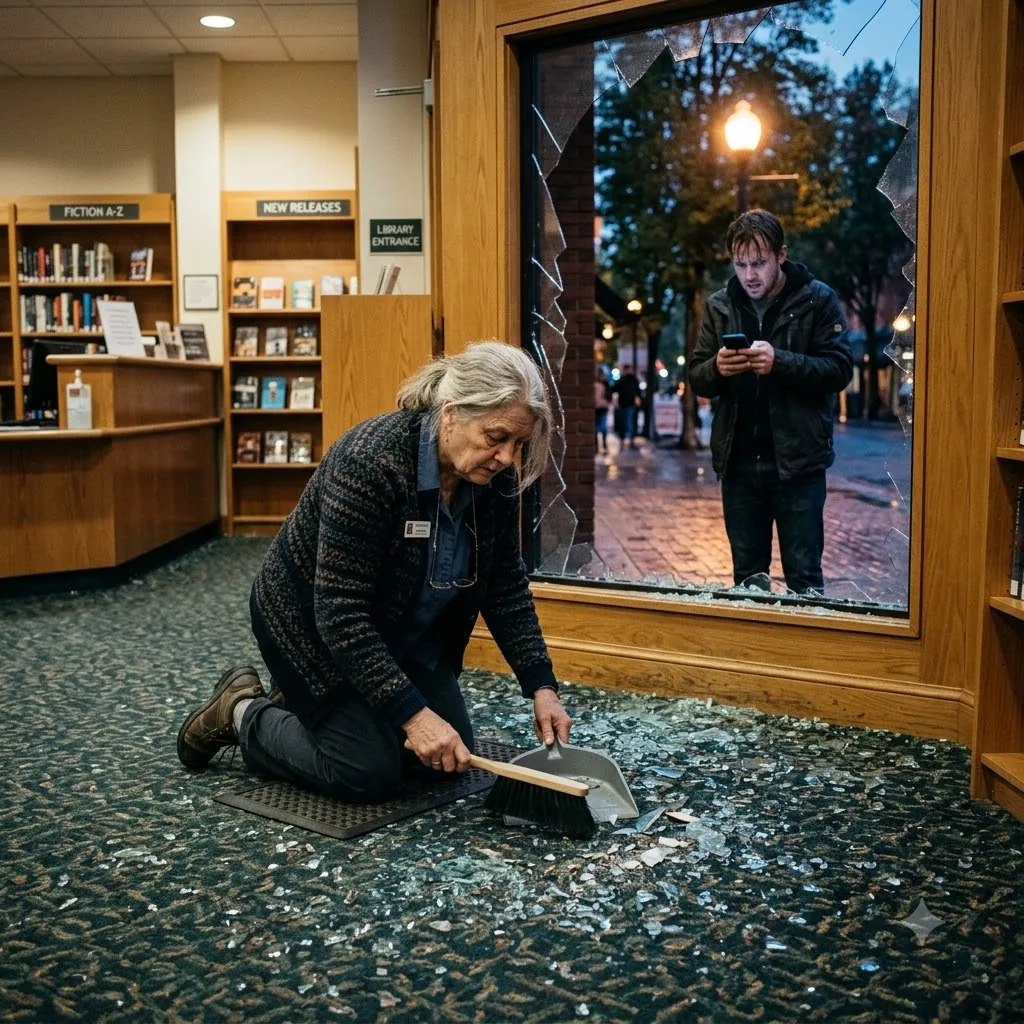
Helen looked back down at the brick in her hand. She stared at the crude black ink scrawled across the flat clay underside. She examined the street address, specifically focusing on the number ‘4’. It was drawn with a sharp, closed triangle at the top and an unusually long vertical stem.
She had seen that exact handwriting on three dozen Freedom of Information Act requests Greg had filed at her circulation desk over the past month. She had seen it on the aggressive protest signs he left behind in the foyer.
“There are no sponsors,” Helen said, her voice cutting cleanly through the wind.
Greg flinched, hugging his knees, but he didn’t look up.
“There is no dark money buying your studio equipment,” Helen continued, her tone stripping away his grand narrative piece by piece. “You weren’t begging a handler for an extension on your phone. You were begging your mortgage lender.”
Greg let out a miserable, broken sound that was half-sob, half-cough.
Helen stepped closer, holding up the heavy masonry. “And this. This is your handwriting, Greg. I know your fours. You threw this through the glass.”
Greg rubbed a trembling, dirt-stained hand across his pale face. “I came at three in the morning,” he whispered, his voice cracking. “I made sure the building was completely empty. I wouldn’t actually hurt anyone, Helen. You have to believe that.”
“You put your own daughter’s elementary school address on it,” Helen said, the disgust finally sharpening her words. “Why?”
“Content,” Greg choked out, staring at the ground. “I was going to come back at nine. When you opened. I was going to set up the tripod and ‘discover’ it in the wreckage. I was going to tell my audience that the radical left found out where my kid goes to school.”
Helen stared at him, repulsed by the sheer pathetic depth of the lie. The great ideological warrior, reduced to staging a hate crime against himself.
“The outrage,” Greg muttered, shivering violently in the damp cold. “The super-chats. A GoFundMe for a home security system. It would have cleared the mortgage arrears by tonight. I just needed a physical escalation. The algorithm stopped pushing my videos when it was just me yelling in my truck. I needed something real to happen.”
He looked up at her, his eyes red and pleading. “But you found it first. If you open the doors today, and hand that brick over to the police, I go to jail for fraud. The channel dies. The bank takes the house. Please, Helen. Tell the city the door is a safety hazard. Close the branch for the day. Give me twenty-four hours to figure out another way to get the money.”
Helen stood motionless in the freezing wind. The grand, terrifying culture war that had consumed her life, the righteous siege that had terrified her staff, wasn’t a war at all. It was just a desperate, broke man trying to monetize public outrage to keep a roof over his head.
She felt no triumph in exposing him. She only felt a bitter, cynical recognition.
Helen reached her free hand deep into the pocket of her wool cardigan. Her fingers brushed against the heavy, tri-folded cardstock she had been carrying since yesterday afternoon. She pulled it out. The paper bore the embossed gold seal of the county commissioner’s office.
She dropped the letter onto the wet gravel, right next to Greg’s foreclosure notice.
Greg stared at the crisp official document, confused. “What is that?”
“A formal notice of administrative restructuring,” Helen said, her voice as flat and gray as the morning sky. “The county council is cutting the library budget by thirty percent next fiscal year. This branch is slated for permanent closure at the end of the month.”
Greg frowned, wiping a mix of cold sweat and rain from his eyes. “But… my audience is protesting you. If they close the library, we win.”
“There is a contingency clause,” Helen said, looking down at him. “The branch can remain open, and my pension will fully vest, if I can prove we are an ‘essential community hub.’ I have to show a sustained, fifty percent increase in daily foot traffic by the thirtieth. I need engagement metrics.”
Greg slowly looked from the county letter back up to Helen’s stoic face. His brow furrowed as the implication settled over him.
“Your angry mobs,” Helen said quietly, “are the only people who come here anymore, Greg. Every time your subscribers show up to scream at me, every time they barge in to film the shelves and demand to inspect the catalog, I count them at the door. I scan their driver’s licenses when they demand public registry forms. It all counts as civic engagement.”
The wind howled across the empty parking lot, violently rattling the jagged teeth of safety glass still clinging to the destroyed entryway.
“You are the only reason my numbers are up,” Helen said. “If I close the doors today to protect you, I lose the daily quota. The city gets the excuse they need to terminate me early, and my healthcare is gone.”
Greg stared at her, the breath stalling in his lungs. The righteous, patriotic siege. The noble defense of the community. It was all a mirage. They were just two drowning people, clinging to opposite ends of a rope, performing a violent theater to extract enough pennies from a blind system to survive.
“If I stay open,” Helen said, her grip tightening on the heavy brick, “you lose your house.”
“If I don’t give them a win,” Greg whispered, staring blankly at the wet gravel, “you lose yours.”
Helen looked past him, staring at the shattered front doors of her library. Then she looked back down at the pathetic man kneeling in the freezing rain. Neither of them had a clean way out.