Story code: ST-000685
Part 4: One More Night
Red and blue lights strobed fiercely against the buckled aluminum siding of the garage, washing out the harsh glare of the livestreamer’s ring-light. The sirens had wailed down the cul-de-sac only moments after Helen’s fractured whisper echoed across the digital broadcast. Now, two patrol cruisers idled directly behind the massive front-end loader, their radios spitting static into the exhaust-choked air.
A uniformed officer unspooled a roll of yellow barricade tape, stretching it across the cracked asphalt of Elias’s driveway to quickly cordon off the so-called hazardous environment.
“Nobody crosses the line!” the officer shouted, waving back the milling remnants of the digital militia.
Helen didn’t even blink. She ducked cleanly under the yellow tape, her boots crunching over the landslide of empty Narcan vials and sterile plastic caps Elias had spilled across the concrete.
“Ma’am, stop!” the officer barked, reaching out to grab her arm.
Helen violently jerked her shoulder away. “Don’t you touch me,” she hissed, her voice vibrating with a maternal ferocity that froze the young cop in his tracks. “My daughter is in there.”
Councilman Vance stepped forward, his pristine neon vest glowing brightly under the police strobes. “Helen, please be reasonable. That structure is a condemned biohazard. The girl inside is likely a vagrant who stole Chloe’s jacket. We need to clear the area and let the demolition proceed as legally mandated.”
Helen turned slowly. Elias leaned his tired weight against his workbench, watching the remaining blood drain entirely from the politician’s face under her intense stare.
“If that machine moves one more inch,” Helen said, pointing a shaking finger directly at Vance’s chest, “I will personally dismantle your entire life.”
She didn’t wait for his response. She spun around and marched straight toward the reinforced steel door. Elias caught her eye as she approached. He gave a single, slow nod, stepping off to the side to leave the threshold completely clear.
Helen crossed the small triage antechamber and pushed through the heavy plastic privacy curtains into the main ward. A moment later, Elias heard it. A sharp, ragged gasp, followed immediately by the undeniable, heavy weeping of a mother clutching a child she had spent six agonizing weeks believing was dead in a forgotten alleyway.
Out in the driveway, the political theater violently unraveled. Davis stood frozen near the shattered window, staring blankly at the dark screen of his phone. He had abruptly killed the livestream the second Helen threatened the councilman. The righteous crusade of his digital militia had entirely deflated, punctured by the visceral reality of a grieving neighbor.
Vance looked frantically around, realizing the cameras were off and the crowd was murmuring in localized, undeniable guilt. The neighbors who had just brought crowbars and flashlights were now staring at their boots. They were looking at the capped insulin syringes not as cartel poison, but as the desperate, sterile tools that had kept the neighborhood’s lost children breathing.
“Shut it down,” Vance muttered to the heavy machinery operator, waving a quick, dismissive hand to save whatever face he had left.
The massive diesel engine of the front-end loader sputtered and died. The sudden silence in the driveway was deafening, broken only by the crackle of police radios and the muffled sobbing echoing from Elias’s back room.
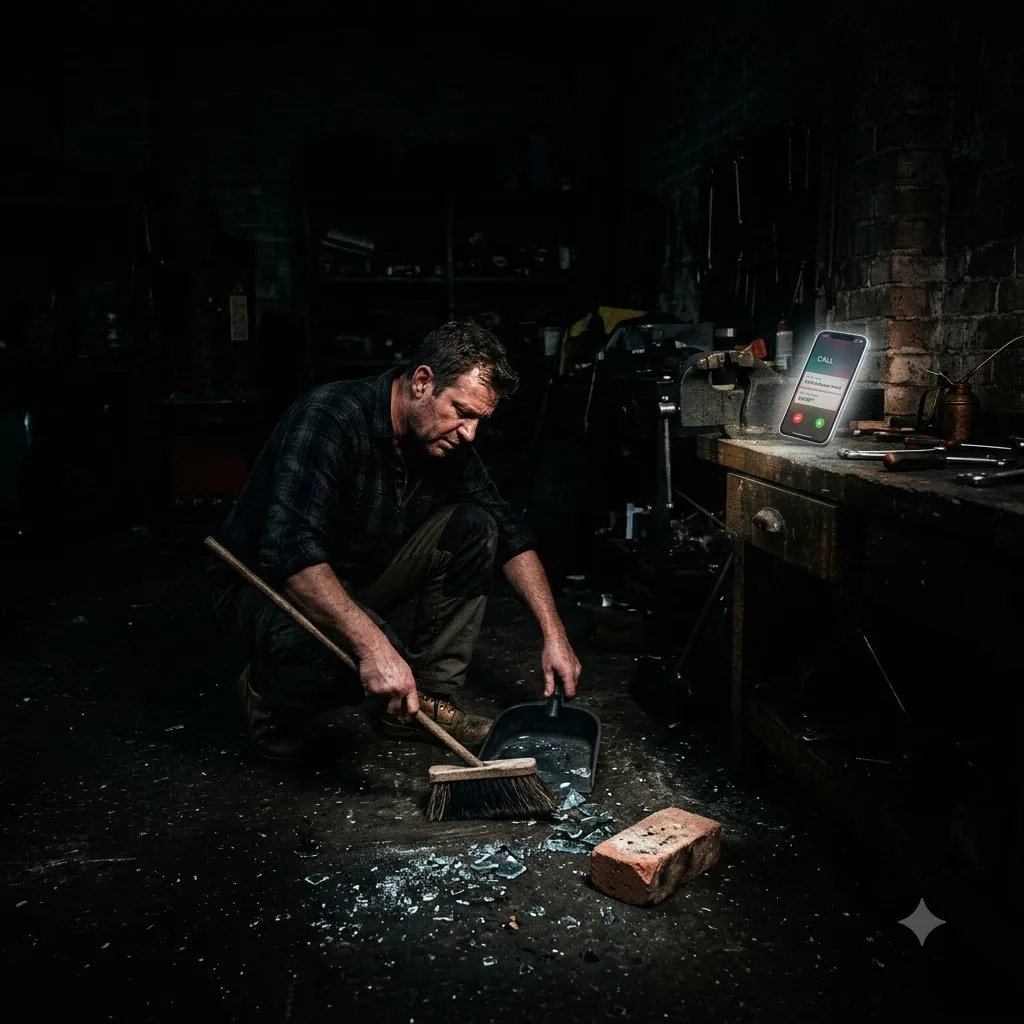
Elias pulled his jacket tighter against his chest, sliding down the cold cinderblock wall until he sat heavily on the swept concrete floor. The freezing night air poured freely through the ruined garage door. His sanctuary was permanently compromised. The heavy rubber weatherstripping he had meticulously installed was torn. The purified, climate-controlled seal was broken forever.
A senior officer approached him, a thick clipboard in hand. The cop dropped a stack of yellow and pink carbon-copy citations directly onto Elias’s lap. Code violations. Emergency abatement fees. Trespassing fines for operating an unlicensed medical facility.
“You can’t go back inside tonight,” the officer said. His tone lacked the previous aggression, replaced entirely by a weary, procedural detachment. “City’s boarding it up until the administrative hearing tomorrow.”
Elias looked down at the stack of fines that would undoubtedly bankrupt him. He ran a numb thumb over the cracked screen of his phone, which had finally stopped buzzing with death threats. He had lost the building. He had lost his safe anonymity. The massive legal battle ahead would consume whatever small savings he had left after buying the synthetic nutrient reserves.
But through the ruined doorway, past the yellow police tape fluttering aggressively in the winter wind, he could hear Chloe’s weak, raspy voice calling for her mother. The sound drifted out over the spilled red biohazard bins and the broken glass, clear and undeniably alive.
Elias closed his eyes and leaned his head back against the freezing cinderblock. He was sitting in the dark, surrounded by the complete wreckage of his life’s work. But as he listened to the fragile rhythm of a reunited family holding each other in the ward, he knew the ultimate truth. He had kept them alive for one more night.