Story code: ST-000448
Part 4: The Invisible Toll
The heavy silence in the corridor felt absolute, broken only by the faint, rhythmic breathing of the two dozen students sitting on the damp linoleum. The ugly, violent word *thug* seemed to cling to the fluorescent lights overhead, casting a sickly, exposing glare over the morning.
Chloe’s chest heaved rapidly beneath her tailored slate-gray suit. The furious adrenaline that had propelled her into the crowd suddenly evaporated, leaving her stranded and completely exposed in the center of a circle of glowing phone screens. A father standing near the lockers did not lower his device. He simply stared at her over the top of his phone, his face a mask of profound, quiet disgust. The mother in the trench coat pulled her daughter a half-step backward, treating Chloe like she was the true biological hazard in the room.
Principal Evans finally moved. The sheer, unvarnished bigotry captured on high-definition video by members of his own PTA had broken his bureaucratic paralysis. The district’s new mandate, the sanitized removal, the compliance hearing-none of it mattered now. The representative of the Citizens’ Curriculum Directorate had just immolated herself in the middle of the first-period rush.
“Chloe,” Evans said. His voice was trembling, but it sounded shockingly loud in the deadened hallway. He reached out, his hand shaking, and grasped her elbow. “We are leaving. Right now.”
Chloe blinked. Her eyes darted frantically to the dozens of unblinking camera lenses surrounding her. The mottled red flush drained from her cheeks, quickly replaced by an ashen, terrified pallor. She opened her mouth to speak, perhaps to pivot back to the sterile, frictionless language of district policy, but the words completely failed her.
“Officer Davies,” Evans commanded, forcing himself not to look at Marcus. “Stand down.”
Davies hesitated. His leather gloves creaked as his hand hovered near his pepper spray. He looked at the seated teenagers, at the furious parents, and finally at the sixty-year-old history teacher standing calmly in the center of it all. The SRO slowly lowered his arm, stepping backward from his invisible perimeter and leaning against the wall.
Evans did not wait for any further response. He gripped Chloe’s arm tighter and forcefully steered her toward the main administrative office. She stumbled in her expensive leather pumps, her rigid posture completely collapsed. The hallway parted for them. Parents practically pulled their children out of the way to avoid touching her coat as she passed. She was escorted out not as a conquering authority, but as a disgraced spectacle, her ruined reputation permanently logged in the district’s digital ether.
Marcus watched them disappear through the heavy double doors. He waited for a surge of triumph to bloom in his chest. He waited for the righteous, soaring vindication that usually accompanied the climax of his historical lectures. But nothing came. Instead, a profound, agonizing weight settled over his shoulders, pressing down into his bones.
Maya scrambled up from the floor, her notebook still clutched tightly to her chest. “Mr. Hayes? Are you okay?”
Marcus looked at his brilliant junior, then at the concerned faces of the teenagers who had spontaneously formed a human shield around him. “I’m fine, Maya,” he said softly. “Thank you.”
“They can’t fire you now,” the mother in the trench coat said, stepping forward, her phone finally lowered to her side. “Not after this. We’ll send this to every news station in the state. They’ll have to fire her. We have your back.”
Marcus forced a gentle, appreciative nod. He thanked the parents, his voice quiet but steady, and gently urged his students to head to the cafeteria until the administration sorted out the morning schedule. He stood silently and watched the crowd slowly disperse, their voices murmuring in shocked tones as they replayed the unhinged video on their screens.
When the corridor was finally empty, Marcus turned and walked toward the rear exit. Davies did not try to stop him or follow him. The security guard merely stood near the locked, barricaded door of Room 204, staring intently at his own boots.
Marcus pushed his weight against the heavy metal exit doors and stepped out into the crisp, biting air of the faculty parking lot. The sun had finally crested the tree line, casting long, pale shadows across the cracked asphalt. He walked slowly to his old pickup truck, his dress shoes scraping against the pavement. He felt twenty years older than he had when he parked in his assigned space just an hour ago.
He unlocked the heavy driver’s side door, climbed onto the worn fabric seat, and pulled the door shut. The thick silence of the cab enclosed him, muting the distant sounds of the school day beginning.
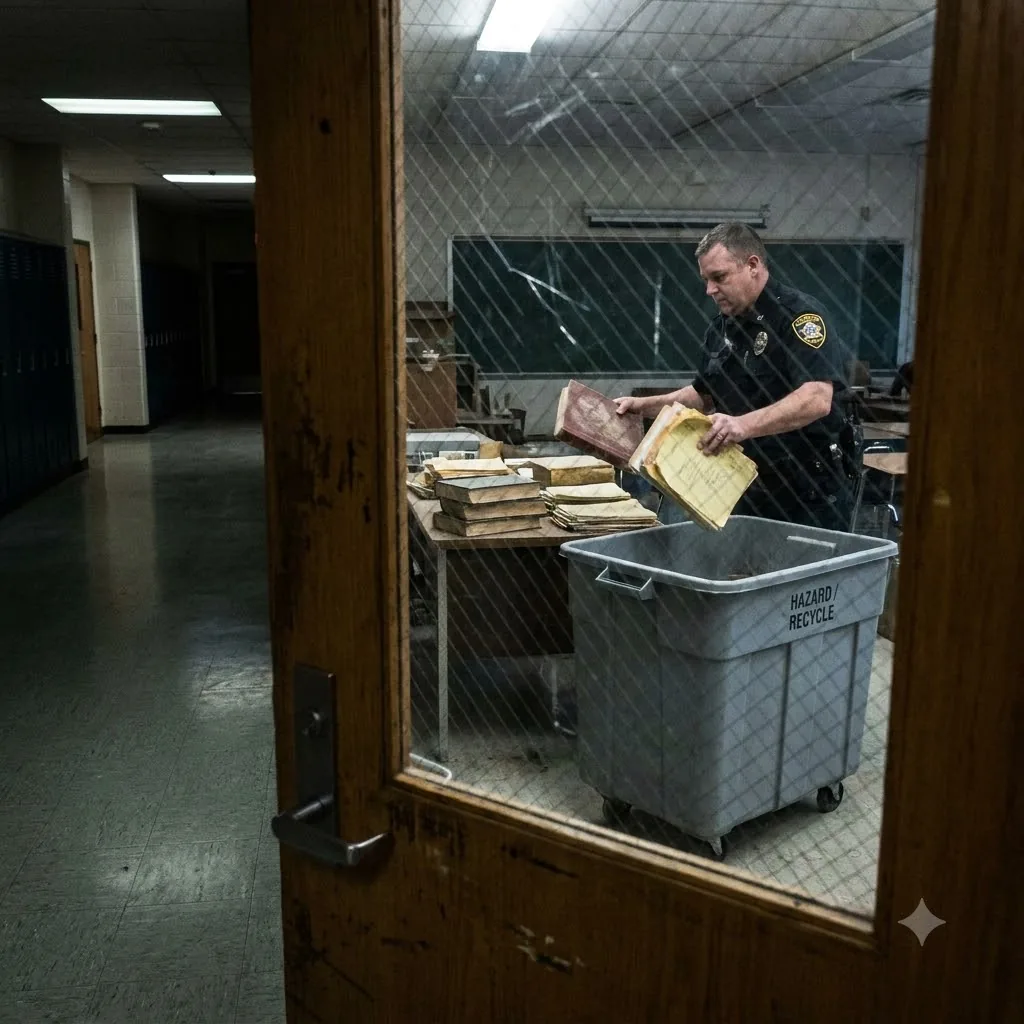
He leaned his forehead against the cold steering wheel. The adrenaline had completely left his bloodstream, leaving behind a hollow, aching fatigue. They had won a skirmish in the hallway, but his archives were still gone. Two decades of curated history, the irreplaceable telegrams, the fragile letters from organizers who had bled for the right to vote-all locked in gray plastic bins, hurtling toward an incinerator.
Marcus reached into the deep pocket of his wool coat and pulled out the single textbook he had managed to save. He had taken it home the night before to review a specific passage for his lecture. It was a thick, dog-eared anthology of the Civil Rights movement, its spine heavily reinforced with clear packing tape. He ran his thumb over the worn, familiar texture of the faded cover.
He sat in the quiet of his truck, staring blindly out through the windshield at the brick facade of the school he had served for twenty years. He found absolutely no joy in the victory. The emotional residue felt like ash in his mouth. He was deeply, profoundly exhausted by the invisible toll of it all-the relentless, crushing burden of having his life’s work, his dignity, and his entire humanity reduced to a split-second, hateful assumption about the color of his skin. He closed his eyes, holding the solitary book tightly against his chest, and breathed out into the cold, still air.