Story code: ST-001708
Part 4: The Opaque Wall
“Delete it,” Vance whispered, his voice completely hollowed out, stripped of all its polished, bureaucratic menace. He lunged across the mahogany desk for the laptop, but I slammed the silver lid shut and yanked it back against my chest. The satisfying snap of the magnetic latch echoed in the stifling room.
It was done. The servers had it. Every student with a smartphone who clicked the morning announcements link now had his verbatim threat in their pockets.
Vance’s face contorted into something ugly and desperate. He snatched his desk phone and furiously hammered a four-digit extension. “I need Officer Miller back in here. And pull Leo’s emergency contact file. Call his father.”
The suspension was swift and brutal. Ten days, pending a formal expulsion board hearing. Sitting in the stiff wooden chair opposite Vance’s desk, I listened as he spoke to my dad. Vance didn’t mention the journal or my gender identity on the phone. He couldn’t. Reading my private thoughts aloud to my parents now would only prove the exact blackmail charge I had just published to the entire school district. Instead, he leaned entirely on my physical interference at the security table-the moment I covered his hand.
“Aggressive insubordination, physical contact with an administrator, and threatening behavior,” Vance recited smoothly into the receiver, though a thin sheen of sweat coated his forehead.
My father arrived twenty-five minutes later. He didn’t look at me when he stormed into the administrative suite. He just signed the disciplinary release forms with hard, angry strokes of his pen. His jaw was set in that rigid, terrifying line that meant a storm was brewing, waiting to break the second we were behind the closed doors of our house. My stomach twisted into a cold, heavy knot. I had saved the journal from Vance, but the physical cardboard notebook was still shoved inside my clear bag, and it was coming home with me. The reckoning with my hyper-conservative parents hadn’t been avoided; it had merely been relocated.
“Get your things,” my dad muttered, turning on his heel.
I slung the clear plastic backpack over my shoulder. The heavy cardboard spine rested against my back. Vance stood in his office doorway, trying to project his usual towering authority, but his desk phone had started ringing. Then his cell phone lit up. A moment later, the administrative assistant’s multi-line console lit up like a Christmas tree. The digital shockwave was hitting the district.
We walked out of the front office just as the bell rang for the end of first period. The heavy wooden doors swung open, releasing a flood of students into the main corridor.
I braced myself for the stares, keeping my eyes glued to the scuffed linoleum. I felt the familiar, crushing urge to shrink, to become as small and unnoticeable as possible. The suspension meant I was dead weight. An outcast caught in the gears of the machine.
But the hallway was strangely quiet. It wasn’t silent, but it lacked the chaotic, echoing roar of slamming lockers and shouting teenagers.
I looked up.
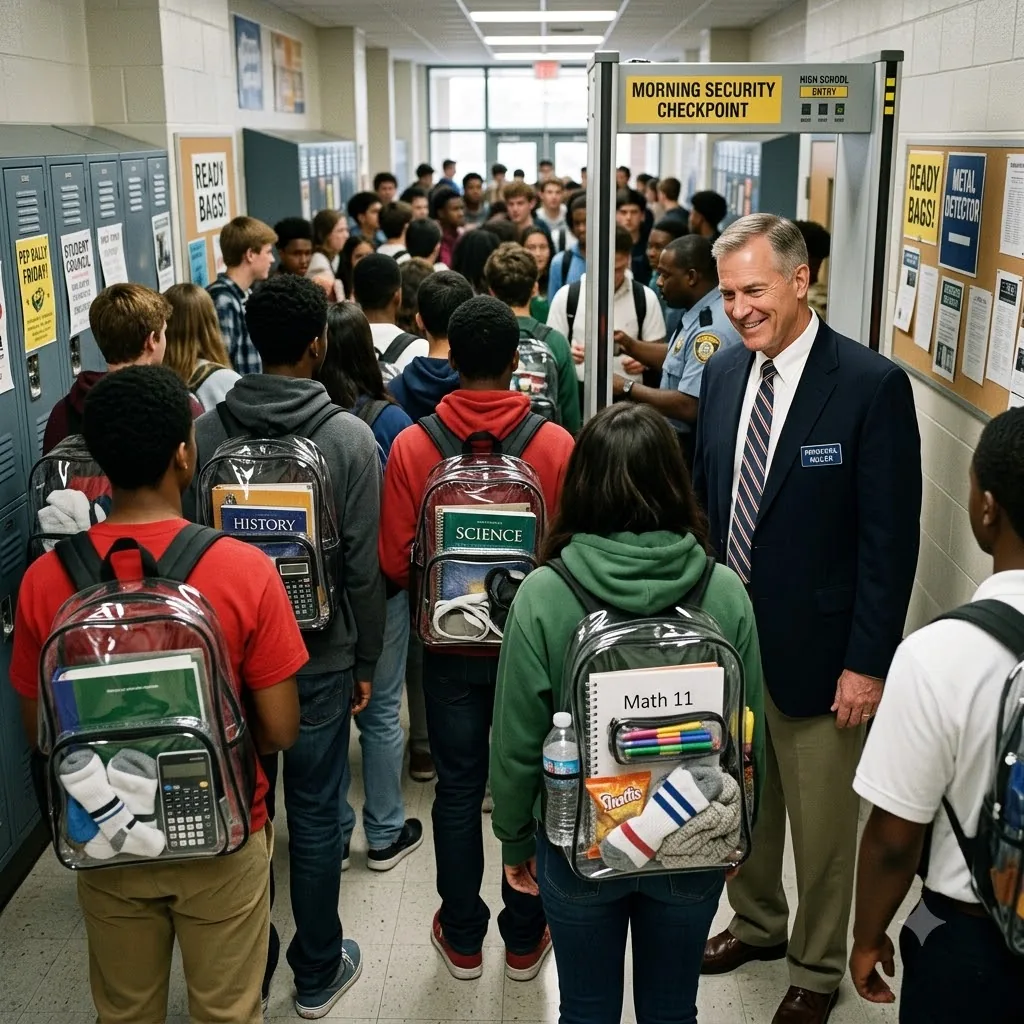
Sarah Miller was standing by her locker. Her massive AP Biology textbook was gone from her bag. In its place, completely lining the inside of the clear plastic, were sheets of printer paper taped together, rendering the backpack entirely opaque. Across the white paper, written in thick black Sharpie, were three bold words: *We Hear You.*
Beside her, Toby, the freshman from the security line, had lined his bag with a dark gray hoodie, completely obscuring whatever was inside. Jenna walked past us, her backpack wrapped internally with a collage of pages torn from a fashion magazine.
It wasn’t just them. As I walked down the center of the corridor trailing behind my angry father, I watched the sea of clear plastic transform. Student after student emerged from their classrooms with their bags blocked out. Construction paper, gym towels, aluminum foil stripped from the cafeteria. They had weaponized the very policy meant to expose us. The administration wanted transparency, so the student body had built a solid wall.
Marcus, the junior whose final-notice utility bills had been mocked that morning, caught my eye. His bag was lined with a black heavy-duty garbage bag. He didn’t say a word, just gave me a single, firm nod as I walked by.
My father didn’t notice a thing. He was storming ahead, blinded by his own anger and embarrassment, eager to drag me to the car and deliver whatever punishment awaited me at home. He didn’t see the silent rebellion blooming around us.
When we pushed through the double glass doors into the blinding morning sun, the heavy knot in my chest didn’t magically disappear. I was still suspended. I was still going to lose my place at the school paper. And within the hour, I would be sitting at the kitchen table, forced to finally open that cardboard notebook and explain the deepest, most terrifying truths of my identity to a father who had never once shown a capacity to understand.
The fallout was going to be brutal. The isolation in my room, stripped of my electronics and cut off from the world, would test every ounce of strength I had left. I gripped the plastic straps of my backpack as we reached his idling car, my knuckles turning white.
But as I slid into the passenger seat and looked back at the brick facade of Liberty High, I saw a dozen students walking past the cafeteria windows, their opaque, blocked-out backpacks swinging proudly against their shoulders.
Vance had tried to use my truth to bury me in the dark. Instead, I had dragged his cruelty into the light. I was terrified of the storm waiting for me at home, but the crushing, suffocating weight of hiding was gone. I was finally seen, and for the first time in my life, I wasn’t facing the administration alone.