Story code: ST-001198
Part 2: The Liability Shield
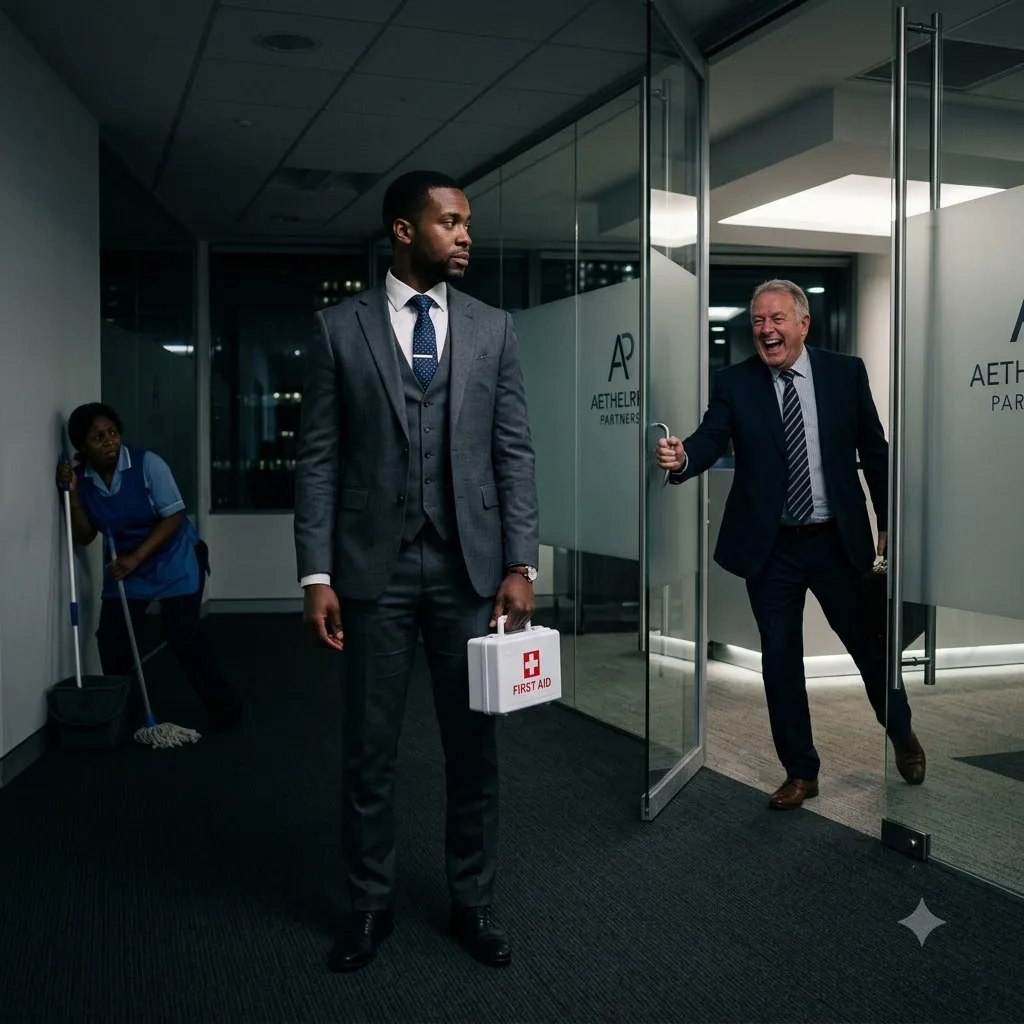
Marcus stared at the perfectly manicured finger pointed at his chest, the heavy canvas trauma kit pulling at his shoulder socket. Richard’s booming voice seemed to vibrate the glass walls of the executive suite, demanding immediate expansion of the vendor’s ruthless protocols. The sharp, toxic stench of ammonia and burning plastic continued to drift down the corridor from the utility closet, an invisible, choking cloud that Richard completely ignored in his financial euphoria.
Richard dropped his hand, finally noticing the bright red medical bag in Marcus’s grip. He frowned, the expression wrinkling his otherwise smooth, expensive features. He asked if Marcus was planning to perform minor surgery on a budget report, letting out a short, booming laugh at his own joke. He patted the leather-bound financial printout, reiterating that the numbers didn’t need life support, they needed a wider rollout.
Marcus tightened his grip on the bag’s nylon handles. He kept his voice steady, matching Richard’s volume just enough to project authority without challenging the board member’s ego. He stated there was a critical flaw in the new liability structure, a direct threat to the quarterly margins Richard was so fiercely protecting. He said it required Richard’s immediate, on-site assessment.
The word ‘liability’ acted like a physical tether. Richard’s smile vanished, replaced by the shark-like focus that had earned him his seat on the board. He adjusted the lapels of his bespoke charcoal suit and demanded to know what Marcus meant, insisting the vendor’s contract was entirely ironclad against parent-company exposure.
Marcus didn’t explain. He stepped forward, forcing Richard to either yield the hallway or collide with him. Richard sidestepped, his polished leather shoes squeaking faintly against the marble floor. Marcus led the way down the corridor, moving briskly toward the utility closet. With every step, the chemical odor grew denser, burning the back of Marcus’s throat. He listened to Richard’s footsteps following close behind, accompanied by a steady stream of dismissive corporate jargon. Richard muttered about minor operational hiccups, emphasizing that any localized non-compliance was solely the vendor’s financial burden, not theirs.
Marcus pushed the heavy oak door of the closet fully open. The harsh fluorescent light flickered slightly, illuminating the cramped space. Leticia was still pressed into the corner behind the deep ceramic mop sink. Her breathing was rapid and shallow, her eyes wide with a terror that seemed to age her face by a decade. She had managed to tuck her ruined, weeping left forearm behind her back, but the cheap fabric of her uniform shirt was heavily stained with clear fluid and dark blood.
Richard stopped in the doorway, effectively blocking the only exit. He pulled a pristine white handkerchief from his pocket and pressed it to his nose, his eyes narrowing in disgust at the overwhelming chemical stench. He didn’t look at Leticia’s trembling shoulders or the tears tracking through the dust on her cheeks. Instead, he stared at the dirty mop bucket and the warped, unlabeled grey spray bottle sitting in the sink.
Marcus unzipped the trauma kit and placed it on the edge of the sink. He pointed directly at the melted plastic bottle. He told Richard that the vendor’s miraculous forty percent cost reduction was a mirage built on illegal, hyper-concentrated industrial solvents. He explained that they were forcing untrained, unprotected staff to mix chemicals so corrosive they were actively eating through commercial-grade plastic containers.
Richard lowered his handkerchief slightly. He looked at the bottle, then at the financial report still tucked securely under his arm. He let out a long, exasperated sigh. He told Marcus that supply chain logistics were beneath their pay grade. He stated that if the vendor found a cheaper compound to achieve the required cleanliness metrics, that was the absolute essence of the free market. He argued that the melting bottle was merely a localized storage error, not a systemic failure requiring board intervention.
Marcus reached out and gently took Leticia’s shoulder, ignoring her quiet, panicked whimper. He guided her forward into the center of the small room and carefully pulled her arm out from behind her back.
Under the bright overhead lights, the chemical burn was impossible to ignore. The skin from her wrist to her elbow was a jagged landscape of blistering, raw, yellowish tissue. The edges of the wound were still actively reacting to the solvent, weeping violently. The smell of dissolving flesh mingled with the sharp ammonia, creating a sickening, metallic odor in the confined space. Marcus watched Richard’s face closely, waiting for the horrific visual evidence to shatter the man’s obsession with the financial report. He waited for basic human shock to override the corporate conditioning.
Richard stared at the raw, exposed tissue for three long seconds. His expression did not soften into horror or empathy. Instead, his jaw clenched tightly, and his eyes grew incredibly cold and calculating.
He stepped back into the hallway, pulling a sleek smartphone from his suit pocket. He didn’t ask Leticia her name or if she needed an ambulance. He spoke directly to Marcus, his voice entirely devoid of warmth. He pointed out that the cleaner was not wearing the mandatory, vendor-issued personal protective equipment outlined in section four of the operational manual. He declared her a walking liability, an unauthorized risk who had just willfully violated the zero-tolerance safety policy he had implemented last week.
Leticia sobbed, a terrible, broken sound, and shrank back against the wall, clutching her melting arm to her chest. She whispered frantically that she couldn’t lose this job.
Richard ignored her entirely. He tapped the screen of his phone, bringing up the building security directory. He ordered Marcus to escort the woman out of the building through the freight elevator immediately, demanding she be removed from company property before she bled on the executive carpets and triggered a mandatory OSHA investigation. He stated that treating her on-site would constitute an admission of parent-company responsibility, effectively voiding the vendor’s liability shield. He looked up from his screen, locking eyes with Marcus, and issued a direct, uncompromising ultimatum: either Marcus marched the bleeding cleaner out the back door in the next two minutes, or Richard would have security terminate both of their contracts before midnight.