Story code: ST-001486
Part 2: The Taste of Sugar
The sound of the heavy steel door slamming against the concrete echoed down the narrow corridor like a gunshot. Mateo’s jaw snapped shut, the specific phrase he had been instructed to deliver dying on his tongue. He flinched, his shoulders violently hitching as the noise sent a fresh wave of blinding pain through the base of his skull.
Heavy, measured footsteps advanced down the hall. A corrections officer stepped into the harsh fluorescent light of the commissary wing. It was Officer Barrett, a broad-shouldered man with a reputation for conducting random, aggressive shakedowns. Barrett’s thumbs were tucked casually into his utility belt, but his pale eyes were scanning everything-the scuffed linoleum, the Plexiglas window, and finally, Mateo, who was slumped against the cinderblock wall.
Mateo desperately tried to straighten his posture. He locked his knees, willing the tremors in his legs to stop, but the deep, bone-aching fever refused to be ignored. He felt a bead of cold sweat slide down the back of his neck, soaking into his gray collar.
“Moving a lot of inventory there, eighty-four-forty-two,” Barrett said, his voice a low, gravelly rumble that seemed to vibrate in Mateo’s aching teeth. The officer stopped a few feet away, his gaze dropping to the two massive, bulging yellow mesh bags resting on the floor by Mateo’s boots.
Mateo swallowed the dry, metallic taste in his mouth. “Just stocking up, boss.”
Barrett took another step closer, invading Mateo’s personal space. The smell of the officer’s stale coffee and peppermint gum turned Mateo’s stomach. Barrett’s eyes narrowed as he took in Mateo’s pale, clammy face, the dark circles under his eyes, and the visible tremors shaking his hands.
“You look like absolute garbage,” Barrett said. “You carrying a bug? Because if you are, I’m sending you to medical right now. And if you go to medical, this little haul here goes into lockup as abandoned property until you’re cleared.”
Panic, sharp and icy, pierced through Mateo’s fever haze. If the bags went into lockup, the transaction was voided. The digital funds his wife had bled herself dry to deposit would be gone, but he wouldn’t have the goods to show for it. The people waiting for him in Cell Block D wouldn’t accept an excuse about Officer Barrett or a trip to the infirmary. They would simply assume he had kept the money, and the consequences for that would be immediate and brutal.
“I’m fine, boss,” Mateo forced out, his voice hoarse. “Just hot in here. The AC must be broken.”
Barrett didn’t look convinced. He kicked the side of the mesh bag. The twenty bags of flamin’ hot chips and the blocks of instant ramen crunched loudly. “You know the rules on block-trading. We’re cracking down on extortion. I see you slinging these honey buns to settle debts, I’m tossing your cell and throwing you in the hole. You understand me?”
“They’re for me,” Mateo lied, his heart hammering against his ribs like a trapped bird. “I just… I have a sweet tooth.”
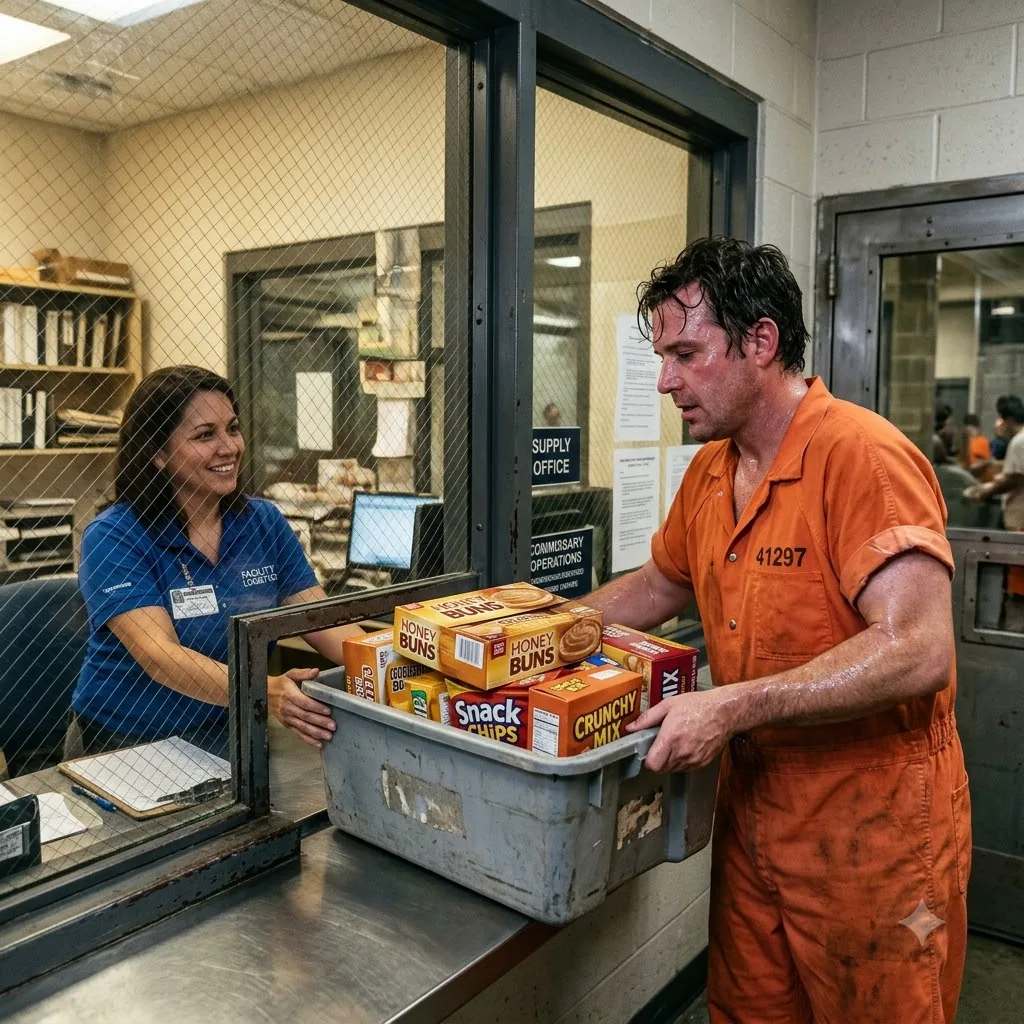
Behind the Plexiglas, the commissary manager remained entirely silent, watching the exchange with a bland, unreadable expression. The cheerful, weaponized smile was gone.
Barrett let out a short, humorless laugh. “Is that right? You’re shaking like a leaf, sweating through your uniform, and you just blew nearly three hundred dollars on junk food. I think you’re muling this for someone else. So prove it’s for you. Eat one right now.”
Mateo stared at the officer, his vision swimming. “What?”
“You heard me. You’re so hungry for glazed buns, let’s see you eat one. Open the bag.”
Mateo’s stomach violently contracted at the mere thought. The fever had stripped him of any appetite days ago; even keeping water down was a monumental task. But Barrett was watching him, a hand resting lightly near the radio on his belt. If Mateo refused, the bags were gone. His wife’s double shifts, the missed choir recital, the empty bank account-all of it would be for nothing.
With agonizing slowness, Mateo reached down. The muscles in his back screamed as he bent over and uncinched the top of the yellow mesh bag. His thick, clumsy fingers grabbed one of the thirty-six Honey Buns. He stood back up, swaying slightly, and fumbled with the plastic wrapper.
The sound of the tearing plastic was deafening. The smell hit him instantly-a heavy, artificial wave of pure sugar, stale frying oil, and chemical preservatives. His salivary glands ached, but his mouth remained completely dry. His throat tightened in a preemptive gag.
“Go on,” Barrett prompted, crossing his arms.
Mateo brought the pastry to his cracked lips and took a bite. The texture was dense and sickeningly soft. The icing immediately coated the roof of his mouth in a thick, cloying paste. He tried to chew, but there was no moisture to break the food down. It felt like he was chewing on sweetened clay. The nausea rose rapidly, a burning sensation clawing its way up his esophagus.
He forced himself to swallow. The heavy mass dropped into his fiercely churning stomach, sitting there like a lead weight. He closed his eyes for a fraction of a second, fighting the desperate, overwhelming urge to vomit all over Barrett’s polished black boots.
“Delicious, right?” Barrett mocked, watching Mateo’s face turn a lighter shade of green. The officer lingered for another ten seconds, waiting to see if Mateo would throw it back up. When Mateo only stood there, breathing heavily through his nose, holding the half-eaten pastry, Barrett finally snorted in disgust. “Clean up your mess and get back to your block. If I catch you trading a single one of those chips, you’re mine.”
Barrett turned and continued down the corridor, the heavy clack of his boots slowly fading away.
Mateo stood frozen until the officer turned the corner. He immediately spat the remaining unchewed pastry into his hand, tossing it and the ruined Honey Bun into a nearby trash can. He gripped the edge of the Plexiglas counter, dry-heaving once, twice, his entire body shuddering with the effort to keep his stomach contents down.
He looked through the glass at the manager, hoping to salvage the end of the transaction, but the manager had already turned his back, sorting through a box of inventory. The window of opportunity to deliver the phrase had closed.
Mateo looped his aching wrists through the heavy mesh drawstrings. The bags felt twice as heavy as before, the plastic cords digging deep into his skin, cutting off his circulation. He dragged them forward, his boots shuffling weakly against the floor.
He made it out of the commissary wing and into the transitional hallway leading toward Cell Block D. The lighting here was dimmer, the security cameras spaced further apart. He kept his eyes on the floor, counting his steps, trying to outrun the dizziness.
As he passed a recessed utility alcove, a shadow detached itself from the wall.
A tall inmate with a jagged spiderweb tattooed across the entire left side of his neck stepped out, effectively blocking the narrow hallway. Mateo stopped, the heavy bags swinging and hitting his shins.
The tattooed man looked down at the haul, then back up to Mateo’s fever-slicked face.
“You’re late,” the man said, his voice a soft, dangerous hiss that echoed off the concrete. “And my boy in the storeroom says he didn’t hear you say the words.”