Story code: ST-000326
Part 4: Weaponized Politeness
The microphone emitted a low, electronic whine that seemed to stretch the silence into something sharp and brittle. Chloe stood frozen, her hands still pressed flat against the wooden podium. Her chest, which had been heaving with righteous indignation a second ago, went completely still.
Marcus watched her eyes dart across the gymnasium. He saw the exact moment she realized the depth of her exposure.
In the second row, Mrs. Gable-who frequently posted on the bakery’s community page about inclusivity and neighborhood harmony-slowly lowered her gaze to her lap, her cheeks burning pink. Mr. Lin crossed his arms, shifting uncomfortably in his metal folding chair. Nobody gasped again. Nobody leaped to Chloe’s defense. Instead, the progressive allies of Elm Street sat in a heavy, embarrassed silence. It wasn’t the silence of people shocked by a revelation; it was the suffocating silence of people who had just watched the quiet, unspoken rules of their gentrification violently dragged out into the fluorescent light.
Chloe had committed the cardinal sin of their curated neighborhood: she had said the quiet part loudly into a PA system.
“I-” Chloe stammered, her voice suddenly small and breathless, completely stripped of its polished influencer cadence. She looked pleadingly at Chairman Higgins. “I just meant from a purely demographic standpoint. For the foot traffic. I wasn’t saying anything about…”
Her voice trailed off. There was no way to repackage the ugliness she had just unleashed.
Higgins cleared his throat, the sound wet and nervous. He adjusted his wire-rimmed glasses, pointedly refusing to look at Chloe, Marcus, or the crowd. His hand finally dropped onto his wooden gavel, but he didn’t strike it. He just used the handle to anchor his trembling fingers.
“The board,” Higgins began, his voice tight, “takes these allegations of… of falsified complaints very seriously. In light of this metadata evidence, the pending commercial injunction regarding the alleged biological hazard at 402 Elm Street is immediately suspended, pending a full, independent city review.”
“Suspended?” Chloe choked out, taking a frantic step toward the table. “But Mr. Vance needs the expansion paperwork finalized tonight! I already ordered the patio furniture! My investors-”
“The board will not be taking further comment from Sugared & Spiced at this time,” Higgins interrupted. His tone was sharp, desperate to distance himself and his committee from the radioactive epicenter of the room. “We are adjourned.”
He struck the gavel once, a hollow crack that signaled the end of Chloe’s expansion.
Marcus didn’t smile. He didn’t feel the euphoric rush of victory he thought he might. He simply picked up his manila folder, closed the cover, and stepped away from the podium. As he walked back down the center aisle, the crowd parted for him. People murmured polite, indistinct apologies. Mrs. Gable offered a weak, sympathetic nod that completely failed to reach her eyes. Marcus realized they weren’t looking at him as an equal; they were looking at him as a liability they had failed to politely erase.
He pushed through the heavy oak doors of the community center and stepped out into the cool night air. The streetlamps cast long, pale shadows across the cracked pavement.
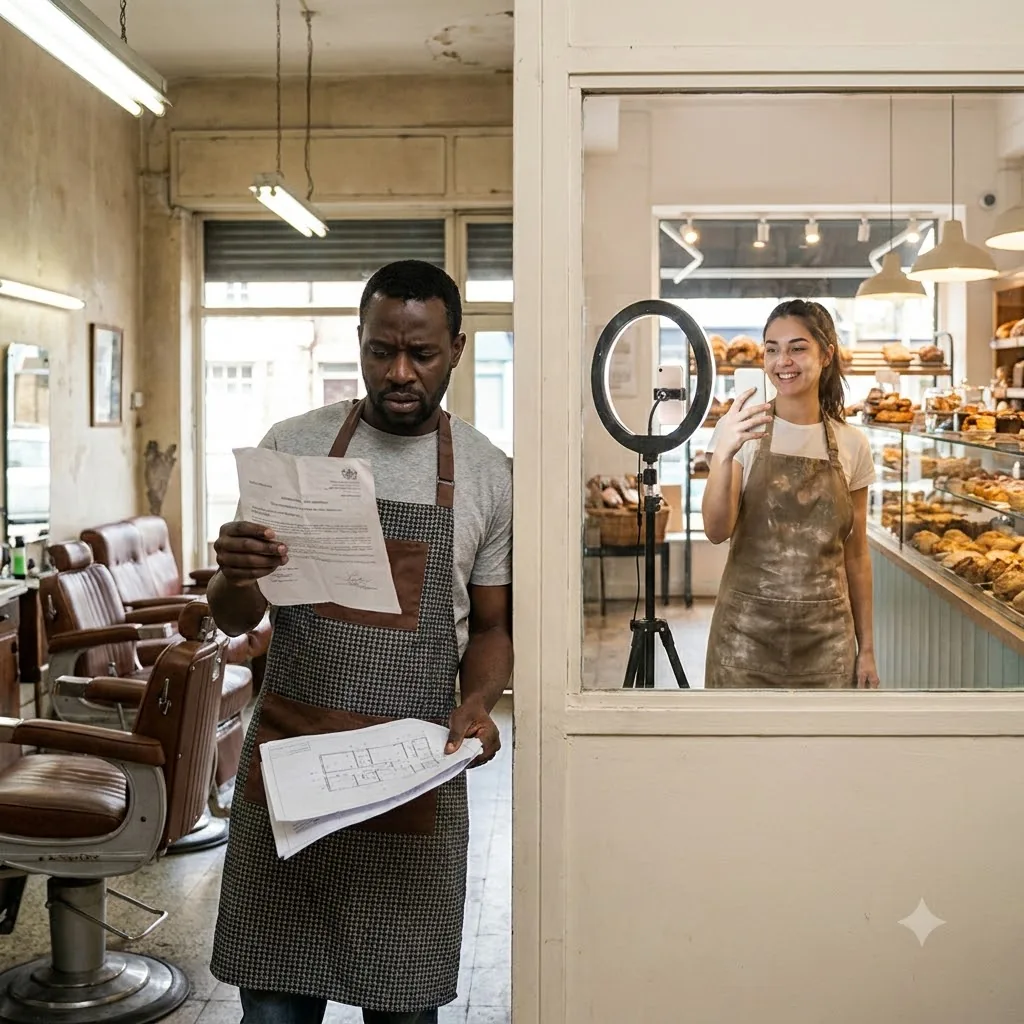
He walked the three blocks back to his shop. The walk was quiet. When he reached the corner, he stopped on the curb. To his left, the windows of Sugared & Spiced were dark, though the ring light inside had been left on by her assistant, casting a ghostly, artificial halo over the pristine display of imported macarons. Tomorrow, the bakery would likely remain closed. Chloe would probably post a tearful apology video, claiming her words were taken out of context, blaming the overwhelming stress of small business ownership. Her followers might forgive her, or she might be forced to rebrand entirely.
To his right, the vintage neon sign of Marcus’s Cuts hummed, casting a warm, buzzing red-and-blue glow over the checkered floor tiles inside. It was the exact same light his grandfather had stood under for decades.
Marcus pulled his keys from his pocket, the brass heavy and cold in his palm. He had stopped the padlocks. He had bought himself time. The legacy lease would hold up against Mr. Vance now that the neighborhood board had publicly retreated from their fraudulent structural claims.
But as he looked back at the pastel facade next door, Marcus understood the true nature of the war he was fighting. It wasn’t just about a single forged environmental report, or a greedy landlord looking for a buyout. It was against an entire ecosystem of weaponized politeness. It was against a community that would smile in his face, compliment his shop’s “rustic vibe,” and then quietly collude to legislate his existence out of the zip code the moment his grandfather’s friends made their artisanal customers mildly uncomfortable.
Marcus unlocked the heavy glass door of the barbershop and stepped inside. The air smelled of talcum powder, barbicide, and old leather. He didn’t reach for the overhead light switch. He just stood in the dark, listening to the steady, enduring hum of the neon sign, bracing himself for the long, relentless fight to keep his grandfather’s doors open tomorrow, and every tomorrow after.