Story code: ST-000486
Part 3: The Ledger
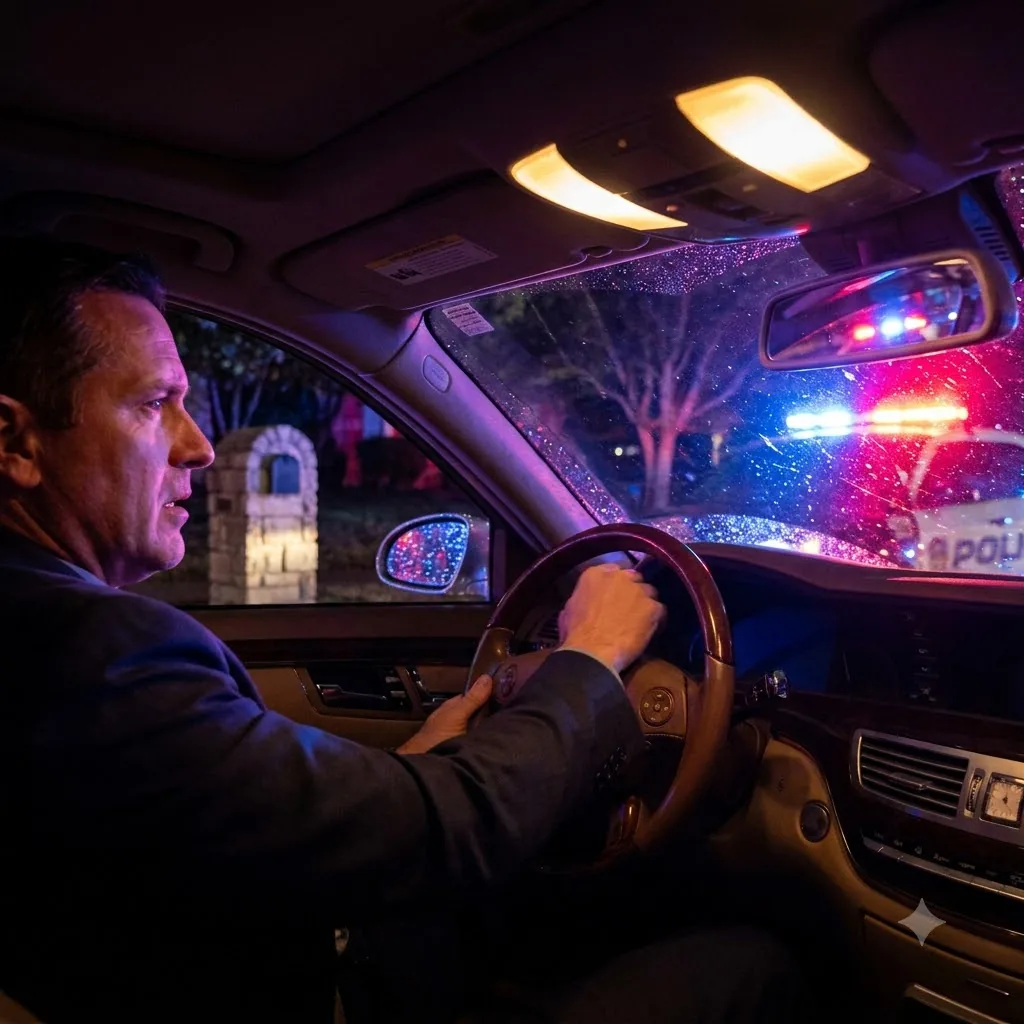
“I am going to move my right hand down to my hip,” Marcus said. His voice sounded thin in the freezing air, stripped of the deep, resonant confidence he used in boardrooms and negotiations. It was the careful, fragile tone of a man holding his own life by a single, frayed thread. “I am going to press the release button.”
“Two fingers only,” the officer barked over the low, steady hum of the idling cruiser. “Index and thumb. Keep the rest of your hand open and visible. You do not reach into any pockets. You do not touch the console.”
“Understood.”
Marcus slowly uncurled his right hand from the steering wheel. The tactical flashlight remained pinned to his face, casting a blinding white glare that threw the lower half of the cabin into impenetrable shadow. Lowering his hand into that dark void went against every survival instinct he possessed. He swallowed hard, keeping his eyes locked forward on the dashboard, and began to move his arm.
He dragged his fingertips lightly against the fabric of his own coat, making sure the officer could track the movement. Down his chest, over his ribs, tracing the diagonal strap of the seatbelt until he felt the hard plastic housing of the buckle at his hip. He extended his index finger and thumb, just as instructed, and pressed the red button.
The metal tongue clicked free with a sharp, mechanical snap. The belt retracted violently, sliding up his chest and thudding against the B-pillar. Marcus instantly snapped both hands back up to the ten and two positions on the steering wheel, his chest heaving as he released a breath he hadn’t realized he was holding.
“Use your left hand to open the door from the outside,” the officer commanded, the heavy boots shifting slightly on the concrete. “Step out of the vehicle and face away from me.”
Marcus stared out the windshield at the dark, silent expanse of Oakbridge Court. He looked at the sprawling Tudor home that he owned. He looked at the manicured lawn separating his property from David Thorne’s estate. He pictured David, safely locked inside his warm house behind a heavy oak door, having proudly done his civic duty by calling the police on a stranger in the driveway.
He pictured himself stepping out of the car, being pushed against the freezing metal of his own sedan, and having cold steel cuffs ratcheted onto his wrists for the entire neighborhood to see when the sun came up.
A strange, glacial calm suddenly washed over Marcus. The suffocating terror that had gripped his throat since the emergency lights first flared in his rearview mirror began to evaporate. It was replaced by a cold, furious clarity. He wasn’t trapped on a dark, lawless highway. He was sitting on his own property, being held at gunpoint because a neighbor didn’t bother to recognize him.
More than that, the clarity brought a sudden, tactical realization.
David hadn’t called 911. The neighborhood watch didn’t use the standard city dispatch. They used the Oakbridge Court private emergency line-a dedicated routing service that bypassed the central precinct and connected directly to the dedicated subdivision patrol.
The polite, terrified compliance fell away.
“I am not stepping out of this vehicle,” Marcus said.
The words hung in the freezing air, crisp and absolute.
“Excuse me?” The officer’s voice dropped an octave. The tactical flashlight dipped a fraction of an inch as the man leaned closer to the open window. The leather of his duty belt creaked menacingly. “Sir, I am giving you a lawful order to exit the-”
“My phone is in the center cup holder,” Marcus interrupted. His voice had completely transformed. It was no longer the deferential tone of a suspect. It was the sharp, unyielding command of an executive taking control of a hostile room. “I am going to pick it up. I am going to unlock it. And I am going to show you exactly who I am.”
“Do not reach for that center console!” the officer yelled, his left hand raising the flashlight like a weapon while his right hand gripped the sidearm tighter. “Keep your hands on the wheel!”
“You aren’t responding to a city dispatch call,” Marcus stated, raising his voice to cut through the officer’s aggression. “David Thorne called the Oakbridge neighborhood line. That line routes directly to the off-duty city detail hired to sit at the subdivision entrance. That’s you.”
The officer hesitated. The sudden, fearless certainty in Marcus’s voice jammed the man’s mental script. Prowlers casing driveways at midnight did not talk about the internal routing protocols of the neighborhood’s private security line.
Marcus didn’t wait for permission. He took his right hand off the steering wheel and reached down to the center console.
“Hey!” the officer barked, stepping back, bracing his stance.
Marcus wrapped his fingers around the sleek metal chassis of his smartphone and pulled it up into the blinding beam of the flashlight. “It’s a phone,” Marcus said dryly, keeping his movements deliberate but utterly devoid of fear.
Using his thumb, he woke the screen. He bypassed the lock screen and opened his secure email client. He swiped past his unread messages, navigating purely by muscle memory, and tapped on a PDF attachment he had reviewed just four hours earlier from the property management company.
He rotated the phone outward, extending his arm toward the open window. He didn’t hand the device over. Instead, he pressed the bright, glowing screen against the glass of his window, holding it perfectly steady inches from the officer’s face.
“What is this?” the officer demanded, though his eyes instinctively flicked down to the illuminated screen.
“Read the header,” Marcus commanded.
The officer squinted against the backlight. “Oakbridge Court Homeowners Association. Monthly Treasury Ledger. Sir, I don’t care about your-”
“Keep reading,” Marcus cut him off sharply. “Scroll your eyes down to the line item under ‘Security and Patrol.’ Do you see the invoice from the local precinct for the off-duty overnight detail? The one that pays for you to sit in a cruiser and keep this street quiet?”
The officer’s silence was sudden and heavy. The flashlight beam wavered slightly, drifting an inch off Marcus’s face before snapping back.
“Now read the name at the bottom of the document,” Marcus said, his voice dropping into a deadly, quiet register. “Read the name of the HOA Treasury Board Member who digitally signs the authorization for your overtime checks every two weeks.”
The winter wind whipped violently through the open cabin, but Marcus sat perfectly still, holding the screen up in the dark.
The heavy, black-gloved hand resting on the grip of the sidearm slowly loosened. The officer stared at the digital signature on the PDF. He looked at the name glowing brightly in the dark, then slowly lowered the flashlight to look at the plastic driver’s license he was still holding in his left hand.
The names matched perfectly.