Story code: ST-001748
Part 2: The Refusal of the Rods
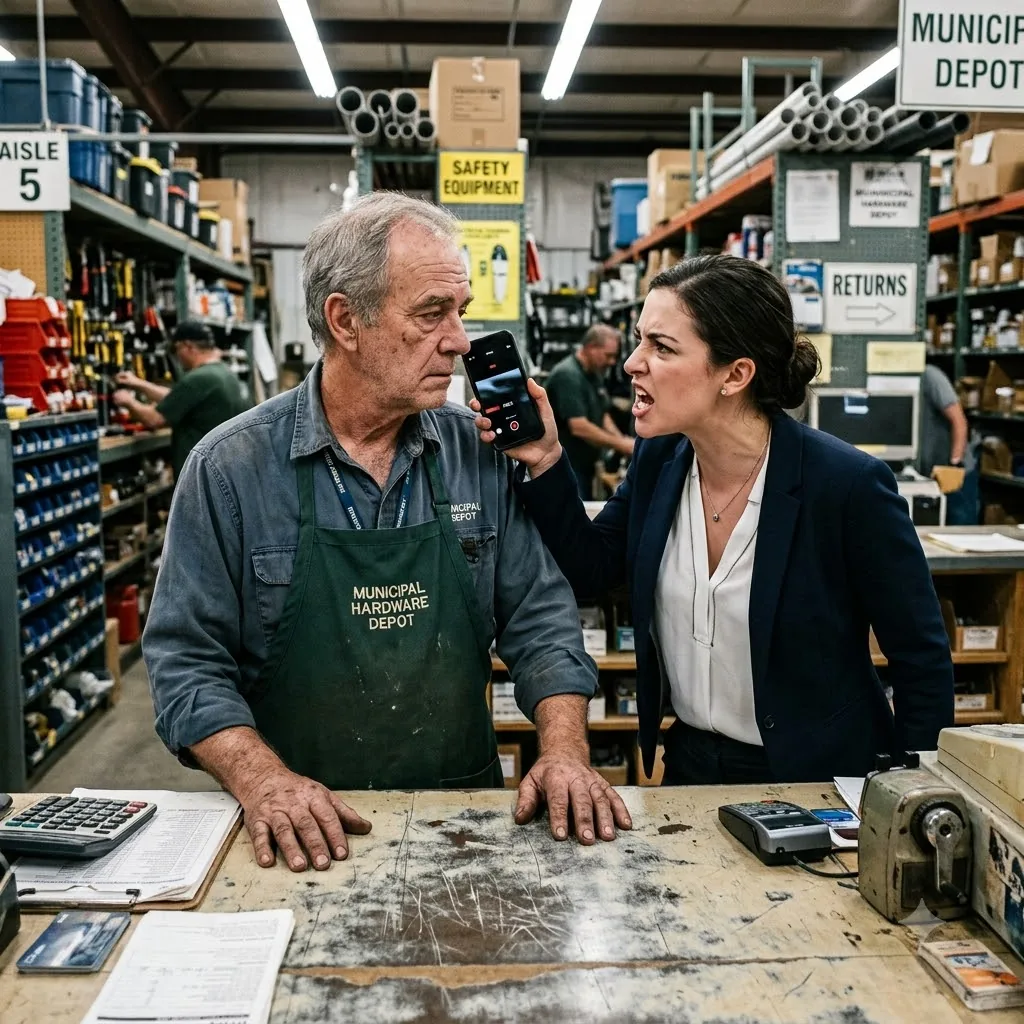
The jagged edge of the triplicate form tore slightly as Chloe yanked it from the printer’s feed tray. The machine let out a final, dying screech before settling back into silence. The heavy scent of warm ink and carbon paper drifted up from the counter, a smell I had known for three decades before a corporate buyout forced my early retirement and stranded me behind this laminate desk.
“Sign the bottom line,” I said, sliding a chewed plastic pen across the scratched surface. “Press hard. It is a carbon copy. I need your signature on all three layers.”
Chloe held the form up to her phone’s camera, making sure the bright fluorescent lights caught the bold red ‘LIABILITY WAIVER’ printed at the top.
“Look at this, guys,” she narrated to her growing audience, her voice dripping with triumphant sarcasm. “The beast of corporate bureaucracy has been slain. All it took was a little public accountability to remind these minimum-wage gatekeepers who actually pays their salaries.”
She scribbled her signature with a violent flourish, not even bothering to read the dense paragraphs of legal and technical warnings beneath her name. She tossed the pen aside; it clattered to the floor and rolled under a display of impact drivers.
I calmly retrieved the paperwork, my thick fingers separating the white, pink, and yellow sheets. I slid the pink customer copy toward her.
“Before you take delivery of the generators,” I said, keeping my voice painfully even, “you are required to purchase the auxiliary earth-grounding array. Specifically, the copper-clad steel rods, item number 44-B. Your primary lines are running directly through the coastal water table. Saltwater intrusion drastically lowers soil resistivity. Without physical grounding rods, standard breakers will not trip during a fault.”
Chloe let out a long, theatrical sigh, pointing the camera lens right between my eyes. “And here comes the upsell. They lose the battle, so they try to squeeze you for accessories.”
“It is not an accessory,” I replied, my lower back throbbing a sharp reminder of my age as I shifted my weight. “It is a physical requirement of the electrical grid. Three-phase power does not care about your resort’s design. If a fault occurs in wet, salty soil without a dedicated path to the earth, the ground itself becomes a live conductor.”
“Chloe, what is the hold-up?”
A young man strode down the aisle, his boots spotless and his designer hardhat tilted back at a jaunty angle. It was Julian, her lead architectural manager. He wore a cashmere sweater draped over his shoulders despite the stifling heat of the depot.
“The local talent is trying to force us to buy dinosaur grounding rods,” Chloe scoffed, turning the camera to frame Julian’s amused smirk. “Tell the chat what you told me about our grid, Jules.”
Julian leaned against the Pro Desk, looking at me with the polite, condescending patience of a kindergarten teacher. “We don’t need manual earth rods, my friend. Our eco-resort utilizes a proprietary smart-grid interface. The system self-regulates phase imbalances wirelessly. We’re using aesthetic integration, not driving ugly copper spikes into our pristine beachfront.”
I stared at him. A smart-grid interface regulated data and power flow. It could not rewrite the laws of physics. It could not stop a catastrophic dielectric breakdown. When a high-voltage surge hit that saltwater soil, their expensive “wireless interface” would instantly melt into a hunk of useless plastic, leaving thousands of amps desperately searching for a way out.
“A software interface cannot ground a physical fault current,” I stated flatly.
“Print the refusal form, grandpa,” Chloe interrupted, tapping her suede loafer impatiently. “I’m not letting you pad your daily sales quota with outdated junk. We decline. Print it.”
My jaw tightened. The medical bills sitting on my kitchen table flashed in my mind-the red ink, the threatening notices, the absolute necessity of my Friday paycheck. If I pushed back harder, they would escalate. If I complied, I was handing them a loaded weapon.
I turned back to the keyboard. I pressed the override sequence a second time. The printer shrieked again, producing a Secondary Equipment Refusal addendum. I slid it across the counter.
“Sign here,” I said. “This explicitly states you are refusing the recommended safety hardware against industrial advice, and assuming all fault liability.”
Julian laughed, signing the paper himself before Chloe could even reach for it. “Gladly. Welcome to the twenty-first century, old man.”
Suddenly, the store’s public address system crackled. *”Tyler to the manager’s office. Line one. Tyler, line one.”*
Over the top of the caulking display, I saw Tyler, my twenty-three-year-old manager, emerge. He looked pale, a sheen of terrified sweat coating his forehead. He held his walkie-talkie with a trembling hand, staring at Chloe’s glowing phone screen like it was a live grenade. He rushed over to the Pro Desk, completely ignoring the customers.
“Frank,” Tyler stammered, his voice cracking. “Corporate… the regional director is on line one. Her livestream just hit sixty thousand viewers. They’re tagging the corporate account, calling for a boycott because of… because of how you’re treating her.”
I looked at Tyler. “I am following the liability protocol.”
“I don’t care!” Tyler hissed, panicked. “Corporate says you’re suspended. Immediately. Unpaid, pending a full HR review on Monday. Take off the apron, Frank. You need to clock out and leave the floor right now.”
The words hit me like a physical blow. Suspended. Unpaid. The fragile math I had done at my kitchen table, balancing my wife’s prescription costs against my hourly wage, instantly crumbled. The heavy brass calipers in my pocket felt like a lead weight pulling me down.
Chloe lowered her phone, a vicious, satisfied smile spreading across her face. “Looks like you finally learned how the real world works. Jules, get the flatbeds to the loading dock. I want those generators on site by noon for the soft-opening test tonight.”
I slowly unhooked my orange apron, folding it over the counter. I pulled the folded yellow carbon copies of the waivers from the desk and slipped them into my jeans pocket. I had lost my job, my insurance, and my pride. But as I walked out toward the suffocating heat of the parking lot, I knew one undeniable fact: tonight, when they flipped the switch on that ungrounded coastal grid, thousands of volts of electricity were going to show them how the real world actually worked.