Story code: ST-000036
Part 4: The Glass Elevator
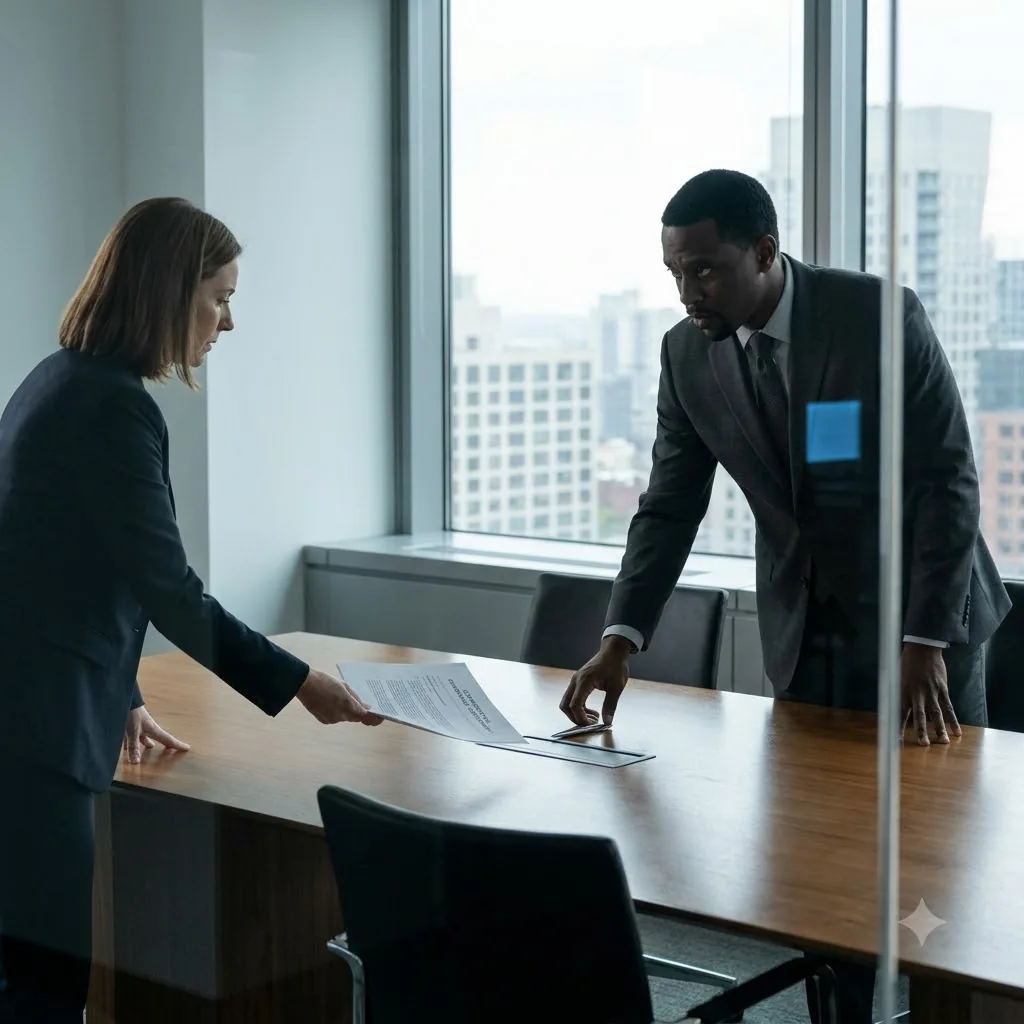
Chloe sat frozen in her ergonomic chair, staring at the bolded words on the toxicology report as if the paper itself had caught fire. Outside her soundproof walls, the red and blue emergency strobes painted the swirling gray dust of the collapsed warehouse in frantic, rhythmic bursts. Inside the office, the silence had grown so dense it felt difficult to breathe. Marcus watched her, feeling the last traces of his enforced corporate deference evaporate into the sterile, climate-controlled air.
Chloe’s mouth opened and closed, but no sound came out. She reached a hand toward the center of the desk, perhaps to push the paper back, perhaps to grasp the edge of the mahogany to ground herself. Instead, her trembling fingers caught the handle of a cold, half-forgotten ceramic coffee mug sitting near her keyboard. The movement was clumsy, a sudden, jagged twitch entirely devoid of her practiced elegance. The mug tipped over with a dull thud.
Cold, dark coffee surged across the polished mahogany, an ugly brown tide rushing directly toward the *Cultural Fit Warning* and Elena’s toxicology report.
Marcus moved with calm, heavy efficiency. He reached out and snatched the thick stock paper of the medical examiner’s report just before the coffee reached it. He didn’t bother saving the disciplinary warning. The dark liquid soaked right into the stark black ink of the corporate memo, blurring Chloe’s signature line into a muddy, illegible smear.
Chloe gasped, jumping back from her chair so quickly the casters squeaked against the plastic floor mat. The coffee dripped steadily off the edge of the desk, splashing onto her pristine beige pumps. She grabbed a handful of dry tissues from a decorative box, dabbing frantically at the ruin on her desk. Her beige blazer, previously her armor of neutrality, was now speckled with dark brown stains. She looked up at Marcus, her corporate shield entirely shattered, leaving behind only a terrified, inarticulate panic.
Marcus looked at the dripping mahogany, then at the frantic woman trying to mop up a disaster with a thin tissue. There was no victory in it. The vindication he had thought he wanted, the satisfaction of proving the executives wrong about both the shelves and the medical protocols, was just ash in his mouth. He folded the toxicology report, taking care to keep the creases sharp, and slid it back into his breast pocket alongside his silenced phone.
He turned his back on Chloe and walked toward the door.
When he pushed the heavy glass panel open, the pristine bubble of the HR suite popped. The sterile executive hallway outside was instantly filled with the chaotic noise bleeding up from the lower levels-the distant shriek of sirens, the muffled shouting of panicked executives on their phones, the frantic clicking of dress shoes on marble floors.
Marcus walked slowly down the corridor, heavily alienated from the frenzy around him. Suits brushed past him, their faces pale, shouting into headsets about liability, insurance clauses, and PR spin. None of them looked at Marcus. None of them looked down at the warehouse floor to see the workers digging through the twisted steel of Sector 4. They were entirely focused on the collapse of their spreadsheets, completely disconnected from the blood on the concrete.
He felt like a ghost drifting through a machine that had just torn itself apart. His job was gone. His salary, the health insurance for his daughter’s asthma, the carefully constructed illusion that playing by their rules would keep his family safe-all of it had been crushed under the weight of the logistics VP’s pallets and Chloe’s collaborative synergies.
He reached the end of the hall and pressed the down button for the executive elevator. The doors slid open with a soft, melodic chime that felt absurdly out of place. He stepped inside the glass-walled car and let the doors close, sealing him back in quiet isolation.
As the elevator began its descent, sliding smoothly down the exterior of the building, the flashing emergency lights washed over his face. Marcus reached into his breast pocket and pulled out his phone. The device was finally still. He unlocked the screen. The notifications from the floor supervisors had stopped updating, their urgent requests for help now tragically obsolete.
Beneath those, buried under the panicked emergency alerts, were the messages he had been locking inside a mental steel box all morning.
They were from his mother. Three texts. *We need to decide by noon, Marcus.* *The director said the cherry wood casket is an extra thousand. I don’t know what to do.* *Please call me. I can’t pick the flowers without you.*
Marcus leaned his shoulder against the cool glass of the elevator wall. The adrenaline was completely gone, leaving only the crushing, gravitational pull of the real world. He watched the flashing red lights reflecting off the screen of his phone, illuminating the cracked glass over his mother’s words. Slowly, with a thumb that felt as heavy as lead, he tapped the reply box and typed: *Cherry wood is fine, Mom. I’ll pay for it. I’m coming home.*
He hit send, letting the quiet hum of the descending elevator carry him away from the wreckage.