Story code: ST-000335
Part 2: The Liquidation Schedule
The massive white letters of the Asset Liquidation Schedule burned against the darkened backdrop of the projector screen. A low, confused murmur rolled through the rows of folding chairs. Oakhaven was a steel town, and its people understood the vocabulary of industrial death. “Liquidation” was not a word associated with community centers or new fabrication plants.
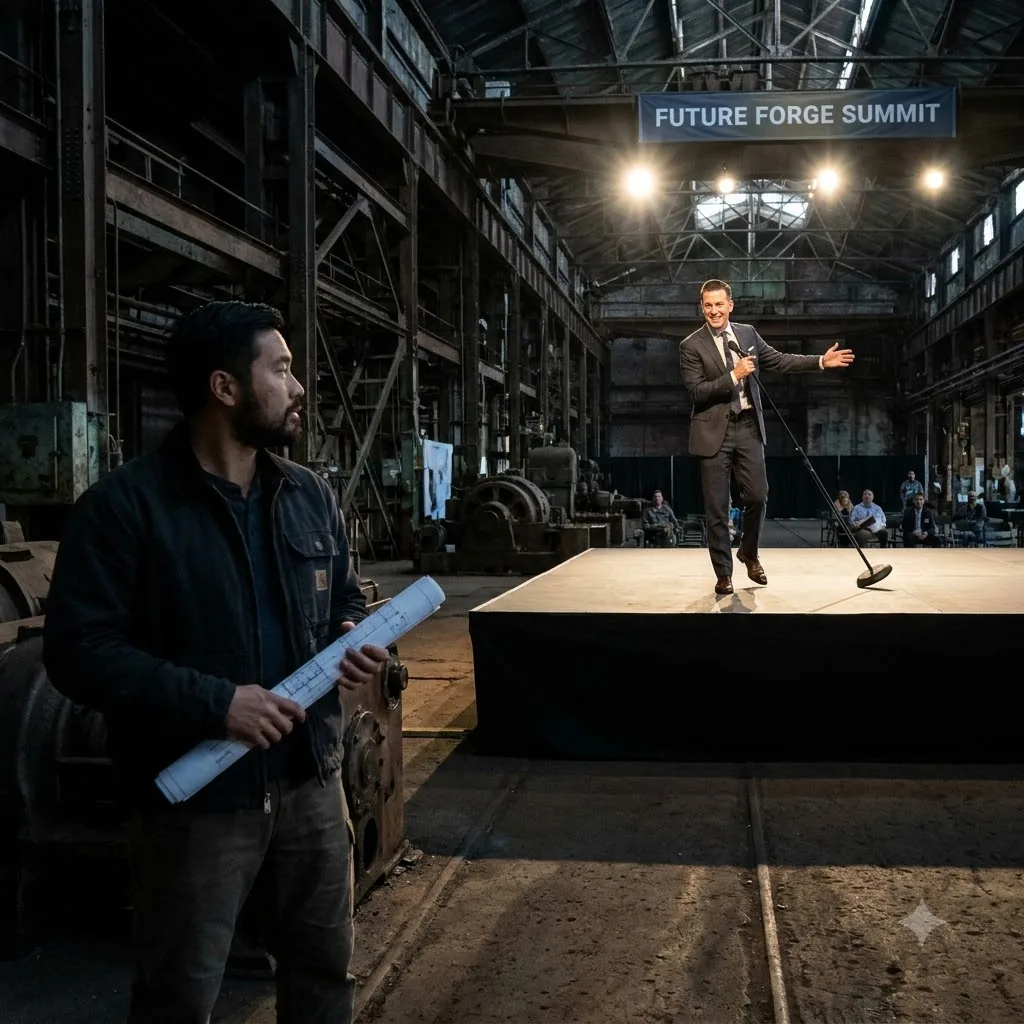
David’s hand hovered an inch from his cardboard blueprint tube on the edge of the stage. His eyes darted from the glaring projection above to the glowing laptop screen resting on the podium shelf. From his angle beside the speaker monitor, he had a clear view of Blake’s presenter notes. The text in the sidebar was bulleted and bolded. *Max yield on raw copper. Immediate auction of heavy machinery. Level site for commercial real estate parcel sale.*
There was no Phase Two. There was no renovation. The regional vice president had not given Blake the Director of Operations role because of a “culture fit.” Blake was here to carve the mill down to the studs and sell the copper wire to the highest bidder. And worse, Blake was using David’s meticulous structural load reports to figure out how fast they could tear the building down without collapsing the roof on the salvage crews.
Blake did not miss a beat. He gripped the edges of the podium, his tailored linen jacket catching the stark stage lights, and projected his voice into the freshly repaired microphone.
“I know what you’re thinking,” Blake said, his tone dripping with practiced, folksy reassurance. “You see the word ‘liquidation’ and you get worried. But in the corporate redevelopment space, this is just a fancy legal term for ‘spring cleaning.'”
A few tentative nods rippled through the middle rows. Blake stepped out from behind the podium, holding the clicker loosely in his right hand.
“Before we can build the state-of-the-art community center you all deserve, we have to liquidate the outdated, hazardous materials currently taking up space in this beautiful historic structure,” Blake continued, gesturing expansively toward the rusted gantry cranes looming in the shadows above them. “That means safely extracting the old wiring, the unsafe iron brackets, and the dormant machinery.”
David stayed frozen by the side steps. He watched Mr. Hendry, his former high school physics teacher, lean forward in the third row. The older man was squinting at the screen, his thick gray eyebrows pulling together in a sharp V. Mr. Hendry had spent thirty years teaching the children of steelworkers how to calculate load-bearing tension. He was currently looking at a diagram that showed the removal of primary support pillars.
“Excuse me,” Mr. Hendry called out, his voice raspy but loud enough to carry without a microphone. He pointed a calloused finger at the projection. “Those red markers on your spring cleaning map. Those are the central I-beams. If you take those out, the western corridor caves in. You can’t put a community center in a collapsed pile of brick.”
The murmurs in the room grew louder. Several shift workers in the back row stood up, crossing their arms. Mrs. Gable looked from Mr. Hendry to the stage, her expression tightening into genuine concern.
Blake’s smile did not falter, but a tight, rigid quality crept into his jawline. He turned toward the side of the stage and extended a hand toward David.
“That is an excellent observation, sir,” Blake said smoothly. “And that exact concern is why we brought Oakhaven’s own engineering prodigy on board to design the extraction grid. David, come on over here. Tell the folks how you handled the math on those support beams.”
The entire room shifted its attention back to David. He felt the blood drain from his face, leaving his skin cold and prickling. His boots felt impossibly heavy against the stage floorboards as he took a step toward the podium. Blake was pulling him into the lie. Blake wanted the hometown boy to validate the teardown map, using the trust David had spent twenty-eight years building with these people to pacify them while the company sold the ground out from under their feet.
David reached the podium. He looked down at the laptop screen. The next slide in the queue was titled *Final Demolition & Land Transfer*. He could see the thumbnail image of the presentation-a flat, empty dirt lot where the mill currently stood.
“David?” Mr. Hendry asked, his voice softening slightly. “Did you sign off on those pillar removals?”
David gripped the edge of the podium. His mind raced through the terms of his employment contract. Section 4, Non-Disclosure. Section 7, Corporate Compliance. If he spoke the truth into the microphone right now, he would be in breach of contract. He would be fired for cause, his stock options would be voided, and the company’s legal department would bury him in litigation fees for damaging a multimillion-dollar liquidation event. He would lose his entire career.
But if he lied, he would be complicit in the destruction of his hometown’s last hope for economic survival.
Blake leaned in close, bringing his mouth inches from David’s ear. He pressed the mute button on the base of the microphone with his thumb.
“You have a very bright future at this company, Dave,” Blake whispered, his voice entirely devoid of the folksy warmth he had used a moment ago. “But if you don’t sell this map right now, I’ll have security escort you off the property, I’ll terminate you for insubordination, and I’ll make sure you never engineer so much as a garden shed in this state again. Are we clear?”
David swallowed hard. The metallic scent of the mill’s rusted iron suddenly felt suffocating. He looked out at Mrs. Gable, who was clutching her purse in her lap, waiting for him to reassure her. He looked at Mr. Hendry, whose eyes were locked on David with an unwavering, demanding trust.
Blake unmuted the microphone and took a deliberate step back, leaving David alone at center stage. He held out the presentation clicker, pressing the smooth plastic into David’s clammy palm.
“Go ahead, David,” Blake said, his voice booming through the overhead speakers. “Walk them through the next phase of your timeline.”