Story code: ST-001258
Part 1: The Silent Protocol
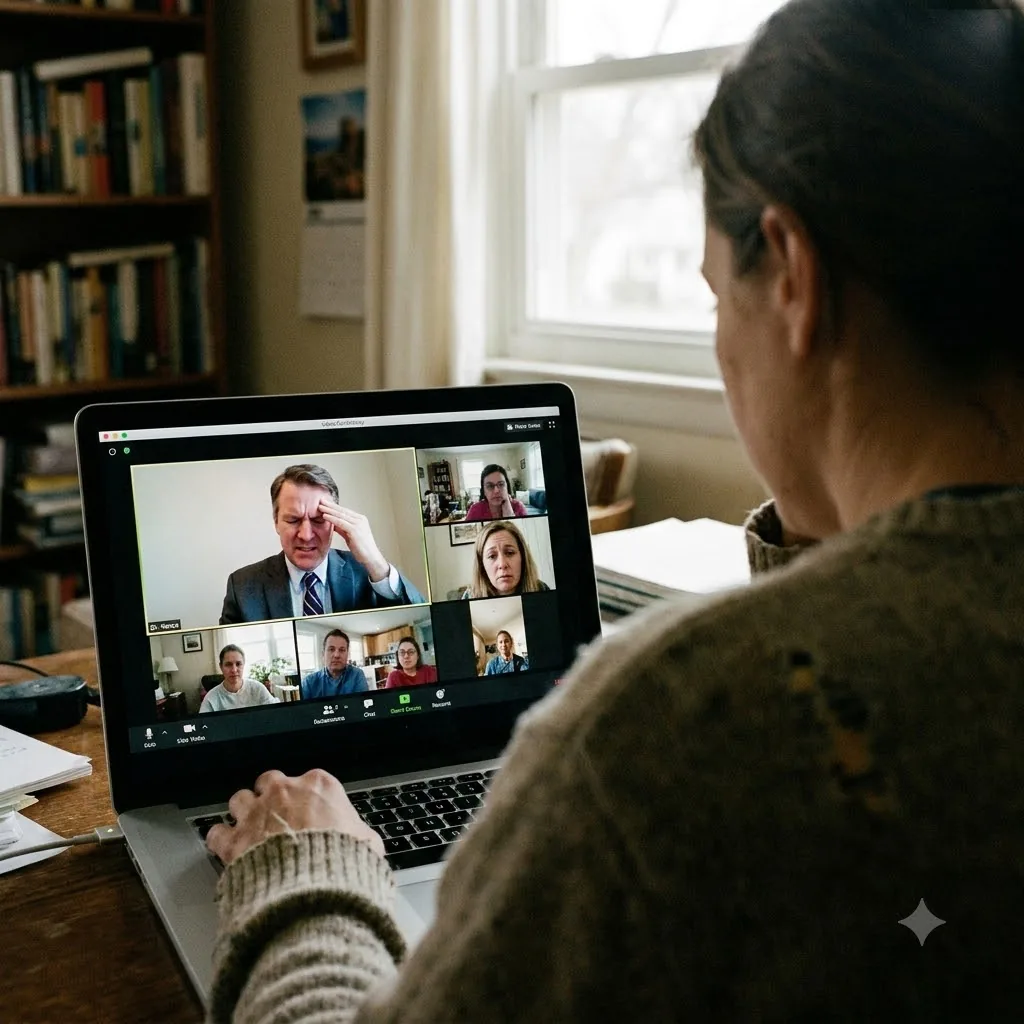
During our mandatory remote learning staff meeting, I watched Dr. Marcus Vance use his administrative privilege to mute veteran chemistry teacher Clara Diaz the moment she pointed out a fatal data-loss bug in the new online grading portal. As the district’s assistant IT coordinator, Sarah Miller-though everyone in the admin office calls me Mara-I was monitoring the live webcam recording log and saw the precise moment Dr. Vance decided to humiliate her to cover his own ignorance. He leaned close to his camera, adjusted his designer glasses, and announced to all eighty participants that Clara’s issues were simply a failure to understand the portal’s advanced architecture.
“We are operating on a high-throughput network, Clara,” Dr. Vance said, his voice carrying the smooth, practiced cadence he used for school board presentations. “If your local machine cannot handle the dynamic latency integration protocol, your grades will naturally drop from the queue. It is a user-side configuration error, not a platform failure. I suggest reviewing the basic IT handbook before wasting department time on a recorded call.”
On my second monitor, which displayed the live admin dashboard, I watched Dr. Vance click the mute button next to Clara’s name. Her video tile showed her taking off her reading glasses. She did not look angry; she simply reached for a microfiber cloth, wiped her lenses, and put them back on. Behind her, stacked chemistry textbooks lined the shelves of her empty classroom.
I checked the system logs. The vendor documentation for our portal contained no mention of a “dynamic latency integration protocol.” It was a completely fabricated term, a string of technical jargon thrown out to silence a teacher who had spent thirty years in the classroom and was not easily intimidated by administrative titles.
I watched the other teacher tiles on my screen. Several of them had their cameras off, but those who remained visible sat in silence, their eyes darting to their keyboards. No one spoke. The school district’s power dynamic was clear: challenge Dr. Vance, and your next evaluation would reflect a sudden lack of professional cooperation.
Dr. Vance unmuted her, his expression settled into a patronizing smile. “Now, if we can move on to the curriculum formatting-”
“Dr. Vance,” Clara interrupted. Her voice was quiet, but it carried clearly through the digital audio stream. “Could you explain exactly how we, as teachers, can manually adjust our local portal settings to accommodate this dynamic latency integration protocol? Since you oversaw the implementation, a quick live demonstration on your shared screen would save us all hours of lost data.”
Dr. Vance’s smile stiffened, but only for a fraction of a second. He leaned back in his leather chair, gesturing with his pen. “It’s a background handshake, Clara. Quite complex. It involves manually routing the browser’s local storage partition through our active directory node to bypass the standard security firewalls. I’m happy to explain it, but it requires a level of network access that classroom teachers simply do not possess.”
During our mandatory remote learning staff meeting, I watched Dr. Marcus Vance use his administrative privilege to mute veteran chemistry teacher Clara Diaz the moment she pointed out a fatal data-loss bug in the new online grading portal. As the district’s assistant IT coordinator, Sarah Miller-though everyone in the admin office calls me Mara-I was monitoring the live webcam recording log and saw the precise moment Dr. Vance decided to humiliate her to cover his own ignorance. He leaned close to his camera, adjusted his designer glasses, and announced to all eighty participants that Clara’s issues were simply a failure to understand the portal’s advanced architecture.
“We are operating on a high-throughput network, Clara,” Dr. Vance said, his voice carrying the smooth, practiced cadence he used for school board presentations. “If your local machine cannot handle the dynamic latency integration protocol, your grades will naturally drop from the queue. It is a user-side configuration error, not a platform failure. I suggest reviewing the basic IT handbook before wasting department time on a recorded call.”
On my second monitor, which displayed the live admin dashboard, I watched Dr. Vance click the mute button next to Clara’s name. Her video tile showed her taking off her reading glasses. She did not look angry; she simply reached for a microfiber cloth, wiped her lenses, and put them back on. Behind her, stacked chemistry textbooks lined the shelves of her empty classroom.
I checked the system logs. The vendor documentation for our portal contained no mention of a “dynamic latency integration protocol.” It was a completely fabricated term, a string of technical jargon thrown out to silence a teacher who had spent thirty years in the classroom and was not easily intimidated by administrative titles.
I watched the other teacher tiles on my screen. Several of them had their cameras off, but those who remained visible sat in silence, their eyes darting to their keyboards. No one spoke. The school district’s power dynamic was clear: challenge Dr. Vance, and your next evaluation would reflect a sudden lack of professional cooperation.
Dr. Vance unmuted her, his expression settled into a patronizing smile. “Now, if we can move on to the curriculum formatting-”
“Dr. Vance,” Clara interrupted. Her voice was quiet, but it carried clearly through the digital audio stream. “Could you explain exactly how we, as teachers, can manually adjust our local portal settings to accommodate this dynamic latency integration protocol? Since you oversaw the implementation, a quick live demonstration on your shared screen would save us all hours of lost data.”
Dr. Vance’s smile stiffened, but only for a fraction of a second. He leaned back in his leather chair, gesturing with his pen. “It’s a background handshake, Clara. Quite complex. It involves manually routing the browser’s local storage partition through our active directory node to bypass the standard security firewalls. I’m happy to explain it, but it requires a level of network access that classroom teachers simply do not possess.”