Story code: ST-000156
Part 4: Digital Residue
Miller wrenched his arm out of Elias’s grip. Mateo watched the younger agent’s face contort with a mix of furious indignation and absolute disgust. Miller tapped the communication device at his collar, barking a coded extraction order that Mateo could not decipher, and gestured sharply to the heavily armored medics. Moving with terrifying, mechanical efficiency, the team collapsed the stretcher, loaded Hector’s thrashing, plastic-wrapped body into the back of an unmarked transport van, and slammed the heavy metal doors.
Hector’s wife, still trembling on the concrete behind Mateo, let out a gut-wrenching wail as the vehicle’s tires squealed against the plaza pavement. She scrambled past Mateo, the shoulder of her floral blouse torn from Miller’s grip, and chased the fading sirens toward the busy avenue. She screamed Hector’s name, her voice cracking over the thick exhaust fumes, until she disappeared around the corner of a shuttered produce stand, completely abandoned by the tactical team.
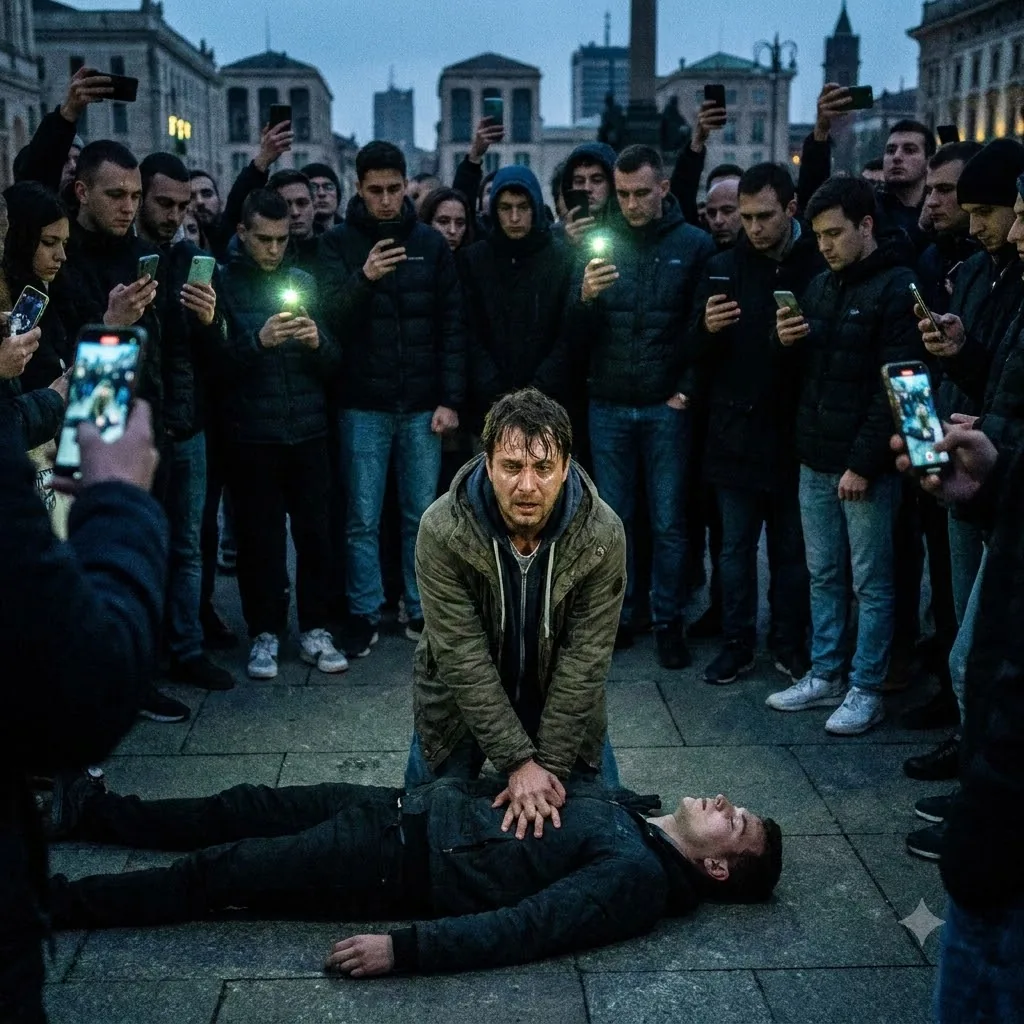
Mateo turned back to the center of the market, his chest heaving, his knees badly bruised and stinging from the dirty stones. The adrenaline that had fueled his desperate tackle was rapidly evaporating, leaving behind a hollow, aching exhaustion. He looked up, expecting the wall of spectators to finally step forward. He expected hands to offer help, voices to ask if he was alright, or even for someone to offer a bottle of water after the brutal physical trauma of the last ten minutes.
Instead, the glowing barricade of rectangles simply lowered in unison.
The silence that followed wasn’t shocked, and it certainly wasn’t respectful. It was purely industrious. The teenager with the skateboard tapped furiously at his screen, his thumbs a blur of motion as he walked away without a single backward glance. The man in the business casual button-down who had been narrating the ordeal immediately turned his back, speaking rapidly into his phone’s microphone to summarize the federal cover-up he had just witnessed, already spinning Hector’s near-death experience into digital currency.
Within seconds, the claustrophobic circle fractured and dissolved entirely. The onlookers scattered into the market aisles, their heads bowed to their devices, prioritizing the upload speed of their footage over the human wreckage left in the center of the square. They didn’t look at Mateo as he wiped Hector’s cold sweat from his forehead. They didn’t notice the scattered plastic buttons from Hector’s violently torn shirt, or the ripped foil wrapper of the useless AED pads discarded in the dirt. The spectacle was over. The audience was gone.
Only the suited man remained.
Elias stood perfectly still among the trampled baskets of dried peppers and crushed woven blankets. Without the rigid posture of command, the imposing operative suddenly looked exhausted. Deflated. Mateo watched as Elias reached up to his ear and pulled a small, translucent earpiece from his canal. A frantic, tinny voice squawked from the tiny speaker, angrily demanding an immediate situation report.
Elias dropped the earpiece onto the stained concrete and crushed it to powder beneath the heel of his polished leather shoe.
“They’ll come for you,” Mateo said, his voice raspy and dry. He remained on his knees, his muscles refusing to support his weight.
Elias looked down at the shattered plastic of his communications unit. “By midnight, my federal access codes will be revoked,” he said, his voice stripped of its former resonant authority. “By tomorrow morning, I’ll be flagged as a rogue asset in every Division database.” He let out a slow, humorless breath. “You don’t break a biological quarantine protocol in front of sixty civilian cameras and walk away with your pension.”
“Then why did you do it?” Mateo asked, staring at the man’s flat gray eyes. “Why did you stop him from taking her?”
Elias didn’t answer immediately. He looked at the retreating backs of the crowd, the hundreds of glowing screens floating away into the dusk like a swarm of fireflies. “Because containment only works in the dark. Once it becomes a spectacle, the operation is already dead. Miller couldn’t see that. Now, I’m the one who will pay for the exposure.”
Elias adjusted the lapels of his charcoal jacket, brushing a layer of plaza dust from the expensive wool. He didn’t offer Mateo a hand. There was no camaraderie between them, only the shared ruin of the afternoon. Without another word, the former agent turned and walked toward the northern exit of the market, disappearing into the shadows of the vendor tents to begin a life on the run.
Mateo was left completely alone in the sprawling debris. He sat heavily on the ground, pulling his knees to his chest. His arms still throbbed with the dull burn of lactic acid, his hands trembling as he stared down at the speck of dark, dried blood on his palm-Hector’s blood, drawn by the silver needle.
He looked around at the bustling artisan market. For years, Mateo had viewed this plaza as a sanctuary, a vibrant, breathing community of neighbors who protected their own. He had believed they were united by a shared humanity.
But the undeniable truth was laid bare in the empty space around him. When a man had fallen, choking on an unnatural death, the community had not rallied to save him. They had formed a barricade of glass and plastic, transforming a dying neighbor’s agony into performative digital theater. The sanctuary was nothing but an illusion. A vendor a few stalls down turned on a string of overhead lights, the warm yellow glow casting long, lonely shadows over the concrete. People laughed in the distance. The smell of roasting corn drifted back over the square, sickeningly normal. Mateo closed his eyes, the phantom clicks of camera shutters still echoing in his ears, paralyzed by the realization that if he were to collapse right now, they would simply return to film him die.