Story code: ST-001052
Part 4: The Residue
Marcus left the intensive care waiting room in heavy, suffocating silence. He didn’t wait for hospital security, and Mrs. Harding didn’t call them. The horrific revelation in her eyes as the video’s audio played had stripped the hostility from the air, leaving only the sterile hum of the fluorescent lights. Marcus walked out through the sliding glass doors, back into a sweltering afternoon that felt entirely detached from the morning’s trauma.
By the time the weekend arrived, the digital hurricane that had threatened to ruin Marcus’s life simply vanished. The internet’s attention span was aggressively short. For forty-eight hours, his face had been plastered across neighborhood apps and social feeds as a monstrous aggressor. Then, someone ripped the unmuted video from a police bodycam release and posted it in the comments. The narrative violently fractured, lost its clean entertainment value, and the algorithmic swarm moved on to a new target. There were no retractions from the jogger. There was no apology from Mrs. Gable. The neighborhood simply pretended the morning had never happened, averting their eyes when Marcus walked to his mailbox.
Through a link shared on a local community board, Marcus learned the grim medical reality. Dale Harding had survived the myocardial infarction, but the prolonged lack of oxygen during the critical minutes before the paramedics arrived had triggered a severe ischemic stroke. The GoFundMe page, set up by Dale’s sister, detailed the catastrophic brain damage. Dale was permanently wheelchair-bound, unable to speak in full sentences, and required round-the-clock care. His career in eviction compliance was over. He would never carry a brown leather folder up another driveway.
Marcus sat at his kitchen table, staring down at that very folder. The police had never returned for it, and Mrs. Harding had left it forgotten on the waiting room chair. Marcus had brought it home. Inside, beneath the foreclosure notice, was the bank’s internal property appraisal.
Marcus traced his finger over the crisp black grid of the document. The numbers were a sterile, bureaucratic tragedy. The appraiser had completely bypassed the recent sales on Marcus’s own street. Instead, they had pulled comparables from a historically redlined district three miles away, artificially tanking Marcus’s property value by hundreds of thousands of dollars. It instantly shoved his mortgage underwater, triggering the aggressive margin calls and the subsequent foreclosure. It wasn’t a failure of Marcus’s finances; it was a systemic financial hit. The bank had simply used the quiet, invisible violence of biased algorithms to steal his equity. Dale had just been the messenger, a pawn in a rigged game, sent to bleed out on Marcus’s driveway.
And Marcus was still going to lose the house. Exposing the flawed comps would take a legal team he could no longer afford. The bank would just wait a few months and send another courier, someone else with a clipboard and a legally binding threat.
On Tuesday morning, the sun broke hot and glaring over the neighborhood. Marcus opened his garage door. The air was thick with humidity and the distant drone of a lawnmower. He reached for his wide push broom, gripping the worn wooden handle with both hands.
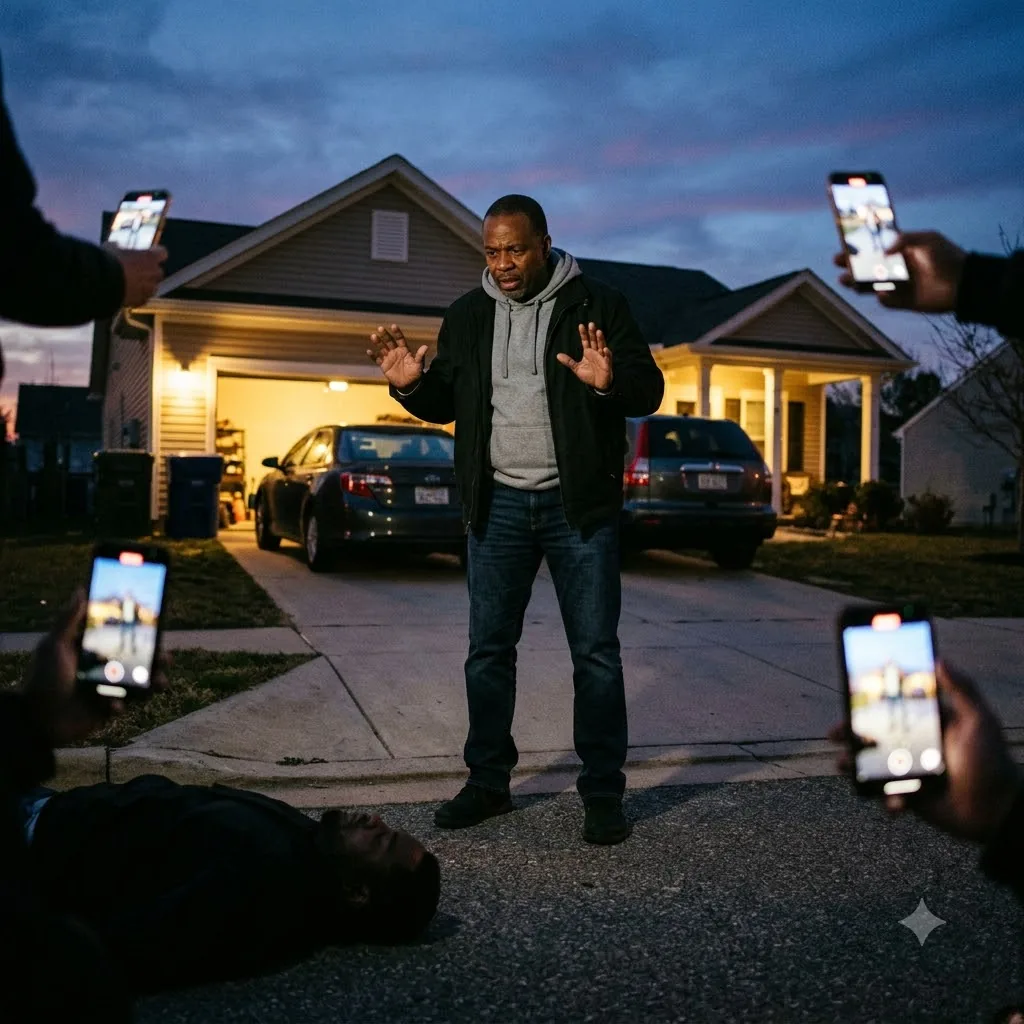
He walked down to the edge of the driveway. The concrete was spotless. There was no physical evidence that a man had nearly died there, no chalk outlines, no lingering medical debris. But Marcus could see the exact coordinates where Dale had collapsed.
The jogger trotted past on the opposite sidewalk, clad in neon green shorts. He kept his head locked perfectly forward, his phone strapped to his bicep, refusing to look at Marcus. A few doors down, the blinds in Mrs. Gable’s front window snapped shut.
Marcus pushed the stiff bristles of the broom over the empty concrete, the rhythmic scratching sound filling the quiet morning. A deep, corrosive shame settled in his chest, heavier than the impending foreclosure. The neighbors had been cowards, hiding behind their screens, but Marcus knew the agonizing truth about himself. He hadn’t acted fast enough.
When Dale first hit the ground, Marcus had frozen. He had let the glowing red recording dots dictate his humanity. For three crucial, irreplaceable minutes, he had calculated his own survival against the optics of a tall Black man touching an unresponsive white man on a suburban driveway. He had waited for permission from the lenses. He had yielded to the police officer’s gun instead of fighting through it.
If he had just dropped to his knees the second Dale clutched his chest, if he had ignored the cameras and started compressions immediately, oxygen would have kept flowing. The stroke might never have happened. Dale might still have his mind.
Marcus dragged the broom backward, sweeping nothing but dust. The neighborhood had moved on, and the internet had forgotten, but Marcus would be forever trapped in that hesitation, sweeping an empty driveway, burdened by the quiet agony of letting a piece of glass and a viral fear stop him from saving a man’s life.