Story code: ST-001015
Part 2: Accelerated Abatement
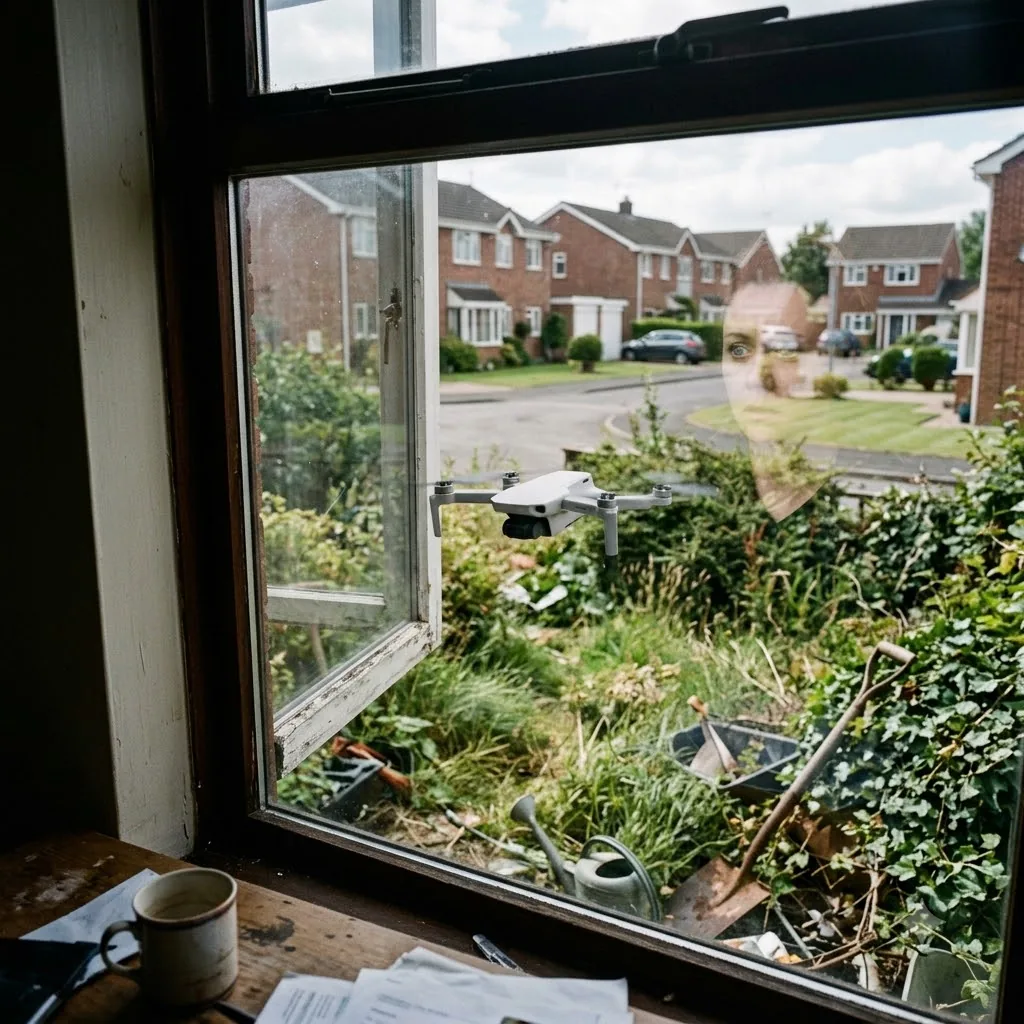
The drone was no longer alone. Behind its irritating, mosquito-like hum came the heavy, guttural rumble of a diesel engine. A white box truck with “Oakridge Community Services” painted on the side rolled down the street and parked abruptly in front of Maya’s mailbox. Its tires crushed the edge of her grandmother’s carefully laid brick border.
Maya gripped the crumpled neon green envelope, her knuckles turning white. Two men in high-visibility vests climbed out of the truck. One reached into the back and pulled out a commercial-grade string trimmer; the other uncoiled a thick yellow hose attached to a chemical tank.
“Hey!” Maya shouted, sprinting down the short walkway. She planted herself directly between the man with the trimmer and the towering stalks of goldenrod. “Turn that off. You are not touching this yard.”
The worker paused, resting the heavy machine against his hip. He didn’t look angry, just deeply tired. “Ma’am, we have a work order. Emergency abatement. We’re supposed to clear the overgrowth and spray the root systems.”
“It’s not overgrowth,” Maya said, her voice trembling with a mixture of rage and panic. “It’s a registered native pollinator habitat, and those trenches are a bioswale. You can’t just spray it.”
“I don’t know what a bioswale is, lady,” the worker sighed, pulling a clipboard from the truck’s passenger seat. “I just know Captain Harrison signed off on a forced compliance order. He said the property owner was unresponsive.”
“Unresponsive? I got the notice three minutes ago!”
The faint hum of an electric motor drifted down the street. Maya looked past the box truck to see a pristine, golf-cart-style utility vehicle gliding down the hill. It came to a silent halt behind the truck. Captain Harrison stepped out. He wore a crisp white polo shirt tucked into khaki shorts, a secondary clipboard tucked precisely under his left arm. He had inherited the position of HOA President from his father-in-law, the original developer of the subdivision, and he treated the inherited role with the unyielding gravity of a wartime commander.
“Is there a problem here, gentlemen?” Harrison asked, his voice projecting easily over the idling diesel engine.
“She won’t step aside, sir,” the worker said, gesturing at Maya.
Harrison adjusted his aviator sunglasses. “Maya. I see you received the citation. I assumed you would be at work, but since you’re here, I suggest you step back and let the contractors do the job you’ve neglected.”
“You have absolutely no right to send a crew onto my property,” Maya said, holding her ground. She felt incredibly small standing on the cracked pavement in her faded t-shirt, but she refused to let her posture falter. “The citation says I have five business days.”
“Read subsection D on the back,” Harrison said smoothly, tapping his own clipboard. “In cases of severe structural hazard or vermin risk, the Association reserves the right to expedite remediation to protect property values. Those trenches you dug are a tripping hazard. And frankly, the whole yard looks like an abandoned lot.”
Maya’s heart hammered against her ribs. He didn’t understand. The trenches weren’t just dirt-they were a desperate, meticulously calculated water management system. Since the city re-graded the street last year, every heavy rain sent runoff flooding directly toward her grandmother’s cracked basement. The goldenrod, the milkweed, the deep swales-they were the only things drinking up the water and diverting it from the foundation. If they filled the trenches and sprayed the roots, the next storm would flood the basement. The resulting mold and structural damage would condemn the house.
“It stops the flooding,” Maya said, trying to keep the desperation out of her voice. “If you flatten this yard, the runoff will destroy my foundation.”
“The Association is not responsible for your foundation, Maya,” Harrison said, his tone dripping with practiced corporate sympathy. “We are responsible for the aesthetic and safety standards of Oakridge. Your grandmother never respected the covenants, either. My father-in-law spent years trying to get her to conform. Now that she’s in a care facility and you’re the primary resident, the leniency is over. If you can’t afford to maintain a property in this neighborhood, perhaps it’s time to sell.”
There it was. The ugly truth laid out in the bright afternoon sun. He didn’t just want the yard cut; he wanted her out.
Maya took a step forward, blocking the path of the chemical hose. “I’m not selling. And I’m not moving.”
Harrison’s polite smile vanished. He turned to the two contractors. “Pack up your equipment, boys. Bill for the full hour, plus the emergency call-out fee. Add it to her ledger.”
“What? No, they haven’t done anything!” Maya protested.
“They deployed to a hostile site,” Harrison said coldly. He pulled a red pen from his pocket, scribbled on a pink slip of paper, and handed it to the worker, who awkwardly passed it to Maya. “Since you are actively obstructing an emergency remediation, your fine is now one thousand dollars. And your grace period is officially revoked.”
Maya stared at the pink slip. The black ink numbers blurred together. One thousand dollars. She only had fourteen.
“I will have the Association’s contracted earthmover here tomorrow morning at eight a.m. with a police escort,” Harrison said, climbing back into his utility vehicle. “If you interfere again, we will file a lien on the house by noon. Have a pleasant afternoon, Maya.”
The electric cart whined as it accelerated back up the hill. The box truck rumbled to life, leaving Maya standing alone on the sidewalk, suffocating in a cloud of diesel exhaust. She looked down at the deep, dark soil of her trenches, then up at the heavy, gray storm clouds gathering on the western horizon.
The heavy machinery would be here at dawn, and Maya had exactly fourteen hours to figure out how to stop a bulldozer with fourteen dollars and thirty cents.