Story code: ST-000290
Part 4: The Weight of Ruin
The green checkmark bloomed on the monitor one last time. *Global Queue: 0.*
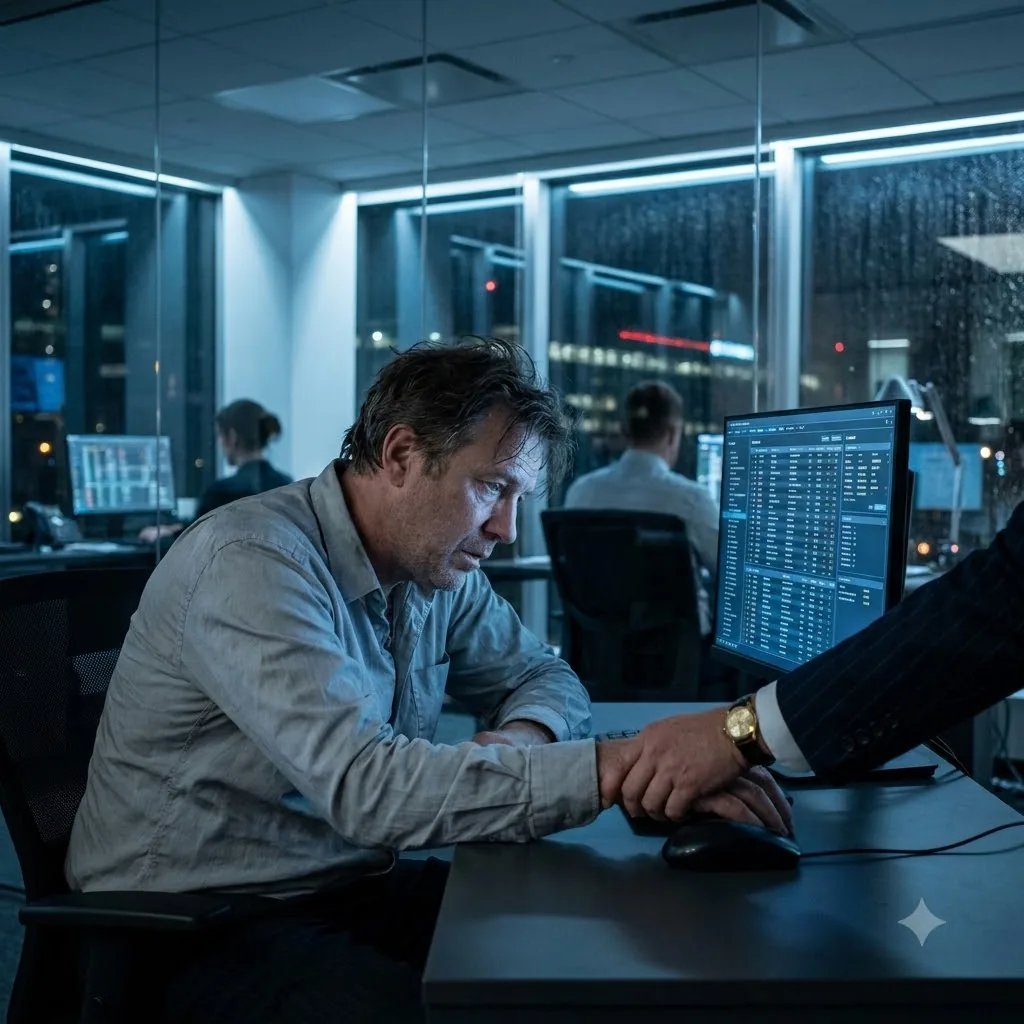
The server banks hummed, completely indifferent to the financial slaughter that had just occurred. Thorne stood frozen, his mouth slightly open, the reflection of the plunging yield counter dancing in his wide eyes. The boardroom video feed was a cacophony of overlapping screams, executives demanding answers from an empty desk, their voices crackling through Arthur’s headset like static.
“You,” Thorne whispered, the word strangled in his throat. He slowly turned to Arthur, his expensive wool suit suddenly looking like a poorly fitted costume. “Do you have any idea what you’ve just done?”
“I aligned the sentiment,” Arthur said, his voice surprisingly steady. His hands, however, shook as he pulled them away from the keyboard. “The machine wanted to heal together.”
Before Thorne could move, the bruised purple diagnostic screen flickered and died. A stark, crimson dialogue box snapped into the center of the monitor.
*Employee 402-Arthur. Severe Contractual Deviation Detected. Exit Contract Breached.*
The green severance progress bar, which had dictated Arthur’s life for the last thirty days, dissolved into digital ash. A new line of text appeared in its place.
*Severance Package: Voided. Extended Health Benefits: Revoked. Network Access: Terminated.*
Arthur didn’t wait for Thorne to call security. He took off his headset, gently setting it down next to his lukewarm coffee, and stood up. Thorne didn’t try to stop him. The Director was already lunging over the desk, frantically hammering the locked keyboard, begging the system to undo the unbreakable federal injunctions Arthur had hard-coded into its core.
Arthur walked away from the cubicle. The oppressive silence of the transitional floor was breaking apart. Across the open-plan office, phones were beginning to ring in a chaotic, unsynchronized chorus. The automated debt-collection systems were likely crashing, while simultaneously, thousands of indentured workers in the warehouses and data centers were opening their personal dashboards to find zero balances.
As Arthur passed a row of low-level analysts, he saw a junior copywriter staring at her monitor. Her hands covered her mouth, and tears were spilling down her cheeks as she read her own emancipation notice. She had a five-hundred-dollar federal relief credit in her account. Arthur kept his head down and kept walking.
He reached the security turnstiles at the main exit. He tapped his plastic badge against the scanner. The light flashed a harsh red. *Access Denied.* He wasn’t an employee anymore. He didn’t exist in the OmniCore architecture. He pushed his weight against the heavy glass barrier, following closely behind a panicked middle manager who had just badge-swiped his way out, sprinting toward the parking lot while shouting into a cell phone.
Out in the evening air, the chill hit Arthur’s face. He walked to his worn sedan, his legs feeling like they were made of lead. He climbed into the driver’s seat and shut the door, sealing himself in the quiet confines of the car.
The adrenaline that had carried him through the override was evaporating, leaving behind a cold, hollow dread. Arthur pulled his phone from his pocket and opened his personal banking app. The screen loaded, displaying a bleak, undeniable reality.
*Checking Balance: -$37.50.*
The automated delay fees had successfully extracted his last remaining dollars before the system crashed. He switched tabs to his mortgage portal. The bold, black numbers stared back at him. *Next Payment: $3,150.00. Due in four days.*
He had no severance. He had no savings. He had no health insurance. He was forty-two years old, blacklisted for life in the corporate communications sector, and staring down the barrel of an imminent foreclosure. The panic was immediate and intensely physical. It clamped down on his lungs, a suffocating, terrifying weight. He rested his forehead against the cold leather of the steering wheel, his breathing shallow and rapid. How was he going to buy groceries? Where was he going to live? The OmniCore system was broken, but the rest of the world’s machinery was still churning, and it did not forgive empty bank accounts.
He forced himself to sit up. He turned the key, and the four-cylinder engine rumbled to life.
In his rearview mirror, the OmniCore campus looked like a disturbed anthill. Men and women in dark suits were sprinting across the manicured lawns. Emergency strobe lights had begun flashing inside the glass atrium of the executive wing, painting the panicked faces of the corporate elite in alternating shades of red and white. The closed-loop economy had shattered, and the architects of the artificial friction were bleeding out in real-time.
Arthur put the car in drive and merged onto the highway, leaving the sprawling corporate park behind. The sun was dipping below the horizon, casting long, dark shadows across the asphalt.
The fear of the unpaid mortgage still sat heavily in his chest, a jagged stone he would have to carry every day from now on. He was going to lose his house. He was going to lose everything he had spent twelve agonizing years building.
But as the miles stretched out between him and the campus, Arthur realized something else. The persistent, crushing ache in his shoulders-the invisible collar of compliance he had worn every single day he drafted a polite denial-was gone. He rolled down the window. The evening wind rushed in, loud and freezing.
He was financially ruined. The safety net was gone, burned to cinders by his own hands. Yet, as he gripped the steering wheel and drove into the darkening night, Arthur felt a strange, heavy relief settling over him. It was a terrifying, absolute ruin, but for the first time in his life, it was a ruin he had chosen.