Story code: ST-000252
Part 4: The Weight of the Pause
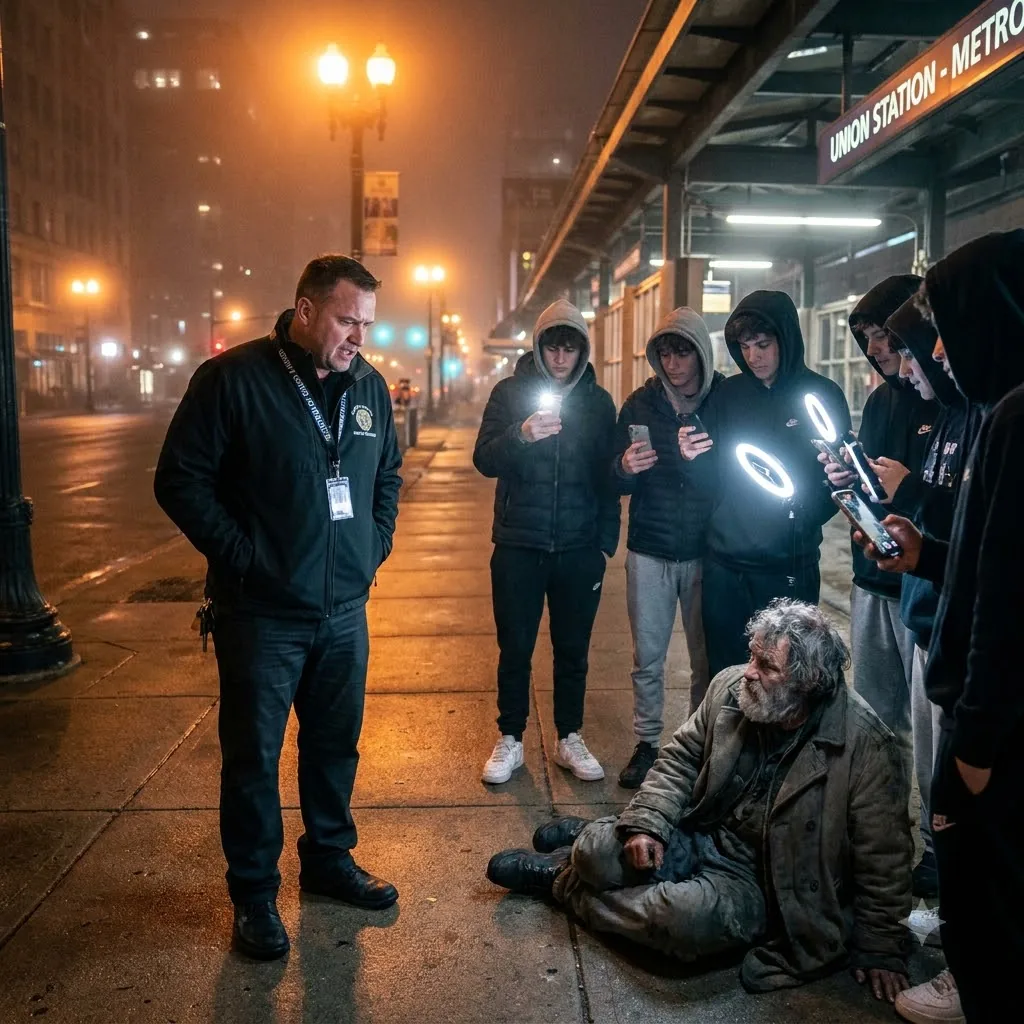
The deafening blare of an airhorn shattered the chaos as an ambulance jumped the curb, its massive grill stopping just feet from the flashing ring of cell phones. Before the vehicle even shifted into park, the rear doors flew open. Two paramedics in heavy navy-blue jackets sprinted into the fray, lugging a green oxygen tank and a rigid backboard.
“Back up! Back the hell up!” the lead EMT barked, dropping his equipment.
Marcus didn’t move. His fists were still tightly locked into the soaked fabric of Dr. Elias Vance’s collar. The disgraced doctor continued to thrash on the wet pavement, his limbs failing in wildly uncoordinated arcs, his voice tearing into a garbled, terrified shriek.
“I said let him go!” The lead EMT stepped in and planted a heavy hand squarely on Marcus’s chest, shoving him violently backward.
Marcus stumbled, his heavy work boots slipping on the wet asphalt. He lost his grip on the collar, falling backward until he hit the cold, hard edge of a concrete planter. The transit officer immediately stepped in front of Marcus, holding up a warning hand, treating the veteran street counselor not as a fellow responder, but as an active threat.
“Keep your distance, SafeStreets,” the officer warned, his breath pluming in the damp air.
Marcus slumped against the planter, his chest heaving as the adrenaline rapidly burned out of his system. He watched the paramedics drop to their knees beside Vance. The doctor was still trying to fight them, but the resistance was weak, sloppy, and deeply unnatural. Vance’s right arm hung uselessly at his side, while his left hand clawed weakly at the air. A string of thick drool slipped from his lips as he tried to speak, but the words were a slurred, incomprehensible babble.
“Sir, calm down, we’re taking over,” the EMT said, shining a penlight directly into Vance’s eyes. The paramedic frowned, moving the light back and forth. “Pupils are unequal and sluggish. He’s got right-sided weakness. Officer, how long was this man down without oxygen?”
The transit officer glanced back at Marcus, his expression hardening with disgust. “Awhile. He was convulsing, then stopped breathing. The medic here just stood over him and watched. Took him at least three or four minutes to start chest compressions.”
“Three or four minutes?” The paramedic swore under his breath, securing a rigid cervical collar around Vance’s neck. “He’s exhibiting severe neurological deficits. Post-hypoxic state. He’s likely looking at anoxic brain damage. Let’s get him on the stretcher. Move, move!”
The clinical words hit Marcus with the physical force of a sledgehammer. *Anoxic brain damage.* Three minutes without oxygen. It took exactly that long for brain cells to begin starving, to begin dying off in the millions, permanently altering a human mind. Marcus knew the timeline. He had taught the timeline in hundreds of overdose prevention seminars. He knew exactly what he was doing when he zipped his bag shut.
The teenagers, realizing the physical altercation was over, began to lower their phones. The climax had passed. The boy whose phone Marcus had shattered stood a few feet away, clutching the broken device.
“You’re completely finished, man,” the boy sneered, tapping the fractured screen. “My boy just airdropped me the backup file. It’s already uploading. Millions of people are about to see you let that guy die.”
Marcus didn’t argue. He didn’t offer a defense. The teenagers turned their backs, their glowing screens illuminating their faces as they hastily typed out captions, scattering into the transit station and disappearing into the city night. They were eager to cash in on the viral currency of a man’s destruction.
The paramedics lifted Vance onto the stretcher, the metal legs snapping into place with a sharp clatter. As they wheeled the doctor toward the back of the ambulance, Vance’s head lolled to the side. His terrified, unfocused eyes drifted over the crowd and briefly met Marcus’s gaze. The spark of recognition, the terror that had been there just moments ago, was completely gone. The eyes staring back at Marcus were vacant, hollowed out, stripped of the sharp, calculating intelligence that had once run the most lucrative pill mill in the city.
The heavy ambulance doors slammed shut, instantly severing the connection. The siren wailed to life, and the vehicle sped away, leaving Marcus completely alone on the damp curb.
He sat in the shadow of the transit station, the flashing red and blue lights of the police cruiser washing over his neon-striped SafeStreets vest. The vest, a symbol of his hard-fought redemption, felt like a fraudulent costume. For eight years, he had stayed meticulously clean. For eight years, he had built a new foundation on the belief that he had climbed out of the gutter to become a protector of the vulnerable. He had convinced himself he was better than the monsters who profited from addiction.
He looked down at his trembling hands, the blue nitrile gloves discarded in a dirty puddle inches from his boots. He had saved Vance’s pulse, but he had murdered the man’s mind. The viral video would undoubtedly strip him of his job, his outreach program, and his public reputation by morning. But as Marcus stared into the empty, wet street, he realized the public ruin was nothing compared to the absolute, irreversible destruction of his own soul. He had let his vengeance win, and in those three agonizing minutes of hesitation, he had become the very thing he spent eight years trying to escape.