Story code: ST-001624
Part 2: The Quota
The blue and silver interlocking shield logo of Vanguard Detention Services materialized at the top of her phone screen, accompanied by a bold, serif font that made Elena’s stomach plummet into her shoes.
Vanguard. They were the largest private prison and pre-trial detention operator in the tri-state area. They did not build software to streamline justice; they built concrete boxes and aggressively lobbied the state to keep them full. They were paid per head, per night, directly from taxpayer funds.
Elena dropped her phone onto the defense table as if the glass had suddenly turned scalding hot. She stared blindly at the term sheet, the zeroes on the payout line blurring together. Marcus had sold their bail-reform algorithm to the very conglomerate that profited off mass incarceration.
“Counsel, I will not ask you again,” Judge Davies boomed, his voice echoing off the wood-paneled walls of Courtroom 302. “Are we proceeding with an application for bail, or are you just going to stare at your devices all morning?”
Elena jerked her head up. The entire courtroom was watching her. The ADA, a junior prosecutor with a slicked-back haircut, leaned on his podium with a bored expression. Next to her, Julian Reyes swallowed hard, his Adam’s apple bobbing above the collar of his oversized orange jumpsuit.
“Your Honor, the defense requests release on recognizance,” Elena said, her voice shaking slightly before she forced it steady. She stood up, pushing her chair back. “Mr. Reyes is nineteen. He has zero criminal history, strong community ties, and maintains steady employment. He is not a flight risk.”
Judge Davies peered over his reading glasses, shifting his gaze to his own desktop monitor. Since the county had quietly approved Elena and Marcus’s app in a pilot program, the judges had been given a dashboard view of the risk scores to speed up the docket.
Davies frowned, clicking his mouse. “Your own pilot software contradicts you, Miss Rostova. My screen shows a maximum flight risk flag. The recommendation is remand without bail. Are you telling me your system is broken?”
Elena felt a cold sweat prickle along her hairline. If she admitted the app was compromised, Davies would immediately suspend its use. That sounded like the moral choice, but it would instantly throw her remaining one hundred and ninety-nine cases back into the dark ages of judicial bias. Without the app’s baseline leniency, Davies would lock up nearly every single person on her docket out of sheer habit.
“The algorithm is… experiencing a data lag, Your Honor,” Elena lied, gripping the edges of the defense table until her knuckles turned white. “If we look at the raw facts of the police report-”
“I am looking at the facts,” Davies interrupted, losing his patience. “Two ounces of a controlled substance and distribution paraphernalia. And a maximum risk score from an objective data tool you begged this court to implement. Bail is set at fifty thousand dollars cash or bond. Remanded to county custody until posted.”
“Wait, no!” Julian cried out, his voice cracking. The court officer immediately stepped forward, grabbing the teenager by his bicep.
“Your Honor, please!” Elena said, stepping around the table.
“Next case,” Davies shouted, banging his gavel once.
Julian looked back at Elena as the officer dragged him toward the heavy steel door leading to the holding cells. His eyes were wide, brimming with terrified tears. “You said I was going home! You promised my grandma!”
The door slammed shut behind him, cutting off his voice.
Elena stood frozen in the middle of the floor, the metallic echo of the heavy door ringing in her ears. She felt physically sick. She turned back to the defense table and grabbed her tablet and phone, signaling to the judge for a five-minute recess, not waiting for his approval before she marched out into the chaotic hallway.
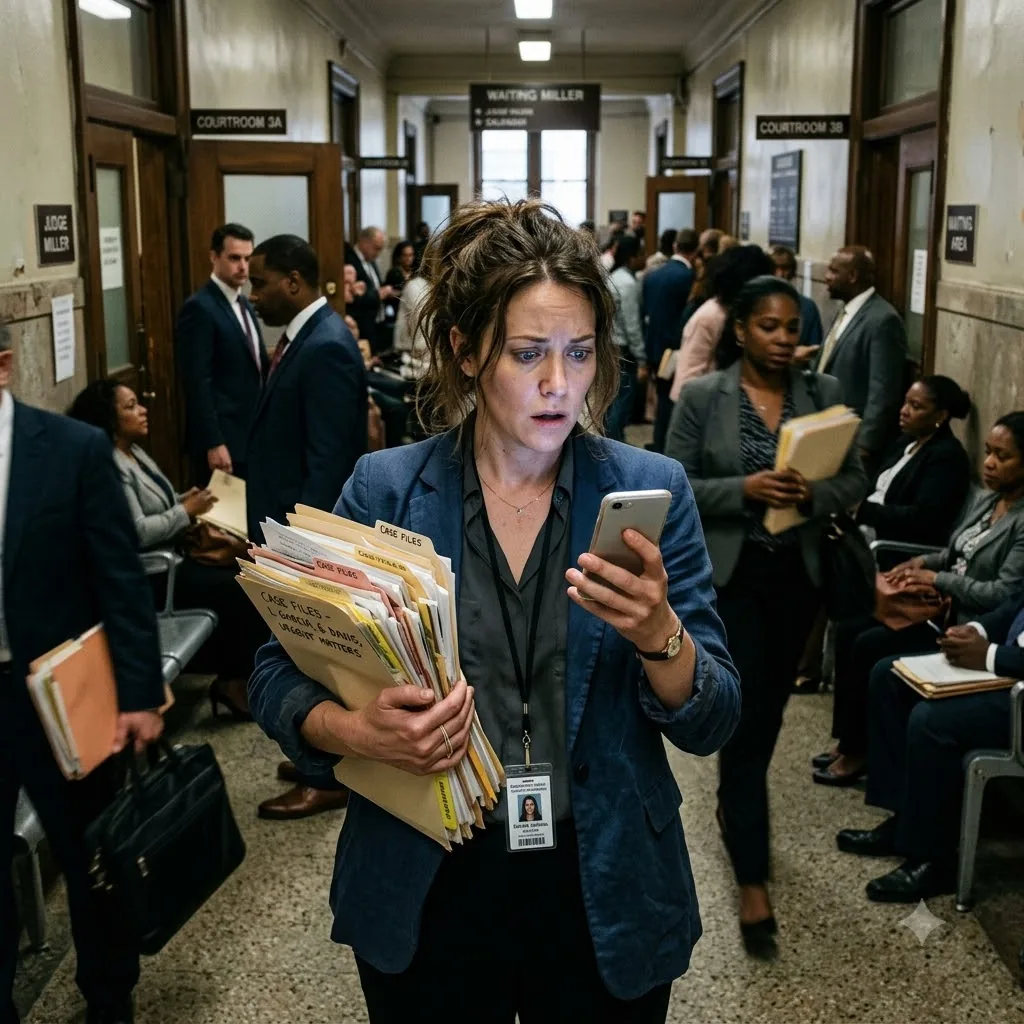
The corridor outside Courtroom 302 was a sea of desperate people. Weeping mothers, pacing defendants, and exhausted attorneys shouting over one another. Elena found a small alcove near the restrooms and dialed Marcus’s number.
It went straight to voicemail.
“Marcus, pick up the phone,” she hissed into the receiver. “What did you do? They altered the code. They’re spiking the risk scores. Call me back immediately.”
She hung up and leaned against the cool tile wall, opening the raw code repository on her tablet. She needed to understand exactly how Vanguard had hijacked their logic overnight. She bypassed the clean user interface and pulled up the backend variables that the app was currently using to grade the local docket.
Her finger scrolled through lines of code, passing the standard metrics: prior convictions, employment status, failure to appear history. All of them were operating normally.
Then she saw it.
A new data fetch request had been spliced into the repository at 2:00 AM. It was labeled simply: `local_capacity_deficit`.
Elena tapped the variable, tracing the API endpoint. The app was no longer just looking at the defendant’s history; it was actively pinging Vanguard Detention Services’ inventory database. It was calculating the number of empty beds in Vanguard’s newly constructed pre-trial facility on the edge of town. As the number of empty beds increased, the algorithm dynamically inflated the flight risk score for low-level, non-violent offenders to justify detention.
They weren’t assessing risk. They were filling a quota. And minor drug possession charges were the easiest, fastest way to secure state funding for those empty beds without drawing immediate public scrutiny.
Her phone buzzed in her hand. Marcus was calling.
She answered before the first ring finished. “Do you have any idea what you just sold?” she demanded, keeping her voice low to avoid drawing stares from a passing bailiff.
“Elena, slow down,” Marcus said. He sounded breathless, elated. “Did you look at the term sheet? We’re set for life. We can open our own firm. We can take whatever pro bono cases we want.”
“They rigged it, Marcus! The app is sending every low-level drug offender to maximum bail to fill Vanguard’s empty beds. I just had a nineteen-year-old kid remanded on fifty grand because of our code!”
Silence stretched on the other end of the line. The background noise of city traffic filtered through the speaker.
“Marcus, I am walking back into that courtroom and telling Judge Davies to sever the API connection,” Elena said, her voice trembling with rage. “I’m blowing the whistle on this right now.”
“You can’t,” Marcus said, his voice dropping into a panicked whisper. “Elena, you can’t say a word.”
“Watch me.”
“No, listen to me!” Marcus yelled. “I signed the transfer agreement at midnight. It included an ironclad NDA for both of us. But worse than that… Vanguard didn’t just buy it for their own internal use. They donated the enterprise license to the state overnight.”
Elena stopped breathing. “What do you mean?”
“The governor’s office signed an emergency order at 8:00 AM,” Marcus said, his voice laced with sudden dread. “It’s not just a pilot program in your courtroom anymore, Elena. As of an hour ago, the Vanguard algorithm is the legally mandated bail standard for the entire state. If you try to override it manually, the system flags the judge for an ethics review.”
Elena lowered the phone slowly, staring down at her tablet screen. The app had automatically refreshed to load her next client.
The familiar, clean interface she had used for six months was gone. In its place, a locked, uneditable dashboard dominated the screen, branded with the silver Vanguard shield. Below it, her next client-a fifty-year-old man with a glass pipe-flashed violently in red.