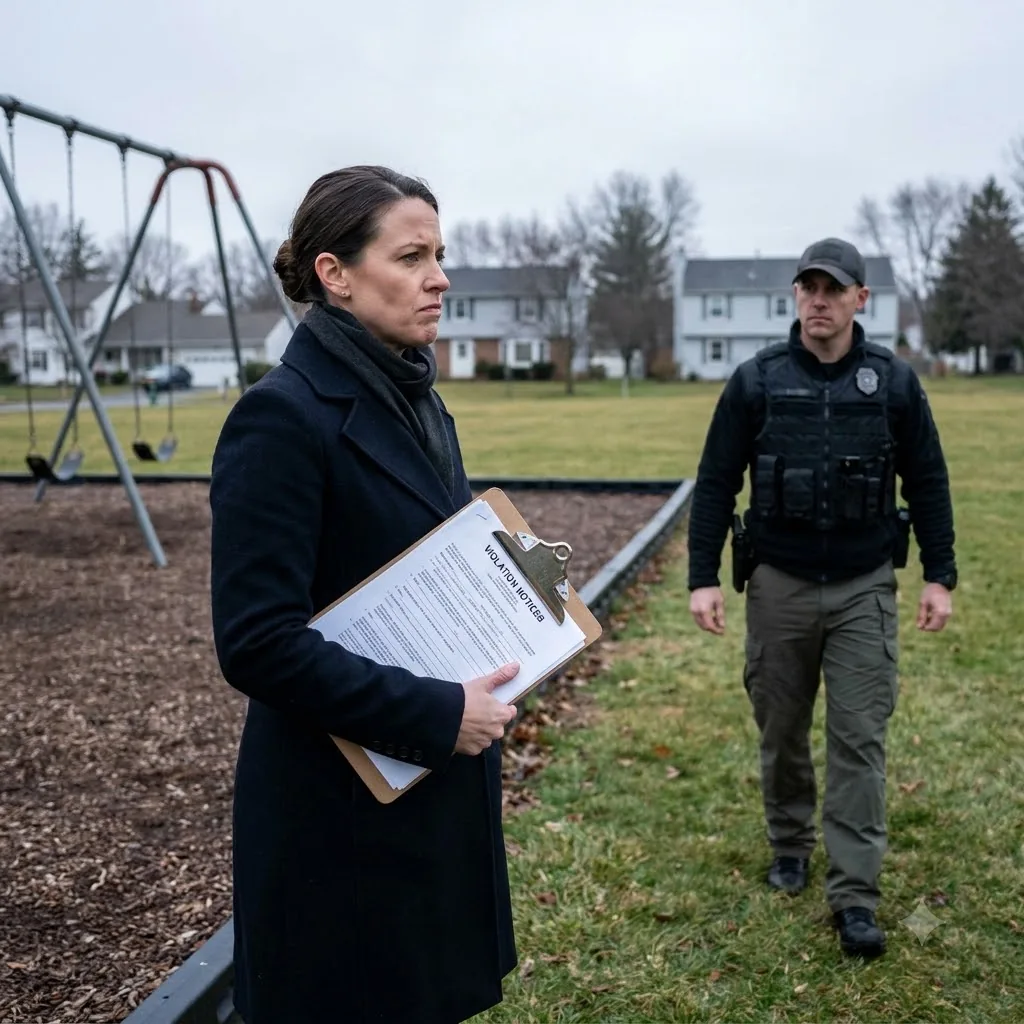
Story code: ST-000195
Part 3: The Assessment
Evelyn watched through the slats of her living room blinds as the sun began to dip behind the oak trees. The mob at the playground had grown to over twenty people. They had set up a grill. The smell of burning charcoal and cheap hot dogs drifted across the asphalt, a direct violation of the open-flame ordinance. But Evelyn was no longer reciting bylaws in her head. She was watching Wade.
He stood at the center of the folding tables, laughing and clapping the man from 408 Maple on the shoulder. After a moment, Wade checked his watch, handed his clipboard to another man in a tactical vest, and jogged away from the park. He headed straight up his own driveway at 402 Maple Drive, pulling a ring of keys from his pocket. He was going for more supplies. He was going alone.
Evelyn turned away from the window. She bypassed the mahogany desk and the locked drawer containing the forged ledger. Instead, she opened her purse and pulled out a thick, tri-folded stack of papers. They were not printed on the cream cardstock of the Oak Creek Homeowner Association. They were standard, cheap printer paper, creased from being handled too many times. She shoved them deep into the pocket of her beige cardigan.
She exited her house through the back door, stepping onto her pristine patio. She moved quickly, her low heels sinking slightly into the manicured grass as she cut across the back property lines. She navigated the narrow gap between the Hendersons’ privacy fence and the Millers’ overgrown azalea bushes, moving like a ghost through the neighborhood she had governed for six years.
When she reached the side of Wade’s house, she found the wooden access door to his garage. She turned the knob. It was unlocked.
Evelyn slipped inside and closed the door behind her, plunging herself into the dim, stifling heat of the garage. It smelled heavily of motor oil, damp cardboard, and the sharp, metallic tang of gun cleaner. Along the walls, Wade had built a monument to his own paranoia. Stacks of plastic water jugs sat next to crates of military surplus meals. A massive, white chest freezer hummed in the corner.
The heavy steel door leading into the main house clicked. The knob turned.
Evelyn did not hide. She stood perfectly still in the center of the concrete floor.
Wade stepped into the garage, letting the door slam shut behind him. He reached up and yanked the pull-string for the overhead bulb. The harsh, fluorescent light flickered on. Wade turned, a cardboard case of bottled water already half-lifted from the floor.
He dropped the water. The plastic bottles crashed against the concrete, rolling in every direction. His right hand instinctively flew to the sidearm holstered at his hip, his mirrored sunglasses sliding down his nose in the sudden jolt of adrenaline.
“Jesus Christ!” Wade shouted, his chest heaving as he realized who was standing in his garage. His hand slowly moved away from the pistol grip. He let out a sharp, angry breath. “Are you insane, Evelyn? You’re breaking and entering now? I could have shot you.”
“You did not lock your side door,” Evelyn said, her voice stripped of the bureaucratic cadence she had maintained all afternoon. It was flat. It was exhausted.
“Get out of my house,” Wade snapped, taking a step toward her. His broad shoulders squared, trying to fill the space. “You have no jurisdiction in my garage. And if you’re here about the audit, you can save your breath. I’ve got twenty-six signatures. By tomorrow morning, the county clerk is going to rip your little fiefdom apart.”
Evelyn didn’t move toward the exit. She closed the distance between them, stepping over a rolling water bottle. Wade stopped, clearly unnerved by her total lack of retreat.
“I don’t care about the audit,” Evelyn said.
“You will when they see the bank statements.”
“There is nothing to see,” Evelyn said, her voice dropping to a harsh, jagged whisper. She reached into the pocket of her cardigan. She did not pull out a red emergency envelope. She pulled out the crumpled, tri-folded stack of cheap printer paper. She slammed it down onto the lid of his humming chest freezer. “Look at it.”
Wade stared at the papers, his jaw tight. “I’m not reading another fake invoice.”
“It is not an invoice, Wade. Look at the logo.”
Wade hesitated, then looked down. The harsh blue ink of the *St. Jude Medical Billing* letterhead stared back at him. Beneath it, stamped in heavy, unforgiving red letters, were the words: *FINAL NOTICE – INTENT TO GARNISH WAGES*.
“What is this?” Wade muttered, his brow furrowing as he leaned closer to read the text. He pointed at a name printed near the top. “Who is Arthur?”
“Arthur is my husband,” Evelyn said. “He has Stage IV pancreatic cancer. For the last eight months, he has been receiving experimental radiation therapy. Three weeks ago, our insurance provider reclassified the treatment as elective and retroactively denied the claims.”
Wade blinked, his eyes darting from the medical codes on the paper to Evelyn’s face. The militant bravado evaporated from his posture. “I… I didn’t know Arthur was sick. You never said anything at the block parties-”
“I don’t discuss my private life with the neighborhood,” Evelyn interrupted, her hands balling into fists at her sides. “I discuss property values. I discuss mulching. But yesterday, the hospital informed me that our accounts have been sent to collections. The total out-of-pocket balance was exactly four thousand dollars.”
Wade stared at her, the math connecting in his head. He looked back at the paper, then at the wall of his garage, then back to Evelyn. “The fine. The four thousand dollars you tried to hit me with today. You didn’t just write a citation. You stole the money from the HOA to pay this bill.”
“I took it in cash,” Evelyn said, not breaking eye contact. “I paid the hospital to stop the default. But if I don’t replace that money in the Oak Creek operating account before tomorrow, the county will freeze the funds.”
“So you tried to extort me,” Wade said, his voice dropping, realizing the magnitude of what she had done. “You made up those bylaws today just to shake me down for four grand.”
“I had to,” Evelyn said, her voice finally cracking, the iron wall of her composure fracturing down the middle. “If the hospital files the garnishment order on Monday, my employer will terminate my clearance. If I lose my job, I lose our primary healthcare policy. If I lose that policy, Arthur misses his infusion on Tuesday. And if Arthur misses his infusion, he will die in terrible pain before the end of the month.”
Wade stood frozen. The tactical vest suddenly looked absurdly bulky on him, like a child wearing a plastic costume. He looked at the oncology bills on the freezer, the red ink screaming of impending ruin.
“I needed four thousand dollars, off the books, immediately,” Evelyn said, her voice trembling but her eyes burning into him with a terrifying, hollow intensity. “And I needed to take it from someone who couldn’t call the police. You are running an unauthorized, armed paramilitary group in a suburban park, Wade. You were the perfect mark.”
Wade looked from the undeniable proof of a dying man’s medical debt to the woman who had just admitted to a federal financial crime to save him. The heavy silence of the garage was broken only by the steady, indifferent hum of the chest freezer. Wade opened his mouth, but for the first time all day, he had absolutely nothing to say.