Story code: ST-001175
Part 4: The Weight of the Surrender
The line-array speakers popped with a sharp, electronic snap. The sound engineer had finally killed the feed. Elias stood at the edge of the stage, the heavy silence ringing in his ears as he watched the stunned faces of eight hundred young adults. Artificial fog swirled harmlessly around his ankles. He slowly lowered the dead microphone to his side.
In the front row, Caleb Warren remained frozen, staring past Elias into the dark wings of the stage. The teenager’s face was a portrait of sudden, devastating comprehension.
Heavy hands clamped onto Elias’s shoulders. Two large ushers, led by a frantic Davis, pulled him back from the precipice. Elias didn’t resist. He let them drag him into the dark backstage corridor. As they hauled him away, the murmur of the crowd finally broke, swelling into a chaotic tide of questions that could not be easily silenced with a closing prayer.
They pushed Elias into a green room-a sterile, windowless concrete block meant for guest speakers. The heavy fire door slammed shut, instantly cutting off the noise of the auditorium.
A second later, the door flew open. Pastor Warren stormed in. His designer cashmere sweater looked disheveled. His face, usually a mask of practiced, benevolent calm, was contorted into an ugly, flushed knot of absolute fury. He pointed a trembling finger at the ushers.
“Get out,” Warren hissed.
Davis and the ushers scrambled into the hallway, pulling the door shut behind them.
Warren paced the small room, his chest heaving, before turning on Elias. “You arrogant, stupid little man,” he spat, his voice completely devoid of its signature hypnotic timber. It was flat, nasal, and venomous. “Do you have any idea what you just did?”
“I explained the mechanics of the blessing,” Elias said, his voice surprisingly steady.
Warren closed the distance between them, invading Elias’s space. The smell of expensive, spicy cologne was overpowering. “You think you’re a martyr? You think you just saved those kids? By Monday morning, my crisis management team will spin this as a disgruntled, mentally unstable contractor trying to extort the church. I will bury you so deep in litigation you won’t be able to afford a cardboard box.”
Elias looked at the pastor, seeing nothing but a terrified CEO desperate to protect his equity.
“You’re done, Elias. You are terminated,” Warren said, his voice dropping into a dangerous, ragged whisper. “And that apartment you’re living in? The one the church holds the lease on? You have until midnight to get your pathetic belongings out of it. I want your keys. I want the master drive. And I want my money.”
Elias reached into his breast pocket. His fingers brushed against the stiff paper of the cashier’s check. For the last six hours, it had felt like a lead plate against his ribs, pulling him down, suffocating him with its heavy promise of survival.
He pulled it out and tossed the three-thousand-dollar check onto the cheap laminate folding table in the center of the room. It fluttered down, landing next to a half-empty bottle of water. Next, Elias dug into his frayed messenger bag and pulled out the sleek black USB drive. He dropped it on top of the check.
“Take it all,” Elias said.
Warren snatched the check and the drive, gripping them so tightly his knuckles turned white. “You have nothing,” Warren sneered, stepping back to look Elias up and down with pure disgust. “You have no money, no home, no reputation. You are a ghost. And you threw it all away for an auditorium full of teenagers who won’t even remember your name next week.”
“They’ll remember yours, though,” Elias said softly. “And Caleb’s.”
Warren flinched. The mention of his son struck a nerve that the loss of capital hadn’t. For a brief second, the corporate raider vanished, leaving only an exposed, panicked father who knew his heir had just seen the blood on the ledger.
Elias didn’t wait for a response. He turned his back on the pastor, pushed open the heavy fire door, and walked out.
He navigated the labyrinth of backstage corridors, passing staff members who pressed themselves against the walls, averting their eyes as if he were radioactive. He pushed through the emergency exit bars at the end of the hall.
The heavy metal clanged shut behind him, sealing away the air-conditioned, artificial sanctuary.
The Friday night air hit him like a physical blow. The asphalt of the massive parking lot was still radiating the brutal summer heat. The humidity was suffocating, thick with the smell of exhaust and melting tar.
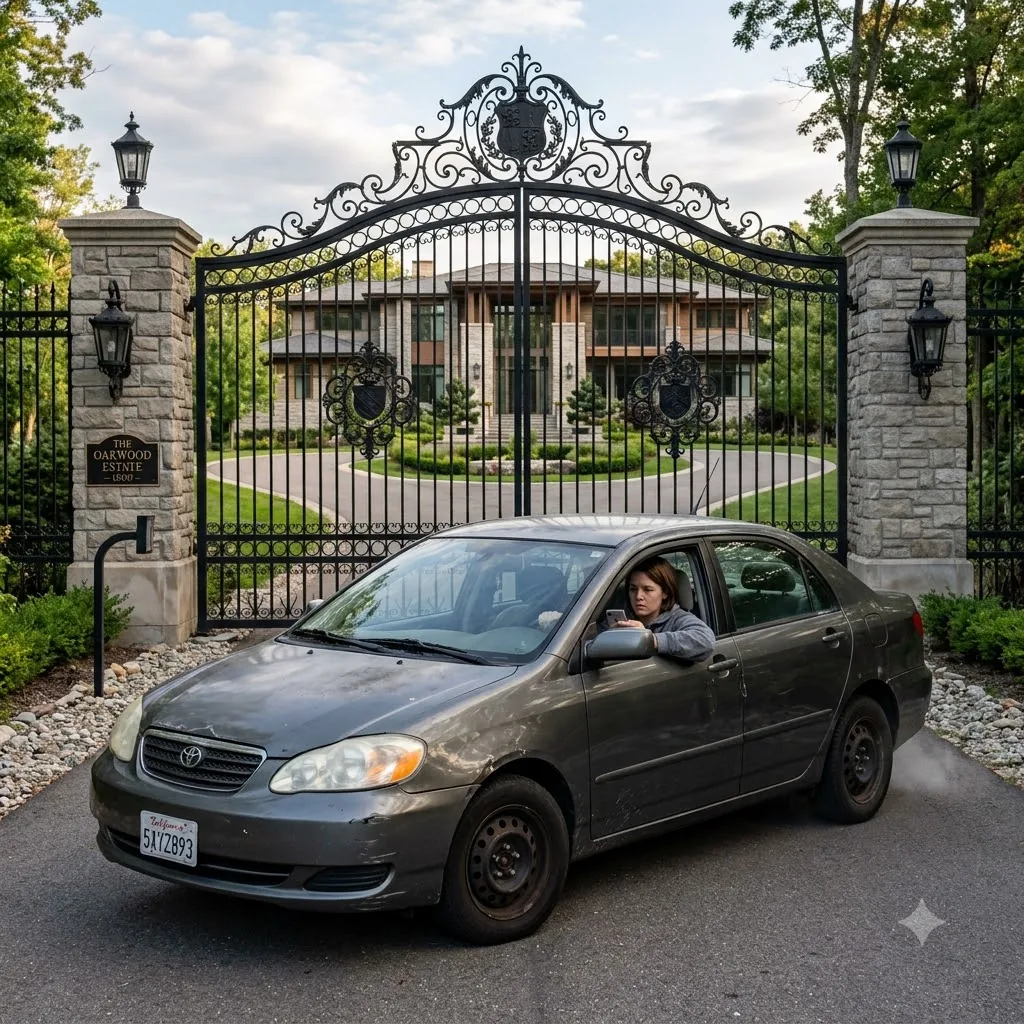
Elias walked across the endless expanse of blacktop, his worn rubber soles scraping against the pavement. He reached his 2004 Corolla, parked far away from the VIP section. The paint was peeling, and the front bumper was held on by a zip tie.
He pulled his phone from his pocket. The cracked screen illuminated his face in the dark lot. He opened the banking app. The red numbers glared back at him.
Negative forty-two dollars and fifty cents.
He was utterly broke. By midnight, he would be homeless. He had no prospects, no references, and no safety net.
Elias slid into the driver’s seat. The cabin was an oven. He rolled down the manual windows, the crank stiff and squeaking in his hand. He put the key in the ignition and turned it. The engine ticked, shivered violently, and finally clunked into a rough, rattling idle.
He gripped the worn steering wheel and looked back at the sprawling, ten-thousand-seat auditorium, a fortress of glass and steel built on the backs of the desperate. He had left everything he had inside that building.
Elias took a deep breath, pulling the thick, sweltering summer air deep into his lungs. He exhaled slowly.
For the first time in ten years, his chest didn’t ache.