Story code: ST-000164
Part 3: The Glass Eye Unblinking
The bartender’s heavy work boots slammed against the hollow wooden stage, the planks groaning in protest as he vaulted clumsily into the narrow aisle. Carl’s thick, damp hand clamped down on Arthur’s collarbone like a vice, yanking him backward with enough force to nearly pop his shoulder out of its socket.
“Get off him, Artie!” Carl bellowed, his voice raw and echoing off the exposed brick. “Are you out of your damn mind?”
The teenager scrambled backward, pressing himself so hard against the corner of the vinyl booth that the fabric tore. He clutched his wrist, his chest heaving. “You saw that!” the boy shrieked, pointing wildly at the scattered patrons. “He attacked me! I’ve got it all on camera! You’re going to jail, you washed-up freak!”
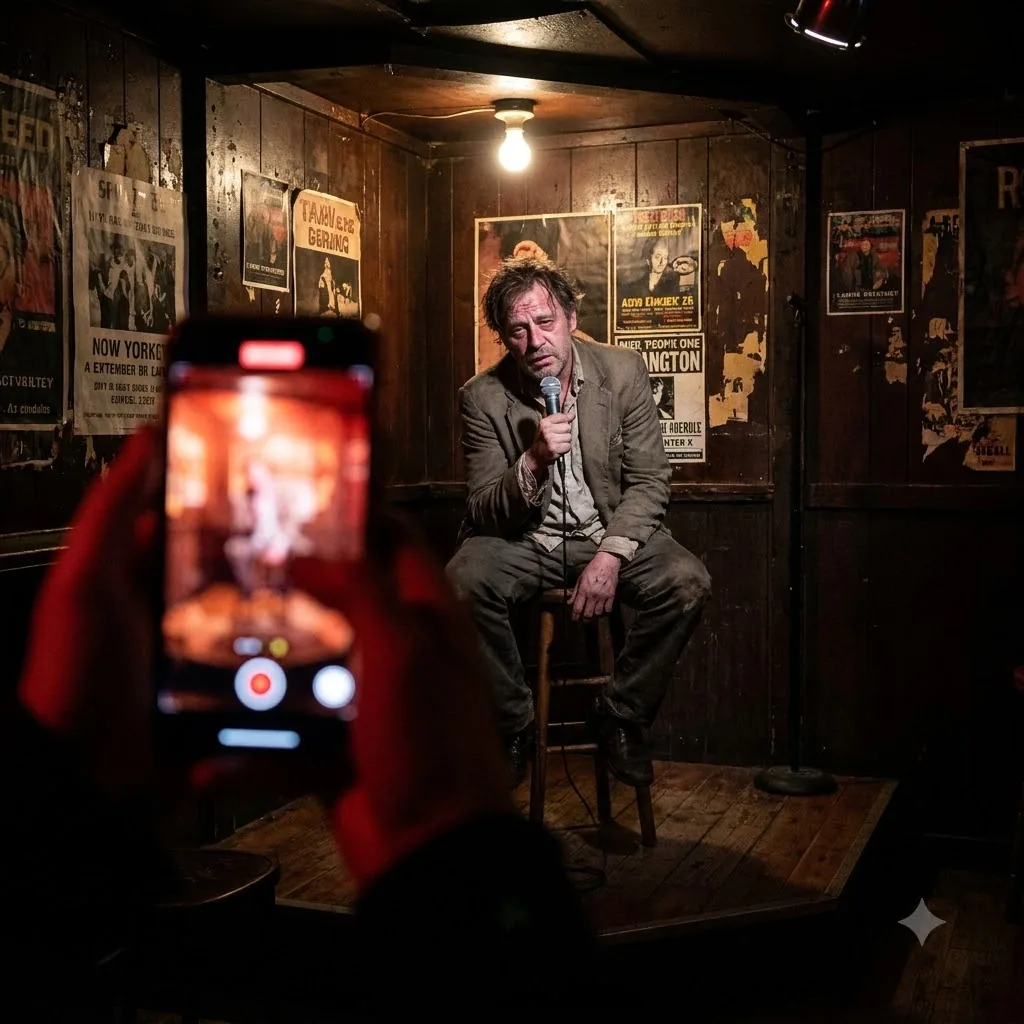
Arthur did not fight Carl’s grip. All the frantic, defensive adrenaline that had propelled him off the stage instantly evaporated, leaving behind a cold, hollow exhaustion that sank deep into his marrow. He stared down at the floor. The smartphone lay in a puddle of spilled amber beer, its harsh LED flashlight pointing straight up at the ceiling, illuminating the swirling dust motes in the stale air. On the cracked screen, the live chat was a blinding, chaotic waterfall of text. The words *ASSAULT*, *LOCK HIM UP*, and *RIP ARTIE* flew upward so fast they blurred into a single, hateful smear of white light.
Slowly, his joints popping, Arthur sank to his knees.
A collective gasp rippled through the shadowed dive bar. The woman in the back row let out a sharp, mocking laugh. The teenager lowered his hand, his panicked expression morphing back into that arrogant, predatory smirk.
“Oh my god,” the teenager crowed, his voice dripping with triumphant venom. “He’s actually doing it. Chat, look! He’s doing the apology dance! Get on your knees and beg, Artie! Tell everyone how sorry you are!”
Carl tugged urgently at Arthur’s jacket. “Come on, man, get up. Let’s go out the back door before someone calls the cops. Just leave it.”
Arthur ignored the bartender. He reached into the sticky puddle of beer and picked up the smartphone. His thumb brushed over a spiderweb crack in the top corner of the glass. He didn’t turn the flashlight off. Instead, he brought the phone up to his face, letting the blinding, unflattering beam illuminate every deep line of exhaustion, every gray hair, and every ounce of defeat carved into his features. He stared directly into the tiny, unblinking black lens of the camera.
“I’m not going to apologize,” Arthur said.
His voice was no longer the desperate, gravelly rasp of a cornered comedian. It was entirely flat. It possessed the terrifying, resonant calm of a man who had absolutely nothing left to lose.
“Give me my phone!” the teenager demanded, lunging forward half a step before Carl threw an arm out to block him.
Arthur kept his eyes locked on the glowing red dot of the recording indicator. “You want the context,” he whispered to the void, his voice carrying effortlessly through the dead silent room. “You all want the missing nineteen minutes. You want to know why a comedian would stand on a stage in Chicago and laugh at fourteen people burning to death in a factory.”
Arthur took a slow, rattling breath. “I’ve been lying to you. I’ve been lying to the press, to the furious bloggers, to my old agent. For three years, I’ve told everyone it was a satire piece. A misunderstood, righteous attack on a negligent CEO. I hid behind the defense of edgy comedy because it was easier than looking in the mirror.”
He shifted his weight on the sticky linoleum, bringing the phone an inch closer to his mouth.
“It wasn’t satire,” Arthur said, his voice dropping to a harsh, trembling whisper that demanded absolute attention. “It was a hemorrhage.”
Someone in the back of the bar dropped a glass. It shattered against the floor, but nobody moved.
“Seventy-two hours before I walked onto that stage in Chicago,” Arthur continued, his eyes glazing over as the memory dragged him under, “I kicked down the locked door of my son’s bathroom. His name was David. He was nineteen years old. He had been complaining about a bad back from his shift at the shipping warehouse, so a buddy gave him something for the pain. Just one pill. A generic painkiller, he thought.”
Arthur swallowed, the sound clicking loudly in the quiet room. “Half of that pill was pure fentanyl.”
The teenager’s mouth opened, but no sound came out. Carl’s heavy hand slowly, almost imperceptibly, slid off Arthur’s shoulder.
“I found him on the cold tile,” Arthur said, the tears finally welling in his eyes, stinging fiercely under the glare of the flashlight. “He was already blue. I remember the paramedics packing up their bags. I remember the absolute, suffocating silence of my house after they took his body away in a black bag. I didn’t know how to breathe. I didn’t know how to exist in a universe that would just… erase my boy over a fake pill to save a few cents on manufacturing.”
Arthur stared through the glass eye, looking at the thousands of faceless judges on the other side of the screen.
“I couldn’t find the man who pressed that fentanyl pill,” Arthur said, his voice rising, thick with a jagged, unresolved agony. “I couldn’t scream at the cartel, or the dealer, or the universe. I had this bottomless, violent rage, and nowhere to put it. So, I didn’t cancel my Chicago weekend. I drove to the club because the silence at home was going to kill me. I sat in the green room, shaking, and I read a newspaper article about Richard Burnston. Fourteen people dead because it was cheaper to padlock the fire exits.”
Arthur tilted the phone, letting the camera capture the utter wreckage of his face.
“I walked onto that stage entirely out of my mind,” Arthur confessed, a single tear cutting a track down his cheek. “When I made that joke about the crematorium… I wasn’t doing a bit. I wasn’t being clever. I was projecting my dead son onto those factory workers. I was screaming at the absolute, meaningless slaughter of it all. I was a broken father having a nervous breakdown in front of three hundred people, laughing at the dark because the dark had already swallowed me whole.”
Arthur lowered the phone slightly, his eyes shifting from the camera lens to the screen itself.
The waterfall of hate had stopped. The chaotic blur of siren emojis and violent text had frozen. The chat was stuttering, struggling to process the devastating weight of the confession. A few scattered hearts floated up, colored blue, followed by an agonizingly slow trickle of ellipses.
Arthur looked up from the screen, turning his gaze to the teenager shivering in the booth. The boy’s arrogance had entirely vanished, replaced by the pale, wide-eyed horror of a child realizing they had just cracked open a tomb.
“You didn’t cancel a comedian,” Arthur whispered, holding the phone out toward the boy. “You live-streamed a father’s autopsy.”