Story code: ST-000798
Part 2: The Liability Act
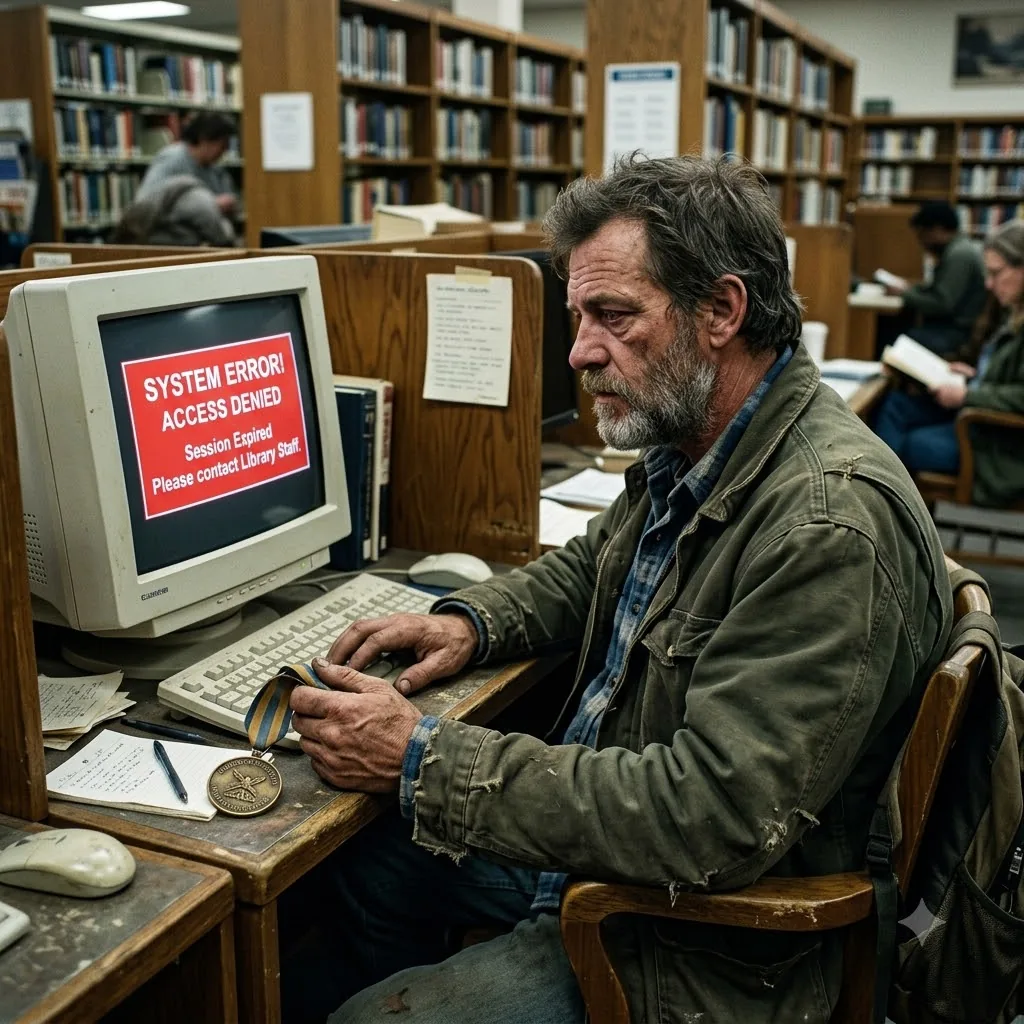
The librarian stepped back, her hands raising instinctively to her chest. Her eyes widened, tracking the sudden, violent movement of the chair and the tight line of Teo’s jaw.
Teo froze. The adrenaline spiking in his blood was a reflex meant for falling trees and shifting winds, not quiet municipal buildings. He looked at the fear in the woman’s eyes and felt a sudden, sickening wave of shame. He was a large man, his shoulders built thick from years of carrying chainsaws up sixty-degree inclines. To her, he wasn’t a firefighter. He was just a threat in a faded canvas jacket.
He forced his fingers to uncurl, though he kept the brass coin safely in his palm. “I’m sorry,” he said, keeping his voice low and carefully flat. “The screen stuck. I’m leaving.”
He didn’t wait for her to respond. He grabbed his duffel bag from the floor, turned his back on the glowing red rejection banner, and walked out into the glaring afternoon sun.
The heat off the pavement was brutal, baking the exhaust fumes of downtown traffic into a thick, suffocating haze. Teo walked with a fast, measured stride, his boots hitting the concrete in a steady rhythm. The address he had pulled from the state directory burned in his mind. Suite 410, State Capitol Annex. Assemblyman Marcus Hayes.
It took him twenty minutes to cross the city grid. The annex building was a towering monolith of blue glass and polished steel, surrounded by manicured drought-resistant shrubs. Teo pushed through the revolving doors and was instantly hit by a wall of aggressively cold air conditioning. The lobby smelled of floor wax and expensive cologne, a stark contrast to the scent of diesel and stale sweat that clung to his own clothes.
He found the elevators and rode to the fourth floor in silence, watching his reflection in the brushed metal doors. He looked exhausted. The deep lines around his eyes made him look ten years older than thirty-two, carved there by chronic dehydration and sleep deprivation on the fire line.
The doors chimed and parted. Teo navigated the carpeted hallway until he found the heavy oak door bearing the state seal and Assemblyman Hayes’ name in brass lettering. He pushed it open and stepped into a reception area that felt more like a luxury hotel than a government office.
The walls were lined with framed photographs. Assemblyman Hayes shaking hands with the Governor. Assemblyman Hayes wearing a spotless, bright yellow fire jacket, standing safely on a paved road while smoke billowed photogenically in the distant background. Teo stared at that pristine yellow jacket. His own gear had been permanently stained black by day three of his first deployment.
“Can I help you, sir?”
A young staffer in a tailored gray suit sat behind a massive mahogany desk. He looked up from a dual-monitor setup, his expression settling into a polite but guarded mask as he took in Teo’s scuffed boots and worn jacket.
“I need five minutes with Assemblyman Hayes,” Teo said, stepping up to the desk.
“The Assemblyman is out of the office today,” the staffer said smoothly, the lie practiced and effortless. “Do you have an appointment?”
Teo reached into his pocket, pulled out the heavy brass commendation, and set it down on the glass-topped desk. It landed with a solid, authoritative *thud*.
The staffer blinked, his eyes dropping to the Governor’s seal.
“I spent three years on a state inmate handcrew,” Teo said, his voice steady. “I held the line at the San Dimas canyon fire. The Governor gave me that coin. But today, the state portal auto-rejected my application for a brush clearing job because of the employment restriction bill Hayes sponsored.”
The staffer’s posture stiffened. He didn’t touch the coin. “You’re referring to the Public Safety and Property Liability Act. Sir, I appreciate your service, but the Assemblyman didn’t write that bill in a vacuum. It was mandated by the state’s insurance underwriters.”
“I’m applying to inspect dead grass,” Teo said.
“You’d be driving a state-owned vehicle and entering private residential property,” the staffer corrected, his tone dropping an octave into bureaucratic condescension. “The liability carriers threatened to pull our municipal coverage if we employed individuals with felony records in unsupervised field roles. It’s a blanket statutory mandate. We can’t put taxpayers at risk.”
Teo leaned forward, placing both hands flat on the edge of the desk. The staffer immediately rolled his ergonomic chair an inch backward.
“At San Dimas, the wind shifted and the ridge collapsed,” Teo said softly. “I spent twelve hours cutting a fire break through a billionaire’s backyard while his roof was catching embers. Nobody asked for my background check when the canyon was melting. I earned the right to work.”
“That was an emergency deployment under armed supervision,” the staffer said, his eyes darting toward the telephone console. “Civilian employment is a different legal category. I need you to take your item and step back from the desk, sir. If you have a grievance, you can submit an appeal through the portal.”
“The portal deletes my session the second I check the box. There is no appeal.”
“Then there is nothing we can do,” the staffer said, his hand hovering over the receiver. “I will call Capitol Security if you don’t leave right now.”
Teo looked at the staffer’s hand, then at the phone. He knew the protocol. If security arrived, they would run his ID. They would see he was on active parole. A police interaction, even a minor one, could be coded as a violation. He could be back in a cell by midnight, his sixty-four saved homes rendered entirely meaningless.
As he reached down to pick up the brass coin, his eyes caught a stack of glossy flyers resting on the corner of the reception desk.
*Town Hall: Wildfire Resilience in Our Communities.*
*Hosted by Assemblyman Marcus Hayes.*
*Today, 3:00 PM. High Desert Community Center.*
Teo slid the coin off the glass, its cold weight settling back into his palm. He looked at the clock on the wall. It was just past one in the afternoon.
“Have a good day,” Teo said quietly.
He turned and walked out of the office before the staffer could pick up the phone. The state had built a perfect, impenetrable digital wall to keep him out, and the staffer had made it clear that playing by their rules would only end in his erasure. But a town hall meant a live microphone. It meant voters, local press, and no digital portal to filter him out.
Showing up there as a parolee to corner a state politician was professional suicide. It risked his freedom, his parole status, and whatever shred of a future he had left.
Teo pushed through the lobby doors, walking back out into the blistering heat. He tightened his grip on the brass coin in his pocket and turned his boots toward the transit station. He had nothing left to lose.