Story code: ST-000824
Part 4: The Empty Room
The lead investor, a man whose custom suit likely cost more than Marcus made in six months, didn’t raise his voice. He simply closed his leather-bound pitch deck. The heavy snap of the magnetic clasp cut sharply through the quiet hum of the conference room projector.
“We are in the business of scaling assets, Leo,” the investor said, his tone devoid of any emotion. “Not defending open-source copyright lawsuits against furious tenant unions.”
“It’s a nuisance claim!” Leo pleaded, his polished arrogance completely dissolving. He stepped in front of the glaring projection of Marcus’s old GitHub log, trying to block the undeniable evidence with his body. “I can rewrite the database architecture by tomorrow. I can scrub the hashes!”
“The core logic is poisoned,” the investor replied, not even looking at Leo as he buttoned his charcoal suit jacket. “You built an eviction engine on stolen, open-source land. The IP is legally radioactive. We’re passing.”
The three men walked out of the glass room without another word, brushing past Elias and Sarah as if they didn’t exist. Leo stood frozen against the whiteboard, bathed in the harsh white light of his stolen code. Marcus watched his former partner’s shoulders slump, expecting to feel a surge of vindication. Instead, his stomach just felt hollow.
“It’s over, Leo,” Marcus said quietly. He closed his laptop, severing the casting connection. The massive projection vanished, leaving the conference room in dim, corporate shadows.
Elias let out a harsh, satisfied breath. “Let’s go home.”
But when they pushed through the heavy fire doors of their apartment building an hour later, the victory shattered.
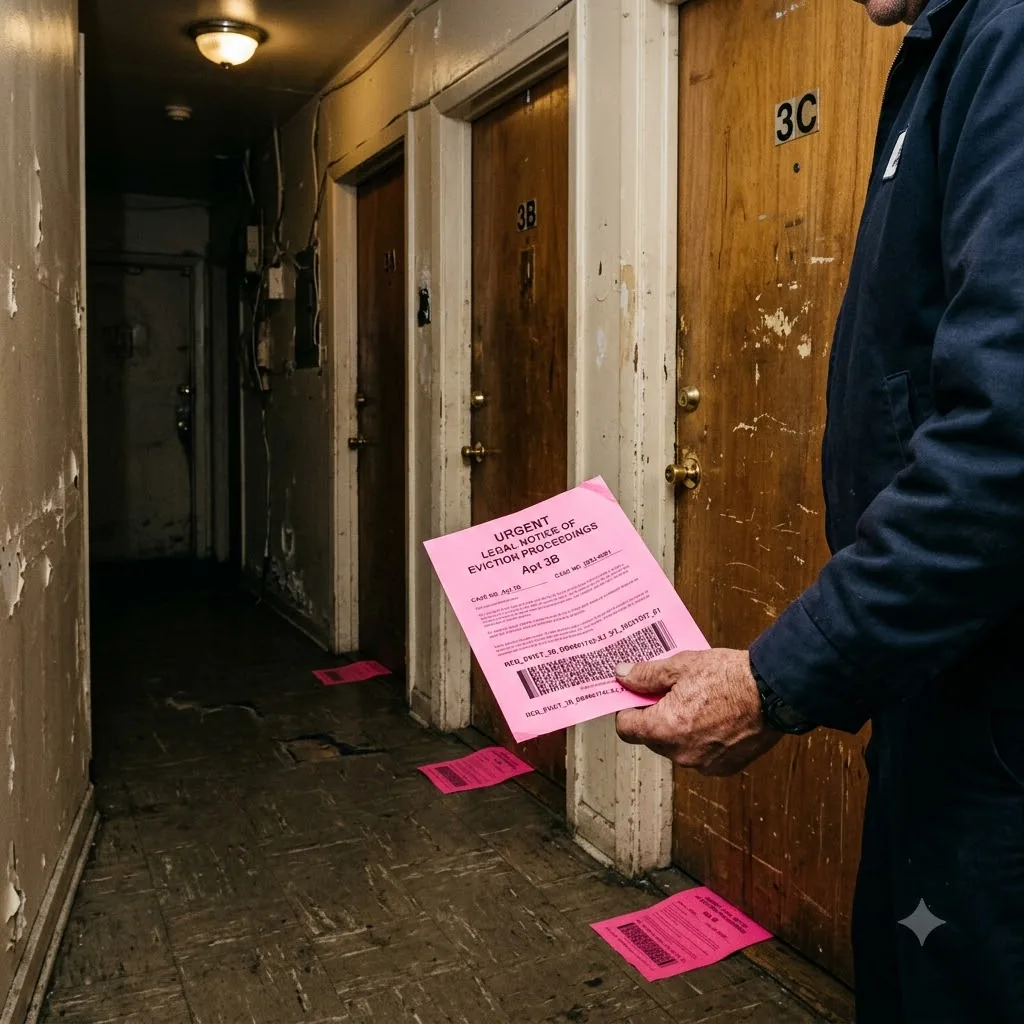
The third-floor hallway was quiet, but it was not a peaceful silence. It was the heavy, breathless quiet of a building holding its breath. The neon pink notice was gone from Mrs. Gable’s door at 3A, but the door itself was propped wide open with a heavy brass wedge.
Marcus stepped into the doorway. The apartment was stripped bare. Faded rectangles on the floral wallpaper marked where framed photographs had hung for a decade. In the center of the living room, Mrs. Gable was taping up a corrugated cardboard box.
“Mrs. Gable,” Marcus said, stepping onto the worn carpet. “You don’t have to pack. We stopped him. The software is dead, and the management company just lost their funding. They can’t enforce the eviction.”
Mrs. Gable looked up. She looked smaller without her thick knit cardigan, her shoulders hunched in a thin cotton blouse. She didn’t look relieved. She looked exhausted to her very bones.
“The paper said I have three days, Marcus,” she said, her voice a fragile, papery whisper. She pressed a strip of packing tape over the box, smoothing it down with trembling fingers. “My sister in New Jersey has a spare room. Her son is coming with his truck in an hour.”
“But it was a lie,” Sarah urged, stepping up beside Marcus. “It was an automated threat. We have them on the run now. The strike is holding.”
Mrs. Gable shook her head slowly. She looked past them, staring at the empty wall. “It knew my pension schedule. It knew exactly when my bank account was empty. A machine did that. A machine decided I didn’t deserve to live here anymore. How do I fight a ghost in a machine, Sarah? I can’t sleep. Every time I hear a footstep in the hall, I think it’s a man coming to put a padlock on my door.”
Marcus felt a cold weight drop in his chest. The algorithm had failed to secure venture capital, but it had succeeded flawlessly in its primary objective. It had applied maximum psychological pressure to the most vulnerable stress points in the building. It had fractured the strike’s solidarity not with legal authority, but with terrifying, omniscient precision.
Elias leaned against the doorframe, his heavy shoulders sagging as the reality set in. There was no physical enemy left to punch.
“Let me help you with that,” Marcus said, his voice thick.
He spent the next hour carrying taped boxes down the narrow stairs, loading them into the back of a rusted pickup truck. When the last box was secured, Mrs. Gable handed her brass keys to Sarah without a word, climbed into the passenger seat, and rode away.
Marcus walked back up to the third floor alone. He stepped into unit 3A. The apartment smelled of old dust and floor wax. In the center of the empty living room, four circular dents in the carpet marked where Mrs. Gable’s armchair had sat for fifteen years.
Marcus sat down heavily on the bare floor right next to those indentations. He pulled his laptop from his messenger bag and set it on his knees. He tethered the computer to his phone’s cellular signal and opened a blank terminal window.
He typed in the forced error command, followed by his old debug credential: `override_auth_mrc`.
The massive, horrifyingly detailed landlord dashboard loaded on his screen, still humming with live data, still displaying his name in the top right corner as the original architect. The engine was still churning, analyzing the financial exhaust of thousands of families across the city, looking for the perfect moment to strike.
Marcus’s fingers hovered over the keyboard. He didn’t write a clean exit script. He didn’t document his changes. He opened the core directory and began writing a recursive deletion loop. It wasn’t enough to kill the dashboard; he had to wipe the foundational database.
He hit execute.
Line by line, the terminal purged the data. He watched the financial records, the vulnerability tiers, and the predictive tracking hashes vanish into the digital void. The dashboard fractured, throwing a cascade of red error codes before the server connection permanently severed, leaving only a dark, empty screen.
Marcus sat in the silence of the vacant apartment, listening to the winter draft rattle the cracked windowpane. The machine was dead, but looking at the permanent dents in the carpet, he knew he would never be able to unwrite the damage it had done.