Story code: ST-000427
Part 4: Data Points
The eighty-inch Smartboard in the front of the choir room abruptly snapped black. In the split second before the massive display died, Toby watched the pale safety contractor successfully yank the heavy orange fiber-optic trunk line straight out of the server rack.
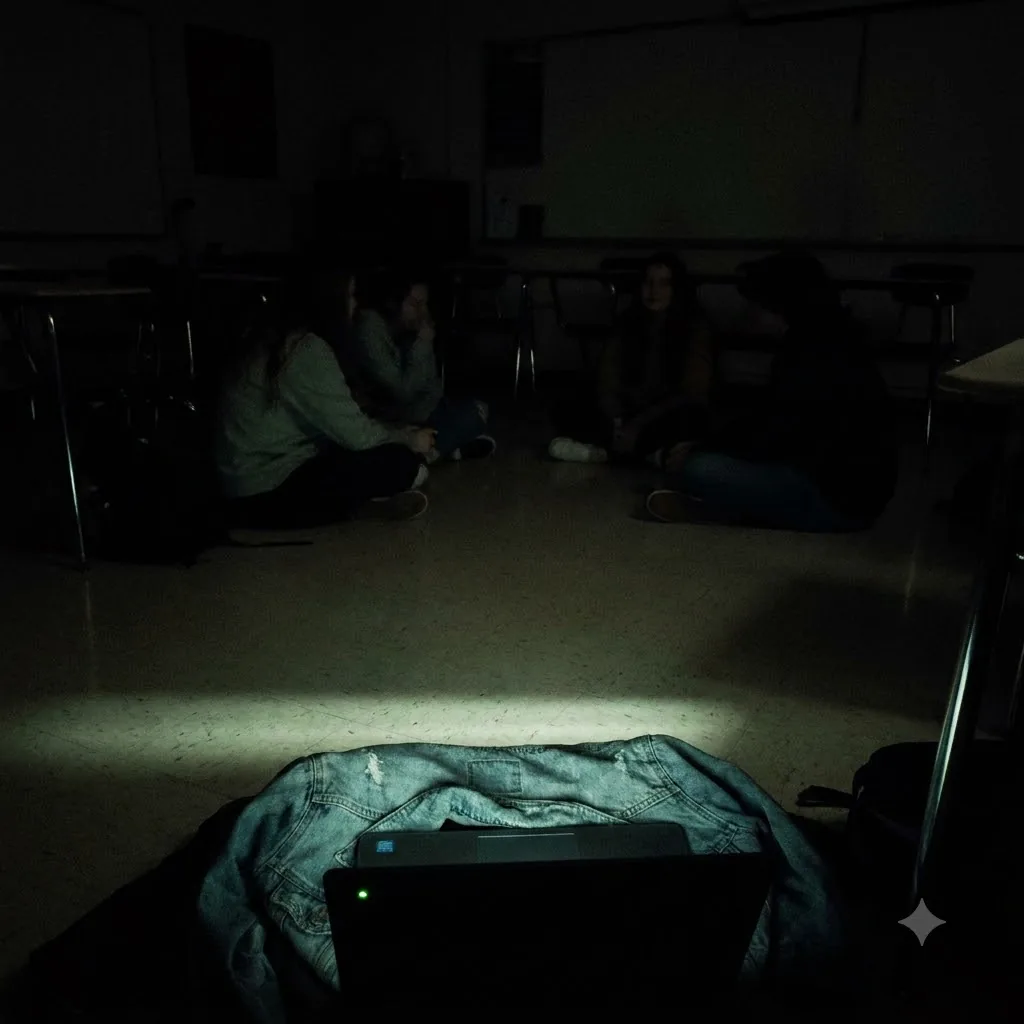
The sudden darkness that rushed back into Room 114 felt heavier than before. The synchronized electronic hum of the forty laptops had vanished, replaced by the ragged, uneven breathing of the students huddled under the risers. They had all just watched their own terror quantified in real-time, broadcast in high-definition glare.
Mr. Gellar didn’t tell them to be quiet anymore. The imposing choir director simply backed away from the barricaded double doors, his heavy hands trembling slightly as they dropped to his sides. He stared blankly at the dead Smartboard, the illusion of his authority entirely shattered.
Ten agonizing minutes later, the intercom crackled. The principal’s voice, usually a booming instrument of absolute control, wavered with a thin, reedy panic as he announced the all-clear.
The immediate consequences unspooled over the next seventy-two hours. Toby didn’t need to hack into the administrative network to see the fallout; it was broadcast in the tense, hushed conversations between teachers in the hallways and the defensive, heavily-worded emails sent to the parents. The district suspended the Aegis Focus software contract indefinitely. The district safety coordinator-the architect of the unannounced trauma simulation who had approved physically restraining Mr. Vance to keep the drill a secret-was placed on immediate administrative leave. The school board desperately tried to frame the incident in their press releases as an overreach by an independent contractor, an innocent safety experiment gone awry.
But Toby knew better. He had seen the Aegis Focus dashboard. The software hadn’t been a glitch; it had functioned exactly as designed. The district hadn’t bought a door-lock system. They had bought a behavioral data harvester, and the students’ visceral panic was the raw material.
By Wednesday, the physical lockdown was a memory, but the atmosphere in the high school felt permanently fractured. The district-issued Chromebooks had been confiscated on Monday morning for a “thorough network sanitization,” leaving the student body to navigate their classes in a strange, analog silence. The missing laptops felt less like a technological inconvenience and more like the removal of active listening devices.
When Friday arrived, Toby sat in the back row of his fifth-period study hall. The heavy wooden door clicked open, and Mr. Vance walked in, pushing a metal cart loaded with the sanitized laptops. The IT administrator looked profoundly exhausted. Deep, yellowish-purple bruises ringed his wrists, a lingering, physical testament to the zip-ties the safety contractor had used to force his compliance.
Mr. Vance didn’t speak to the room. He simply walked down the aisles, placing the cold plastic machines on the desks. When he reached Toby’s row, he paused. The IT administrator set a Chromebook down next to Toby’s open notebook. For a fraction of a second, Vance’s tired eyes met Toby’s. There was no smile, no verbal thanks, just a heavy, silent acknowledgment passing between the only two people who had actively fought back against the watcher in the dark.
Vance moved on, leaving Toby alone with the machine.
Toby didn’t open the lid immediately. He stared at the cheap gray plastic casing. Across the aisle, Sarah pulled her own laptop toward her chest. She didn’t press the power button. Instead, she reached into her backpack, pulled out a roll of heavy black electrical tape, tore off a jagged square, and pressed it firmly over the top bezel where the webcam lens rested.
Down the row, another student did the same with a brightly colored sticker. Then another. A ripple of quiet, mechanical rustling filled the study hall as students permanently blinded the cameras they no longer trusted.
Toby ran his thumb along the edge of his Chromebook. The administration had promised the biometric tracking software was entirely wiped from the hard drives. They promised the local network was secure. They promised the little green lights would never turn on without direct teacher permission again.
But the permanent damage wasn’t in the network code. It was in the realization that had settled like cold lead in Toby’s chest. The adults who were supposed to protect them hadn’t been testing the magnetic door locks or the emergency response times. They had intentionally locked them in a pitch-black room to watch them break. They had cataloged Sarah’s shaking hands, measured the spike of Toby’s heart rate, and reduced their absolute terror to a tidy column of clinical analytics on a corporate dashboard.
Toby slowly opened the lid of his laptop. The screen remained dead and black, reflecting his own pale face in the glossy bezel. The green LED light was off. The machine was technically asleep.
It didn’t matter. Toby knew that no matter how many scripts he wrote, no matter how many firewalls he bypassed or root shells he exploited, he could never delete the feeling of being watched in the dark. The administration had wanted to catalog their fear. Now, it was all they had left.