Story code: ST-001395
Part 2: The Blast Chiller
Four men stepped onto the crushed white gravel, their boots crunching in terrifying synchronization. They wore unmarked tactical gear-olive drab pants, lightweight plate carriers over black shirts, and drop-leg holsters. None wore masks, which meant they didn’t care about leaving witnesses. That realization alone sent a cold spike of adrenaline through Hector’s veins. He recognized the short-barreled carbines slung across their chests. This wasn’t a local gang shaking down a farm, and it wasn’t law enforcement. This was an extraction team. Or an execution squad.
Hector didn’t freeze. The panic of a civilian melted away, replaced instantly by the sterile, hyper-focused geometry of his previous life. Distance: forty yards. Cover: minimal, just the corrugated steel edges of the loading bay and a few stacked wooden pallets. Sightlines: the elevated dock gave him an angle on the lead vehicle, but the two flanking SUVs had cut off the sides of the courtyard.
He backed slowly into the shadows of the plastic strip curtains, letting the heavy, wet air of the packing shed swallow him. The diesel generators still roared behind him, masking the sound of his footsteps as he moved laterally behind a stack of empty plastic fruit bins.
“Hector!” The voice echoed over the courtyard, cutting through the mechanical drone. It was amplified, harsh, and metallic.
Hector peered through the slatted handles of a fruit bin. The man who had shouted stood beside the lead SUV. He wasn’t wearing body armor. He wore a sharply tailored tan jacket, standing with the relaxed posture of a man completely insulated from physical consequence. He held a megaphone in one hand and a heavy iron crowbar in the other.
“We know you’re in there, Hector,” the man in the tan jacket called out. “Or maybe you prefer Mateo? Or El Fantasma? It doesn’t matter. The agricultural camouflage is cute, but we don’t have time for a tour of the orchard.”
Hector’s breath leveled out. *Mateo.* No one had called him that in nine years. The ghost of his old identity wrapped around him like a heavy lead blanket. He patted his pockets. A radio, a pen, and a folding grafting knife with a curved, two-inch blade. Against six visible, heavily armed men.
“You have a very loyal workforce,” the man continued, pacing a few steps forward, the gravel crunching beneath his expensive loafers. “They didn’t want to tell us where you were. The shift manager-Elana, I think her name is?-very stubborn woman.”
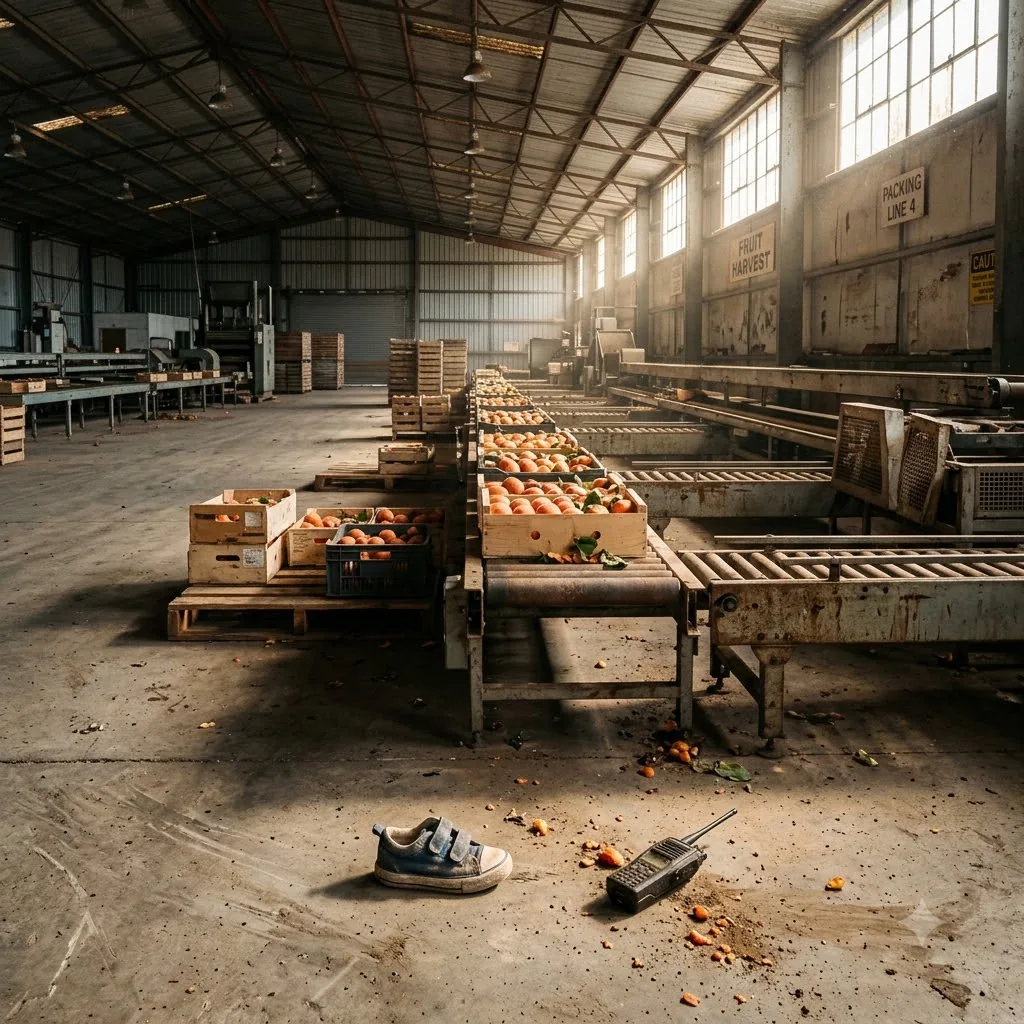
Hector’s grip tightened on the edge of the plastic bin. He thought of the dropped radio, the tiny pink sneaker glowing in the muddy puddle. The cold weight in his chest crystallized into a sharp, jagged rage, but he kept his breathing perfectly even. Rage made you sloppy. Rage got you killed.
“I’ll make this very simple,” the man in the tan jacket said, tossing the megaphone onto the hood of the SUV. He didn’t need it anymore; the sudden silence of the packing shed behind Hector meant someone had just cut the main breakers. The washing vats stopped churning. The sorting belts ground to a halt. The deafening roar of the diesel generators sputtered and died, leaving only the oppressive hiss of the valley wind and the ticking of hot engines in the courtyard.
Without the noise of the machinery, Hector could hear a faint, rhythmic thumping. It wasn’t coming from the yard. It was coming from his left.
He shifted his gaze across the loading dock toward the blast chillers-three massive, heavily insulated steel rooms used to pull the field heat out of the peaches before transport. The exterior locking bars on the main cooler had been thrown shut, secured not with standard padlocks, but with heavy logging chains wrapped tightly around the handles.
The thumping was coming from inside the thick steel doors. Faint, muffled, desperate strikes against the metal.
“Thirty-four people,” the man said, his voice carrying easily in the new silence. “Including the little one. I read the specs on these agricultural coolers, Hector. Hermetically sealed. Airtight. Designed to suffocate the fruit with nitrogen to slow the ripening process. Right now, your people are breathing their own carbon dioxide. In the dark. And it is freezing in there.”
Hector’s eyes traced the pressurized ammonia lines running along the roof of the cooler, then dropped to the chained handles. Thirty-four people. His people. The ones who had invited him to their weddings, the ones who had helped him build this quiet, boring life from the dirt up.
“You took something from my employer a long time ago,” the man said, leaning against the grille of his SUV. “A ledger. A physical black book. He wants it back. He knows you didn’t burn it, because a man like you always keeps an insurance policy.”
Hector knew exactly what book he meant. It was buried in a PVC pipe beneath a peach tree in sector four, three miles away. It contained bank routing numbers, shell companies, and the blood trails of a cartel faction he had dismantled to buy his own freedom. If he handed it over, they would kill him. If he didn’t, they would kill everyone on the farm. They would likely kill everyone anyway, just to leave no witnesses.
“I give you the book, you let them go,” Hector shouted, stepping out from behind the bins, his voice projecting across the loading bay. He kept his hands visible, empty.
The armed men instantly raised their rifles, centering their optics on his chest.
The man in the tan jacket smiled. “There he is. The ghost in the flesh.” He checked a heavy silver watch on his wrist. “You have the book on you?”
“It’s hidden,” Hector said, stepping forward to the edge of the dock, letting the brutal heat of the sun hit his face. “Takes an hour to dig up.”
The man laughed, shaking his head. “Always negotiating. Always controlling the timeline. No, Mateo. You don’t have an hour.”
He snapped his fingers. One of the tactical men walked over to the side of the blast chiller, pulling a heavy pair of industrial bolt cutters from a duffel bag. But he didn’t aim for the chains on the door. He aimed for the high-pressure ammonia release valve near the base of the unit.
“That valve flushes the system,” the man in the tan jacket said softly. “You crack that pipe, the liquid ammonia floods the sealed room. It burns the eyes first. Then the lungs. They’ll drown in their own fluids in about three minutes.”
The tactical operator clamped the heavy steel jaws of the bolt cutters around the brass valve stem, looking back at his boss for the signal.
“You have five minutes to put that book in my hand,” the leader said, his smile vanishing entirely. “If you don’t, we crack the valve. If you try to run, we shoot you, then we crack the valve.”
The thumping against the steel door grew frantic. A muffled, terrified scream bled through the thick insulation. Hector looked at the four armed men, the chained doors, and the bolt cutters resting on the deadly valve. The math was impossible. The distance was too great.
But he was no longer a peach farmer.
Hector slowly lowered his hands, feeling a familiar, deadly stillness settle over his mind. “Five minutes,” he echoed, slipping his right hand into his pocket, his thumb finding the release stud of the grafting knife.