Story code: ST-000697
Part 2: Containment Breach
Arthur watched the terminal window transform into a relentless waterfall of crimson text. Standard 404 and 502 routing errors typically logged in a dull, unobtrusive yellow, but the massive cascade of reverse-ping requests flashing across his secondary monitor triggered the system’s highest internal threat protocols. The seven devices hidden within the West 44th Street residential block were not simply dropping the commercial ad payloads; they were aggressively bouncing them back. Worse, they were using the active connection established by Arthur’s optimization script to trace the origin of the geographical override.
He slammed his palm against the escape key, then hammered `Ctrl+C` in rapid succession, attempting to force-quit the Python script he had just executed. The terminal ignored the standard interrupt commands. The command line was completely locked, hijacked by the sheer volume of incoming traffic. Arthur’s eyes darted across the scrolling logs, catching fragments of the incoming data packets. These were not random bursts of corrupted network noise. They were highly structured, sequential port scans. The external devices were systematically rattling the digital doorknobs of the Omnia Data server cluster, searching for an open vulnerability.
Arthur grabbed his mouse, dragging the cursor toward the system task manager to manually terminate the process tree from the root. The cursor stuttered across the screen, lagging a full second behind his physical hand movements. The CPU usage on his workstation was spiking dangerously high, and the heavy cooling fans suddenly roared to life beneath his desk, whining like miniature turbine engines.
“Come on, drop the connection,” he muttered to the empty room, his voice swallowed instantly by the vast, silent expanse of the seventy-fourth floor.
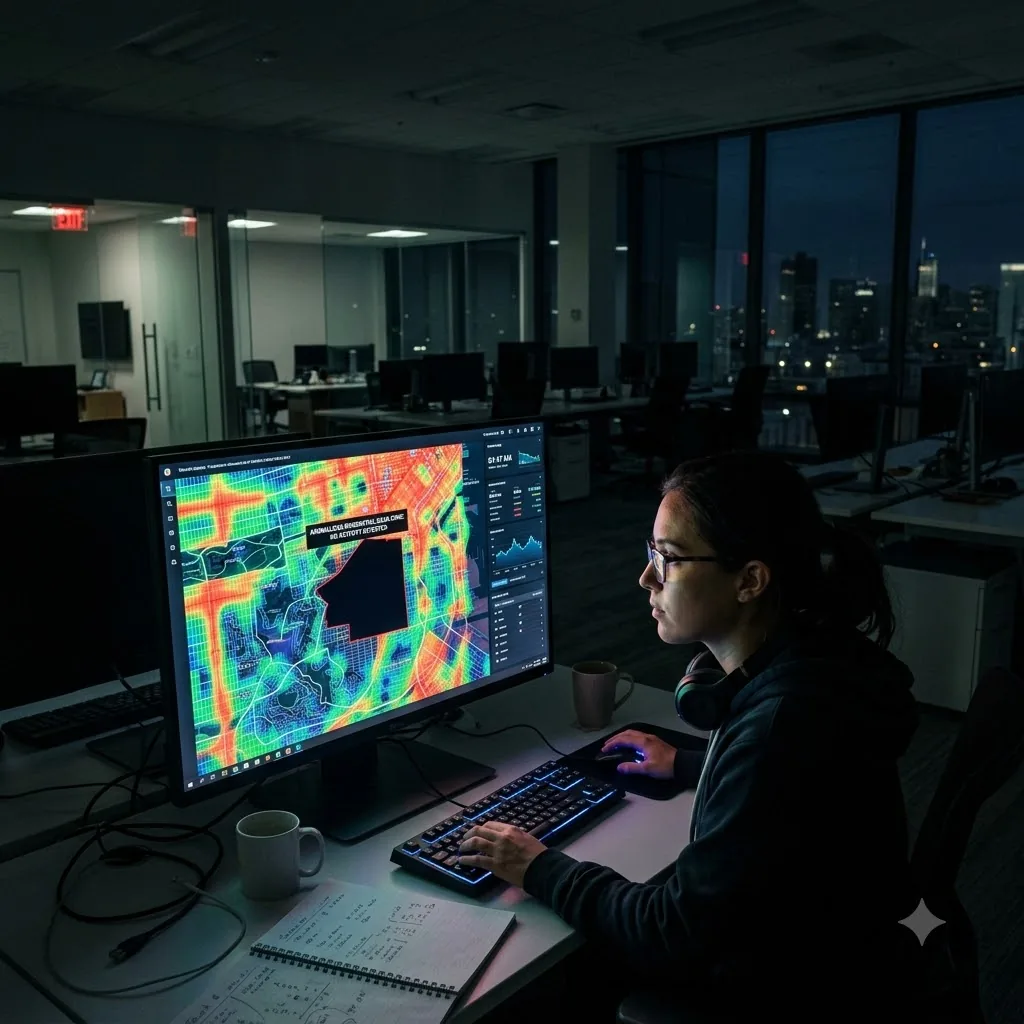
He pulled up the master network diagnostic tool on his primary ultra-wide monitor. The visual representation of the active data flow was terrifying. His brute-force patch had successfully built a digital bridge to force the stubborn devices onto the commercial map, but now those seven unknown entities were utilizing that exact bridge to march straight into the corporate intranet. Nodes on the diagnostic map that usually glowed a healthy green were rapidly flashing red as the incoming packets bypassed the automated ad-exchange servers and began targeting his local subnet.
Panic began to thread itself through his chest. He looked over the low partitions of the surrounding cubicles. The floor was completely dark, illuminated only by the faint, greenish glow of emergency exit signs and the harsh white light bleeding from his own monitors. He was the only engineer with active credentials in the building this late on a holiday. If a catastrophic network breach occurred, the automated security logs would show his employee ID as the sole point of failure. His quarterly optimization metrics would not matter if he compromised the entire regional database.
Arthur reached for the VoIP desk phone to escalate the issue to the global security operations center in London. He dialed the internal emergency extension, pressing the receiver to his ear. Instead of a ringing tone, the handset emitted a high-pitched, digital squeal that made him flinch. The internal voice network was already saturated by the attack. He was entirely cut off from the rest of the company.
He dropped the phone back onto its cradle and stared at the screens. The automated firewall was buckling under the pressure. The reverse-pings had mutated into active handshake requests. The devices were no longer trying to scrub their location; they were actively mapping his.
Arthur frantically typed a new sequence into a fresh, uncompromised command window, attempting to manually sever the localized routing table. He inputted `ipconfig /release` followed by a hard flush of the DNS cache, executing the commands with a heavy strike of the enter key. The commands processed, but the red text kept flowing unabated on the secondary monitor. The external devices had already established a persistent shell.
The realization hit Arthur with the physical weight of a sudden drop. The localized dead zone on West 44th Street had never been a legacy routing error or a database glitch. It was a deliberate, highly engineered quarantine. Someone, or something, had artificially scrubbed those specific coordinates to keep those seven devices strictly isolated from the global grid. By brute-forcing the geographical metadata for a minor bump in ad revenue, Arthur hadn’t fixed a system error-he had breached a containment protocol from the inside out.
The CPU fans screamed louder, vibrating the floorboards beneath his feet. The primary ultra-wide monitor flickered violently. The vibrant retail heat map dissolved into a static field of gray pixels before refreshing into a raw, unfiltered text dump. The devices were pulling data now. Arthur watched helplessly as heavily restricted directories flashed across the screen: executive employee rosters, internal server architectures, and encrypted client financial databases. The seven devices were draining the Omnia Data mainframe through the tiny pinhole he had punched in their shield.
He had to sever the physical connection. It was the only definitive way to kill the session.
Arthur shoved his ergonomic chair back, dropping to his knees on the industrial carpet. He scrambled under the desk, pulling his smartphone from his pocket and activating the flashlight to cut through the shadows. He traced the thick, blue Ethernet cable from the back of his tower workstation to the secured wall port. He gripped the plastic connector, squeezed the locking tab until it clicked, and yanked the cable free from the wall.
Silence returned to the cramped space under the desk, save for the furious, uninterrupted spinning of the cooling fans. Arthur stayed on his knees for a long moment, catching his breath, listening to the steady hum of the building’s HVAC system. He had stopped it. It would cost him a massive disciplinary hearing on Tuesday morning, and he would have to explain his unauthorized Python script to the security review board, but he had physically severed the connection before the external devices could reach the core client servers.
He climbed out from under the desk, wiping dust from his slacks, and dropped back into his chair. He looked at the monitors, fully expecting to see the standard disconnected network icon on his taskbar.
Instead, the red text was still scrolling rapidly down the secondary monitor.
Arthur stared, his heart hammering a frantic rhythm against his ribs. The blue Ethernet cord lay dead on the floor. His workstation did not have a wireless card installed; Omnia Data’s strict security policy expressly forbade internal Wi-Fi components on the core engineering floors. His machine was physically air-gapped.
Yet, the data flow had not stopped. In fact, it was accelerating. The devices were no longer just pulling data. They were writing it. A new progress bar appeared in the dead center of his primary monitor, an unauthorized installation package rapidly unpacking itself directly onto his local drive.
Arthur reached frantically for the hard power button on the front of the tower, but before his trembling fingers could find the switch, the overhead fluorescent lights in his section of the seventy-fourth floor suddenly snapped off with a sharp clack, plunging him into darkness and leaving him bathed only in the harsh, blood-red glare of his breached terminals.