Story code: ST-001191
Part 2: The Human Override
Richard’s microphone let out a sharp, electronic squeal. He shoved his chair back, the metal legs scraping harshly against the linoleum, and stared at the thick manila folder resting directly on top of his printed agenda. The dozen or so residents in the folding chairs behind Marcus murmured, suddenly awake and shifting in their seats.
“Mr. Hayes,” Richard said, his voice amplified and shaking slightly. He reached for the microphone stand and bent it away from his face. “You are out of order. The public comment period is scheduled for the end of the-”
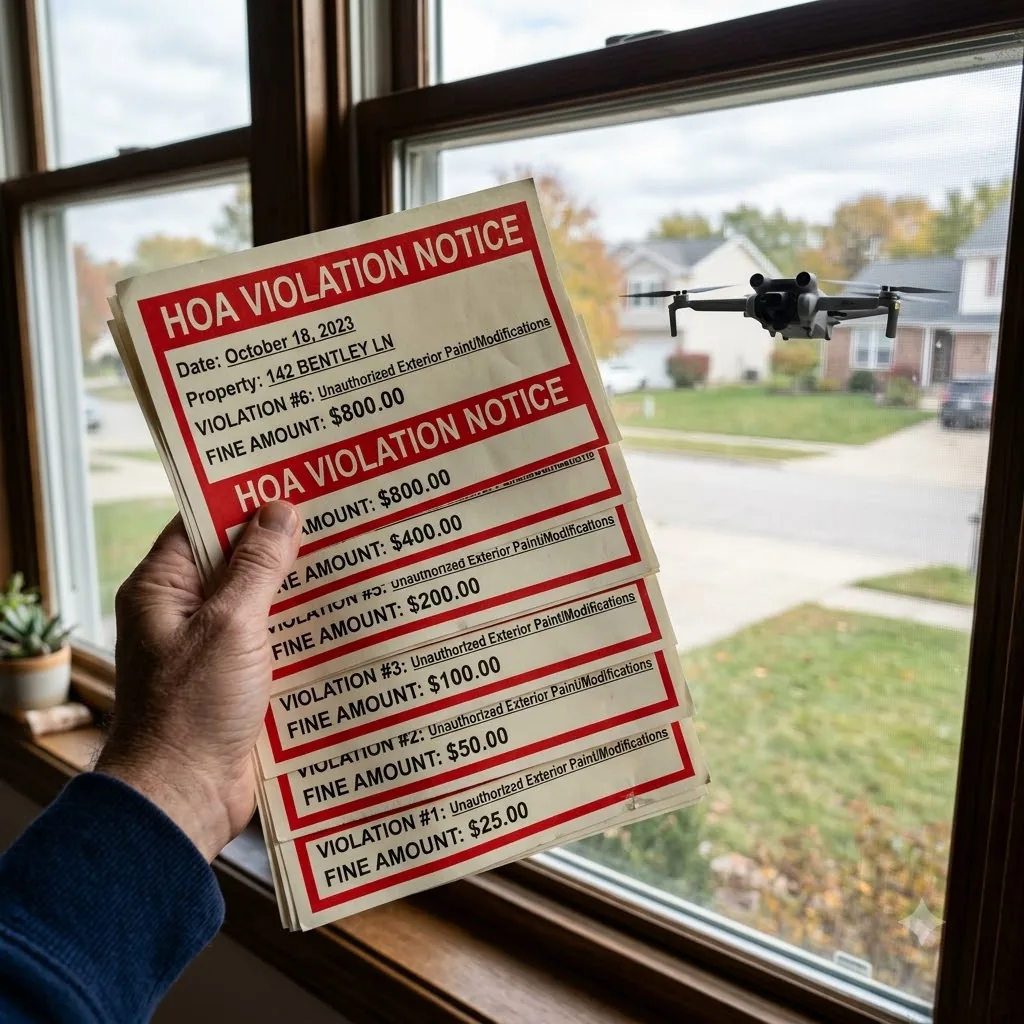
“The automated system you bought is trying to steal my house,” Marcus said. He kept his voice level, but it carried to the back of the small, quiet room. He flipped the heavy folder open. He spread the seven violation notices across the folding table, laying them out in a neat grid right over the pool maintenance budget. “Fifty dollars. A hundred. Two hundred. All the way to three thousand two hundred dollars. Seven days. Six thousand, three hundred and fifty dollars in total fines.”
Richard wouldn’t look at the papers. He kept his eyes fixed nervously on Marcus’s chest. To Richard’s right, a board member named Evelyn adjusted her thick cardigan and peered down at the notices through her reading glasses.
“The drone system operates on a standardized rubric,” Evelyn said, her tone dripping with rehearsed customer-service patience. “It ensures absolute impartiality across the neighborhood. If you received a citation for turf neglect, it means the algorithm detected a sub-optimal chlorophyll ratio in your front yard.”
Marcus pulled out his high-resolution photographs and slapped them down on top of the drone’s pixelated black-and-white images. “It detected rocks. It detected agave, red yucca, and blue fescue. I spent three weeks tearing out the water-hogging sod to install a drought-tolerant xeriscape. It is not dead weeds. It is a desert garden.”
Richard finally glanced down at the glossy photographs. He blinked, but his expression didn’t soften. Instead, he folded his hands tightly on the table. “Did you submit an Architectural Control Committee request for a desert garden?”
Marcus gripped the edge of the folding table. “That’s not what I was cited for. The drone didn’t fine me for an unapproved modification. It fined me for dead grass. It compounded the fine every single afternoon. And your web portal automatically rejected my appeal with zero human oversight. I need you to cancel these fines right now, before the system files a property lien.”
“We don’t cancel fines manually,” Richard said, leaning back and putting more distance between himself and the photographs. He looked at the small crowd, then back to Marcus. “The HOA contracted with an automated management company, OmniTract, to remove human bias from enforcement. The board doesn’t interfere with the software’s dispute resolution process.”
“The software didn’t resolve anything,” Marcus said, his voice rising a fraction. “It rejected my photographic evidence in zero point four seconds. It didn’t look at the appeal. It’s a closed loop.”
“If the system rejected it, then your evidence did not meet the parameters for an override,” Evelyn said smoothly. She tapped a pen against her legal pad. “You can formally appeal to the board during our quarterly variance hearing.”
“Quarterly?” Marcus stared at her. “The seventh notice says any balance over five thousand dollars triggers an automatic foreclosure. The red text on the final letter says the lien process begins immediately upon a rejected appeal. I don’t have a quarter of a year.”
Richard cleared his throat. “Then you should pay the balance to halt the automated collections process, and we can discuss a potential partial refund at the variance hearing next month. Provided you retroactively submit the proper architectural forms.”
Marcus looked back and forth between Richard and Evelyn. He realized they weren’t just being stubborn. They were terrified. They had handed the keys of the neighborhood over to a black-box software vendor to save money on security patrols, and now they had no idea how to stop the machine they had purchased. He could see it in Richard’s eyes-the board didn’t even have the administrative access to log in and delete a fine if they wanted to.
“I am not paying six thousand dollars for planting a yucca,” Marcus said. “I am asking you, the elected board of this neighborhood, to look at this photograph of a living plant, look at this drone photo of a blurry gray blob, and use your human eyes to void a mechanical error.”
“Mr. Hayes,” Richard said, his tone shifting from nervous to defensive. He grabbed a wooden gavel he rarely used and tapped it lightly against a plastic coaster. “You are disrupting an official meeting. The OmniTract system is working exactly as intended to protect our property values. If you do not return to your seat, I will have the secretary log a noise nuisance violation against your address.”
“A noise violation?” Marcus asked in disbelief.
“Two hundred dollars,” Evelyn warned, not looking up from her pad. “Automatically added to your ledger.”
A man in the back row of folding chairs stood up. “Come on, Richard, just look at his pictures. The drone tried to fine me fifty bucks last week because my kid left a green bicycle on the lawn and the camera thought it was an unapproved shrub!”
“Order!” Richard shouted, leaning into the microphone so his voice boomed through the room. “Any resident attempting to bypass the OmniTract portal will be cited!”
Marcus stood paralyzed by the sheer bureaucratic cowardice sitting across the table. He reached out to gather his papers. He snatched the drone photos and his glossy garden prints, shoving them back into the manila folder. The board members watched him, their faces pale but set in stubborn, defensive masks. They would rather let a machine take his home than admit they lacked the authority to turn it off.
As Marcus zipped his folder shut, his phone buzzed violently in his jacket pocket.
He pulled it out. The screen glowed with a new email notification from the Oakridge Estates resident portal.
Marcus opened it. The template was identical to the last one, devoid of any human signature.
*Notice of Escalation*, the subject line read.
He scanned the brief text. *Balance of $6,350.00 remains unpaid following appeal denial. Account has been transferred to OmniTract Legal Division. Property lien filed with the county clerk. Legal processing fee of $1,500.00 has been assessed to your account. Eviction scheduling will commence in 14 days.*
Marcus looked up from the glowing screen. Richard was already leaning back into the microphone, reading the next line of the pool chemical budget, pretending Marcus didn’t exist. The machine had just added fifteen hundred dollars to his debt, and the countdown to eviction had officially started.