Story code: ST-001539
Part 2: The Liability
Marcus read the bolded text again, his brain struggling to process the stark black letters.
**WARNING: IMMINENT SUBSURFACE COLLAPSE AND CLASS-A HAZARDOUS MATERIAL DESIGNATION. ESTIMATED REMEDIAL LIABILITY: $38,500,000.**
The numbers swam before his eyes, blurring into a nonsensical string of zeros. Marcus swallowed hard, the dry, dusty air of the living room suddenly feeling as thick as wet cotton. Thirty-eight million dollars. The entire annual budget for the city’s downtown redevelopment project-the cornerstone of the mayor’s re-election campaign-was barely twelve million. If the city officially took possession of this parcel through eminent domain, as the court-ordered notice in his left hand dictated, they wouldn’t just be taking an old house. They would automatically inherit the legal liability attached to the poisoned soil beneath it.
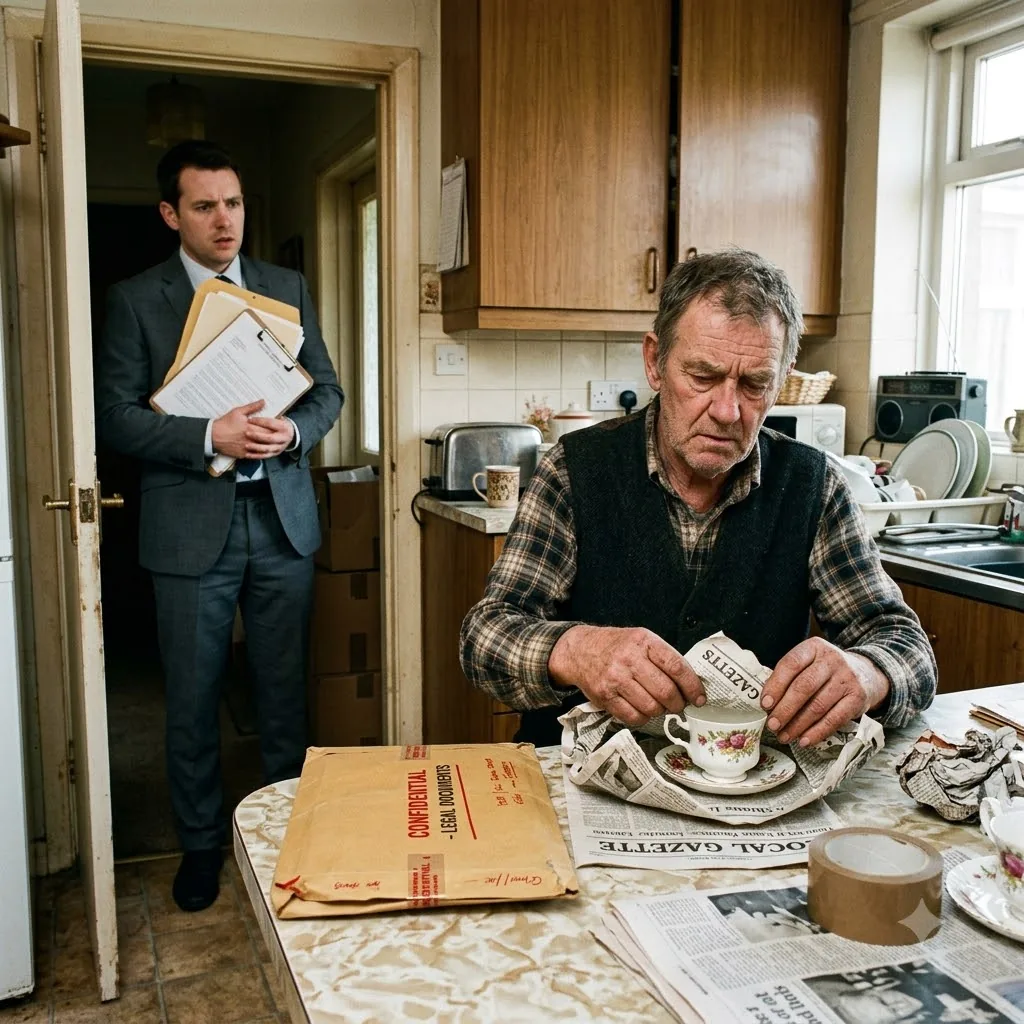
He slowly looked up from the stapled packet. Arthur Pendelton was standing at the far end of the dining table, carefully folding a sheet of yesterday’s sports section around a delicate porcelain sugar bowl. The man’s massive, grease-stained thumbs moved with practiced, deliberate grace.
“Where did you get this?” Marcus asked. His voice cracked, sounding thin and reedy in the cavernous, empty room. He cleared his throat and tried again, aiming for the firm, authoritative tone he had spent the entire morning practicing in the mirror. “Mr. Pendelton, what exactly is this document?”
Arthur didn’t look up from his packing. He placed the wrapped sugar bowl next to the gravy boat in the cardboard box, nesting it perfectly among the crumpled newspaper. “Private geological survey,” the steelworker said. His voice was a low, gravelly rumble, thick with disuse. “Hired them with my pension money three months ago.”
“This… this summary states that the ground under this entire residential block is hollowed out. Filled with toxic runoff from the old iron mill.” Marcus flipped frantically to the second page, scanning the dense paragraphs of chemical breakdowns, groundwater contamination levels, and soil stability metrics. “It says the limestone bedrock is actively dissolving.”
“Mill dumped acid slag in the old mining tunnels for thirty years,” Arthur said, reaching for the heavy plastic tape dispenser. “Everybody in the union knew it. Nobody looked too close because the paychecks cleared. Now the water table shifted, and the acid is eating the limestone pillars holding up the street.”
*Shhrrrk.*
The sharp, tearing sound of the packing tape unspooling made Marcus flinch. The noise seemed violently loud in the quiet house.
“If this report is accurate,” Marcus said, his mind racing through the catastrophic legal and financial implications, “this whole neighborhood is a sinkhole waiting to happen. The new retail center the city is planning… the foundations would crack before the contractors even finished pouring the concrete. The EPA will freeze the entire zip code.”
“Yep.” Arthur pressed the clear tape down over the cardboard flaps, smoothing it out with the heel of his hand. He picked up his thick black marker and wrote *KITCHEN – WIFE’S* across the top in neat, block letters.
Marcus stared at the calloused hands moving with such methodical, terrifying calm. It suddenly made sense. The six months of screaming at town halls, chaining himself to the porch railing in freezing rain, and disrupting city zoning meetings with a bullhorn-Arthur hadn’t been fighting to keep his house. He had been stalling. He had been buying time to quietly gather the irrefutable geological proof, waiting for the exact moment the city forced the seizure.
Eminent domain wasn’t just the seizure of land; it was the legal assumption of title. And with the title came the absolute responsibility for whatever lay beneath the dirt. Arthur wasn’t being evicted today. He was executing a calculated, devastating transfer of toxic debt. He was letting the city force him out so they would be left holding the grenade when it detonated.
“I need to make a phone call,” Marcus said, his hands trembling as he fumbled in his tailored slacks for his cell phone.
He dialed the mayor’s chief of staff, pressing the phone hard against his ear as he paced toward the stripped hallway. The line rang three times before connecting.
“Marcus,” the crisp, perpetually impatient voice of Richard Hayes snapped through the tiny speaker. “Tell me you have the Pendelton property secured. The demolition crews are at the staging area at the end of Elm Street.”
“Richard, we have a massive problem,” Marcus said, turning away from Arthur and lowering his voice to a frantic whisper. “I’m looking at a privately commissioned geological survey. The soil under Pendelton’s lot-hell, under the whole northern development zone-is heavily contaminated with mill runoff. The bedrock is structurally compromised. The mandated cleanup liability is nearly forty million dollars.”
There was a sharp beat of silence on the line. Then, Richard sighed loudly. “Are you seriously falling for this, Marcus? The man dumped two tons of slag iron on the steps of City Hall. He’s a blue-collar lunatic trying to save his childhood home. It’s a forged document meant to scare a junior councilman into halting an eviction.”
“It doesn’t look forged, Richard. It’s got the official seal of the state environmental board stamped on the appendix. We need to halt the seizure immediately. If I hand him this eviction notice and we take possession of the deed today, the city goes utterly bankrupt.”
“Listen to me very carefully,” Richard said, his tone dropping to a dangerous, icy whisper. “Apex Developers has already wired the escrow funds. The press pool is going to be at the ribbon-cutting for the groundbreaking tomorrow morning. The mayor’s campaign hinges on this urban renewal project. If you do not execute that eviction notice right now, you are fired, and I will personally see to it that you never work in local government again. Do not let that uneducated steelworker play you. Serve the notice, clear the property, and signal the bulldozers.”
“Richard, wait, you don’t understand-”
The line went dead.
Marcus slowly lowered the phone. A cold, prickling sweat broke out across his forehead, plastering his collar to his neck. He turned back to the dining room.
Arthur had finished taping the final box. He walked over to the front window and pulled back the edge of a faded moving blanket that had been nailed over the glass to block the sun.
A low, rhythmic rumble began to vibrate through the hardwood floorboards. It wasn’t distant thunder. It was the heavy diesel engines of the demolition excavators and bulldozers rolling down Elm Street, accompanied by the flashing blue-and-red lights of two sheriff’s cruisers leading the convoy. They were exactly on time.
Marcus looked down at the official eminent domain notice in his sweating left hand, and the geological disaster report in his right. He was completely trapped. If he defied Richard’s orders, his political career was instantly over, and the city would likely send someone else to force the eviction anyway. If he served the notice, he would be the man who legally bound Oakhaven to a forty-million-dollar toxic nightmare that could bankrupt the municipality.
Arthur turned away from the window, letting the heavy blanket fall back into place. He picked up a heavy ring of brass keys from the windowsill.
He walked over to Marcus, his face still entirely devoid of the violent fury the councilman had spent weeks preparing to face. The heavy machinery outside grew louder, rattling the remaining glass in the windowpanes. Fine white dust drifted down from the ceiling plaster, dislodged by the intense vibrations of the approaching treads.
Arthur stopped two feet away and held out the keys.
“City wants it so bad,” Arthur said softly, his tired gray eyes locking onto Marcus’s panicked face. “City’s got it.”
Marcus stared at the dangling keys, the worn brass glinting in the dusty light. The rumble outside grew to a deafening roar, shaking the floor beneath his dress shoes so violently his teeth rattled, and Marcus realized with sickening clarity that the vibration wasn’t just from the engines-the ground itself was already starting to give way.