Story code: ST-000644
Part 2: Contraband
The five-point silver star caught the harsh, flickering glare of the overhead fluorescent lights. It was heavy, polished, and unmistakably official. Mateo’s breath caught in his throat, a sudden block of ice settling in his stomach. A deputy. Or a federal marshal. The specific jurisdiction didn’t matter; the implication was universally terrifying. For an undocumented immigrant keeping his head above water by working under a borrowed nursing license, any law enforcement presence was a direct threat. If this officer died on his gurney, the hospital would instantly swarm with investigators and brass demanding answers. Every chart would be audited. Mateo’s carefully constructed existence would disintegrate in hours, resulting in zip-ties and a one-way deportation flight.
He instinctively shoved the leather wallet back inside the shredded lining of the tactical jacket, folding the torn canvas over it to hide the star from the chaotic room. His heart hammered a frantic rhythm against his ribs. He told himself to step away. He could flag down the charge nurse, claim exhaustion, and let a resident handle the dying cop. But the man on the gurney let out another wet, agonizing hitch. The cyanosis was creeping past his lips, turning his thick neck a bruised purple.
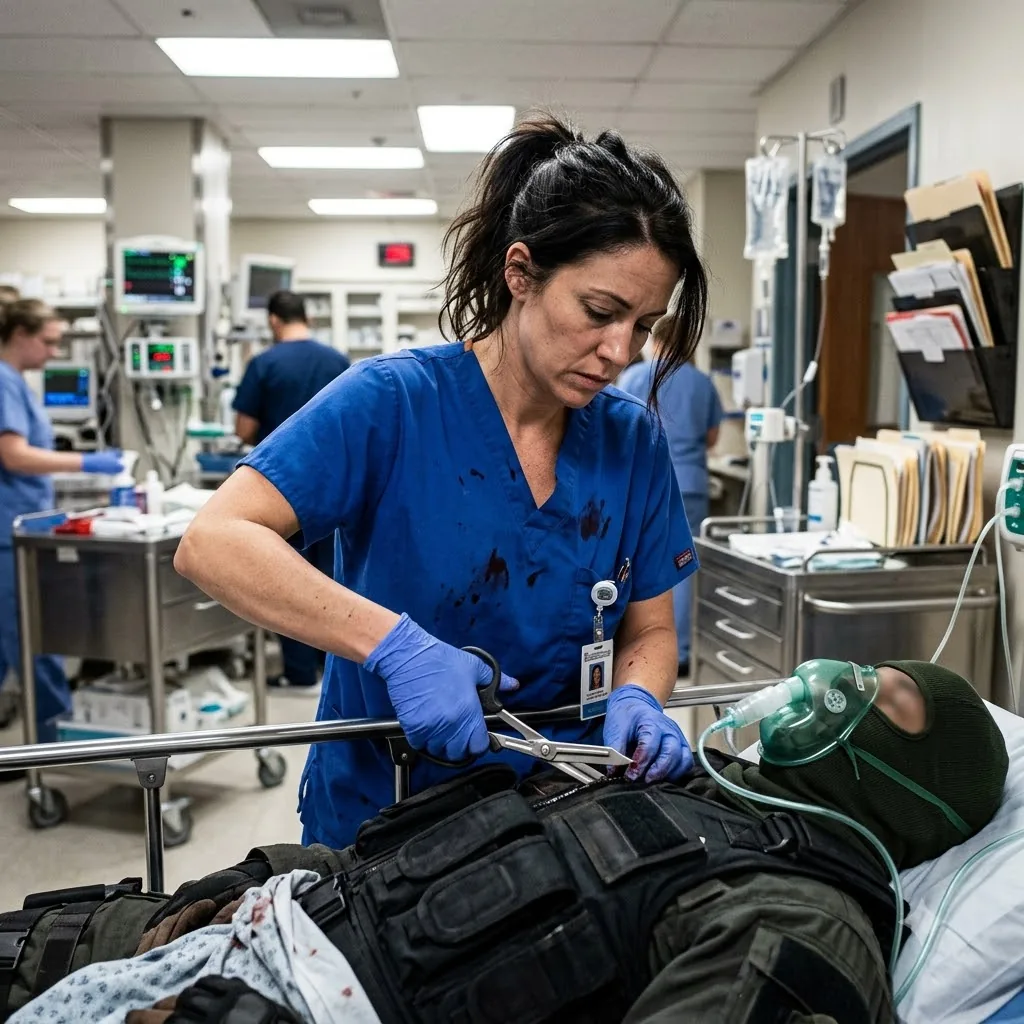
Duty and panic warred violently in Mateo’s chest. Cursing his own unwavering conscience, he grabbed the trauma shears again and dug into the remaining layers of nylon. He sliced horizontally across the heavy chest rig, pulling the rigid panels apart to expose the sternum. As the Kevlar lining shifted, something dislodged from a hidden, velcro-sealed compartment near the armpit. A thick, vacuum-sealed plastic bag slid silently out of the gear, landing square on the patient’s pale, sweat-slicked chest.
Mateo stared at it. The bag was densely packed with a fine, chalky powder, distinctly tinted a pale, chemical blue. It was the exact visual signature of the lethal street fentanyl currently suffocating half the teenagers in the emergency room. It wasn’t a small, personal-use bindle. It was a massive brick, heavy enough to supply a hundred corners.
The air in the trauma bay turned to lead. The man bleeding out in front of him wasn’t an undercover officer trying to bust a ring; undercovers didn’t carry weight like that taped inside their armor during a massive overdose event. This was the source. This was the bad batch. And the officer was holding.
Before Mateo could process the sheer danger, the cardiac monitor above the bed emitted a solid, piercing tone. The agonal gasping stopped. The man’s chest went entirely still.
Clinical training hijacked his frozen limbs. He swept the baggie of blue powder off the patient’s chest and shoved it blindly deep into his own scrub pocket, hiding the contraband just as a passing resident glanced toward Bay Five. He couldn’t let anyone see it, not until he figured out how to survive the fallout. He ripped the backing off the adhesive defibrillator pads and slapped them onto the cop’s clammy skin.
He mashed the analyze button. “Ventricular fibrillation,” the machine announced in a synthetic voice.
“Charging!” Mateo shouted, though the screams from Bay Four completely drowned him out. He stood clear, hit the flashing button, and watched the massive body jolt sharply against the mattress as two hundred joules slammed through the dying heart.
The monitor displayed a chaotic scribble. No pulse.
Mateo dragged the yellow step-stool closer, climbed up, and laced his fingers over the center of the man’s broad chest. He locked his elbows and threw his weight downward. The cartilage in the sternum gave way with a sickening crunch. He pumped hard and fast, counting out loud, his lower back screaming in agony. He was alone on the island of Bay Five. Sweat poured down his forehead. After two grueling minutes of compressions, he paused just long enough to grab a pre-filled syringe of high-dose Narcan. He drove the needle straight into the thick muscle of the patient’s outer thigh, pushed the plunger down, and immediately resumed chest compressions.
“Come on,” Mateo hissed through clenched teeth, his arms burning. “Don’t die on me. Not yet.”
Fourteen. Fifteen. Sixteen.
On the seventeenth compression, the massive body beneath him arched violently. The transition from clinical death to hyper-aroused consciousness was explosive. The Narcan ripped the opioids from the brain’s receptors, sending the patient’s nervous system into sudden, agonizing overdrive.
The cop’s eyes snapped open. The pupils were fully dilated, exposing rings of frantic, bloodshot white. He inhaled with a desperate, tearing roar, spraying bloody foam across Mateo’s face shield. Before Mateo could recoil off the stool, a massive, calloused hand shot upward.
Thick fingers locked around Mateo’s throat like an industrial steel vise. The grip was impossibly strong, driven by raw adrenaline. The cop hauled his torso off the bloody gurney, dragging Mateo down until their faces were inches apart. The man’s breath reeked of chemical decay.
The officer’s manic gaze darted downward, registering his ruined tactical vest. He saw the torn fabric where his wallet was loosely hidden. Then, his eyes locked onto the heavy, square bulge protruding from Mateo’s lower scrub pocket. A trace of pale blue powder dusted the edge of the fabric where the baggie had scraped against the seam.
The sheer panic in the cop’s eyes instantly hardened into a lethal, calculated rage. His grip tightened ruthlessly on Mateo’s trachea, completely cutting off his oxygen. Mateo clawed desperately at the massive forearm, his boots slipping on the step-stool.
“Where is it?” the cop hissed, his voice a wet, rattling gravel that barely carried over the screeching monitors. He leaned closer, using his bulk to block the sightline from the rest of the ER, his thumb pressing directly into Mateo’s carotid artery. “Who else saw?”