Story code: ST-001596
Part 4: After the Crowd Went Quiet
For one suspended second, the whole driveway seemed to listen to the last of Gavin’s own voice fading out of the phone.
Then the block changed sides.
Not with any speech or sudden bravery. Just the small ugly sounds people made when they realized they had been standing too close to the wrong version of things. Mrs. Kemp took two steps back from Gavin as if his shirt might stain. The women under the sycamore stopped pretending they were only curious. Even the younger officer’s face lost that settled, paperwork-saving patience.
Gavin recovered first, or tried to. “That doesn’t prove what she’s implying,” he said. His tone was still measured, but the polish had cracked. “I was talking about a probate delay. Family disputes happen all the time. Lottie was upset and out of breath. Context matters.”
“It sure does,” the tow truck driver said from his cab.
Nobody laughed.
The older officer held out his hand. “Phone. Paperwork. Now.”
This time Gavin did not hand either over smoothly. He hesitated just long enough for everyone to see it, and that hesitation did more damage than the audio had. He looked toward the street, toward his SUV, toward the little pockets of witnesses he had spent weeks cultivating with smiles and cards and helpful talk. None of them moved for him.
Nia watched him understand, piece by piece, what he had lost.
Not just the tow. Not just the paper in his hand. The ease of the block. The open doors, the porch chats, the way older people had begun saying his name like he was some useful young man who knew forms and markets and how to make hard transitions simpler. The neighborhood had been his tool before it became his audience. Now it was turning into memory against him.
He gave the officer the contract. Then, after a beat, he gave over his phone too.
The younger officer took it. The older one folded the sales paper back along its crease and looked at the witness line again. Nia could see him doing the math now that the scene had become inconvenient enough to require actual thought.
Gavin tried one more time. “I haven’t done anything but help that woman. Ask anybody. She called me herself.”
“No, she didn’t,” Mrs. Kemp said.
Her voice shook, but it carried. Heads turned toward her.
She swallowed. “He left flyers first. Then he started catching her outside. Then he knocked even when her curtain was closed. I told him twice she wasn’t interested.”
The nephew with the phone shifted where he stood. “He asked me one time if Miss Lottie had family nearby,” he said, not looking at anyone. “Said he hated seeing seniors pressured by relatives hanging on for inheritances.”
That landed too.
A hot, embarrassed murmur moved through the yard. Nia knew what they were hearing now inside their own heads: every time they had repeated Gavin’s version because it sounded tidy, every time they had watched from the curb and let Lottie become a scene instead of a person. Their guilt did not make them noble. It just made them late.
The officers told Gavin he was done for the evening and not to go back onto the property. They said it in the flat official way men used when they wanted control without spectacle. He started to argue, thought better of it, and aimed one last look at Nia.
It was not rage that unsettled her. Rage would have been cleaner. What she saw instead was calculation still running, still searching for a smaller door after the front one had slammed shut.
“This isn’t over,” he said quietly.
Nia held his gaze. “Not for Lottie, no.”
He left without another word. His loafers finally touched dirt.
The tow truck backed out empty.
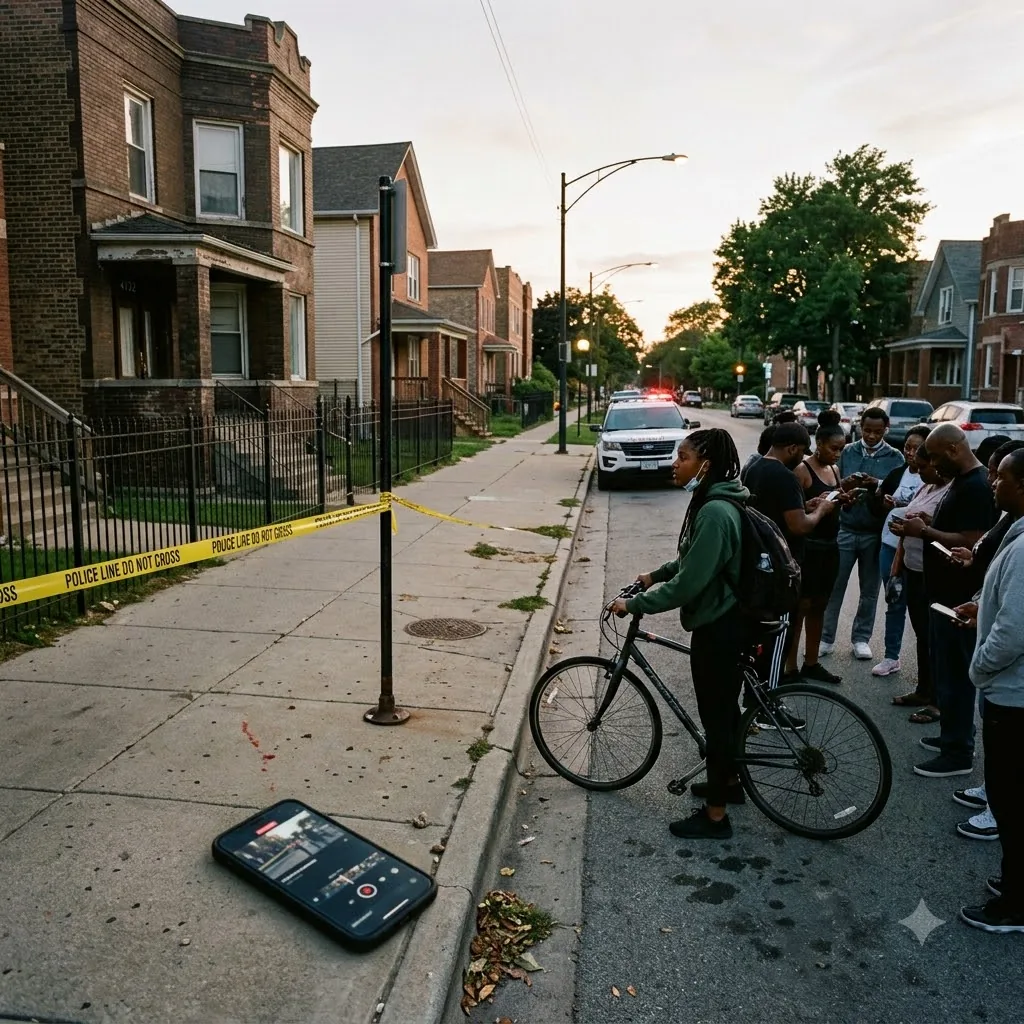
After that, things lost their theater. One officer took statements for real this time, writing down times, names, what Mrs. Kemp had seen, what the driver had heard, what the nephew had on his phone. The crowd thinned once there was work to do and no performance left in it. People who had been eager to watch became suddenly aware of dishes at home, dogs to feed, evening pills to sort.
Nia should have gone with the ambulance hours earlier. That thought kept striking her in useless waves. By the time the tape came down from the porch and the officers let her inside to collect a few things for the hospital, the house felt wrong in a way she had never known before.
Lottie’s sandal was still by the top step. The spilled dirt from the flowerpot had dried in a dark fan across the boards. On the little table by the door sat Lottie’s reading glasses, folded neatly beside junk mail and a church bulletin, as if the day had split in half and only one side of it had been allowed to continue.
Nia moved through the rooms with a grocery bag in her hand, taking what Lottie would ask for first: robe, charger, clean underwear, the blue head scarf she preferred when strangers were in and out of her room. In the kitchen she stopped at the sink.
The medication tray was there. Six bottles, not counting the one police had bagged. One inhaler. A half-full glass of water with a lipstick print gone faint at the rim.
Concrete things. That was what steadied her. This bottle here. That bottle missing. The scarf on the chair back. The sales price on Gavin’s paper so low it was an insult disguised as opportunity. He had not just tried to take a house. He had tried to take timing, confusion, breath, witnesses, and turn all of it into consent.
At the hospital, Lottie was awake but smaller somehow, as if the public part of the day had cost her body extra. There was a bruise shading up along one forearm where someone had gripped too hard, and tape on the back of her hand where an IV had been. Her voice came rough.
“They get him out my yard?”
Nia set the bag down and nodded. “Yes, ma’am.”
Lottie’s eyes closed briefly. Not relief exactly. More like one burden set down while three others stayed put.
“Whole street saw me laid out,” she said.
Nia had no soft lie good enough for that.
She sat beside the bed and helped Lottie tie the blue scarf over her flattened hair. Outside the room, a television murmured to nobody. Down the hall, a cart rattled past. Ordinary hospital noises. They made the day feel even crueler.
“He won’t get the house,” Nia said.
Lottie opened her eyes again. “I know that now.”
What she knew too, and what Nia knew with her, was that some things had already been taken anyway. The block would never fully forget seeing her on the porch and on the ground. Neighbors who should have crossed the street to help had chosen instead to film, replay, interpret. Gavin’s clean image was gone, but that did not give Lottie back her strength, or her privacy, or the hours in which strangers had treated her worst day like proof of whatever story suited them.
Nia reached for her hand carefully, avoiding the tape-marked skin.
Lottie squeezed once, weak but certain.
When Nia finally looked down at their joined hands, guilt moved through her again, heavy and useless and alive. She had stopped him. She had made the truth audible. But the truth had come after the watching, after the porch, after the humiliation had already taken its place in the neighborhood’s memory.
And outside, beyond the hospital glass, the block where Lottie still had to live was settling in for the night with a new story to tell and no clean way to tell it.