Story code: ST-001401
Part 3: Disposable Parts
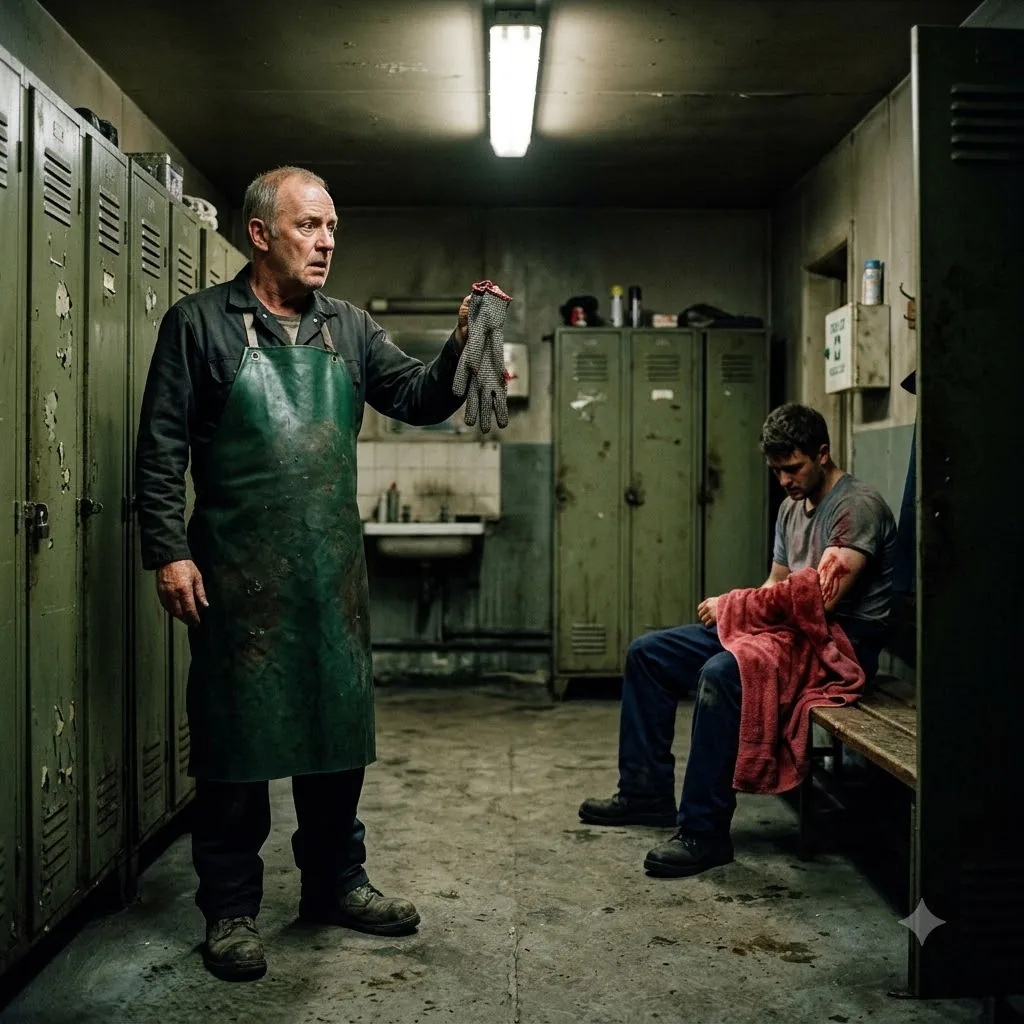
The fluorescent tube overhead popped and hissed, casting long, twitching shadows across the gray concrete floor. Gary stared down into Mateo’s sunken eyes, the boy’s breath sour with shock and copper.
*Kill me in this locker room.*
The words hung in the damp air, heavier than the thick smell of industrial bleach. Gary felt the frantic pulse of the boy’s pinned right wrist hammering against his thumb. Underneath his wide palm, the muffled, tinny voice of the operator buzzed like a trapped hornet.
Gary was not a killer. He was a shift foreman. He was a man who clocked in at four in the afternoon, kept the disassembly line moving, and drove home to a dark, empty house. The violence he knew was institutional, mechanical-the grinding gears of the bone-saw, the swing of the heavy processing hooks, the cold efficiency of the kill floor. The thought of wrapping his hands around the kid’s throat, of squeezing the last breath out of a bleeding nineteen-year-old just to protect a corporate pension, turned his stomach to ice.
His right hand trembled. He didn’t release the pressure on the phone, but the killing intent Mateo had dared him to find simply wasn’t there.
“I’m not going to hurt you,” Gary breathed, the fight suddenly draining out of his heavy shoulders. “But you’re ruining both our lives for nothing. They won’t listen to you.”
“They won’t have to,” Mateo said.
Mateo didn’t pull against Gary’s grip. Instead, the boy shifted his weight on the wooden slatted bench. He leaned his left shoulder forward, the one attached to the mangled, heavily bandaged arm. His face went instantly pale, his jaw clenching so hard the muscles jumped beneath his slick skin. With agonizing slowness, Mateo dragged his ruined left limb across his chest. Fresh blood immediately welled up through the thick white gauze, spilling down his wrist as he forced his trembling fingers-what was left of them-into the chest pocket of his insulated canvas coveralls.
Gary watched, paralyzed by the sheer, sickening willpower it took for the boy to move the shredded nerves in that arm.
Mateo’s bloody fingers hooked the edge of something black and rectangular. He dragged it upward, letting it tumble out of his pocket and land heavily on his thighs.
It was a second cell phone. A cheap, prepaid smartphone with a cracked screen protector, utterly separate from the blue administrative device Gary was currently smothering.
Mateo didn’t try to pick it up. He couldn’t. He just let it rest on his lap. He leaned forward, letting a heavy drop of blood fall from his bandages onto the black glass, and nudged the screen awake with his elbow.
The bright, artificial glare of the screen cut through the locker room shadows.
Gary’s eyes darted down. The breath rushed out of his lungs in a single, painful exhale.
It was a photograph. The angle was high, taken from the metal maintenance catwalk directly above the kill floor. The harsh factory lighting clearly illuminated the vertical bone-saw. And it clearly illuminated Gary, standing by the steel housing, leaning his full weight against the heavy safety shield while he secured it backward with a thick, yellow industrial zip-tie.
Mateo nudged the screen again with his bloody elbow. The image swiped left.
Another photo. Closer this time. A tight shot of the yellow zip-tie holding the safety guard back, keeping the razor-sharp teeth fully exposed. At the bottom corner of the image, the bright red digital timestamp read October 14th.
Three weeks ago.
“You think you’re the only one trying to survive?” Mateo whispered, his voice rattling deep in his chest. “I saw the new quotas on the breakroom board last month. I knew someone was going to slip on that wet floor. I knew the line was moving too fast. So I took pictures. Every week. Just in case.”
Gary stared at the glowing screen. The heavy chainmail glove hidden in his own canvas pocket suddenly felt like a lead weight, threatening to pull him through the floor. He had risked everything to dig that glove out of the machine gears, thinking it was the only piece of evidence. Thinking he was controlling the narrative.
“Mateo…” Gary started, his voice hollow, stripped of all its factory-floor authority.
“I wasn’t going to show anyone,” Mateo interrupted, tears of pain and adrenaline finally spilling over his eyelashes, cutting clean tracks through the dark grease on his cheeks. “I was just going to find another job and quit. But then my hand got caught. And you left me bleeding by the catch-tray so you could go hide the glove.”
Gary slowly lifted his right hand off the blue administrative phone. He let Mateo’s uninjured right arm fall free. The operator’s voice immediately blasted back into the echoing aisle, crisp and painfully loud.
*”…local authorities are approximately three minutes out. Caller, if you are unable to speak, please remain on the line.”*
“I was trying to save my pension,” Gary mumbled, the words sounding pathetic, even to him, as they bounced off the dented metal lockers. “I gave them thirty years.”
Mateo let out a wet, bitter laugh that ended in a sharp cough. “Save it for what, Gary? To sit in your truck? You don’t talk to anyone on shift. You don’t go anywhere after. You eat your lunch alone in your cab with the engine running. You have no wife. No kids calling you on your breaks. You have nothing but this factory.”
The words hit Gary with the blunt, devastating force of a sledgehammer. He took a slow step backward, his rubber boots squeaking against the wet concrete.
“They don’t care about you,” Mateo said, leaning forward into the flickering light, his dark eyes boring into Gary’s pale face. “You think hiding my glove saves you? The second the federal inspectors see these photos, corporate is going to say you went rogue. They’ll say you bypassed the guard to meet quotas without their permission. They aren’t going to protect your pension, Gary. They’re going to feed you to the auditors to save their own bonuses. You’re just a disposable part.”
Gary looked from the glowing photos on the burner phone to the blue device still gripped in Mateo’s right hand. The siren of a distant police cruiser began to wail through the high, frosted windows of the locker room, a faint, rising howl cutting through the heavy rain outside.
He reached into his jacket pocket. His calloused fingers brushed against the wet, heavy ball of ruined chainmail. He had traded his soul to protect a company that had already written his obituary.