Story code: ST-000924
Part 3: The Fuzzy Match
The red recording light pulsed with the same steady, indifferent rhythm, but the camera capturing the footage no longer belonged to Elaine. It was a professional Sony camcorder mounted on a heavy aluminum tripod, operated by a bored legal videographer in the corner of a sterile, windowless conference room.
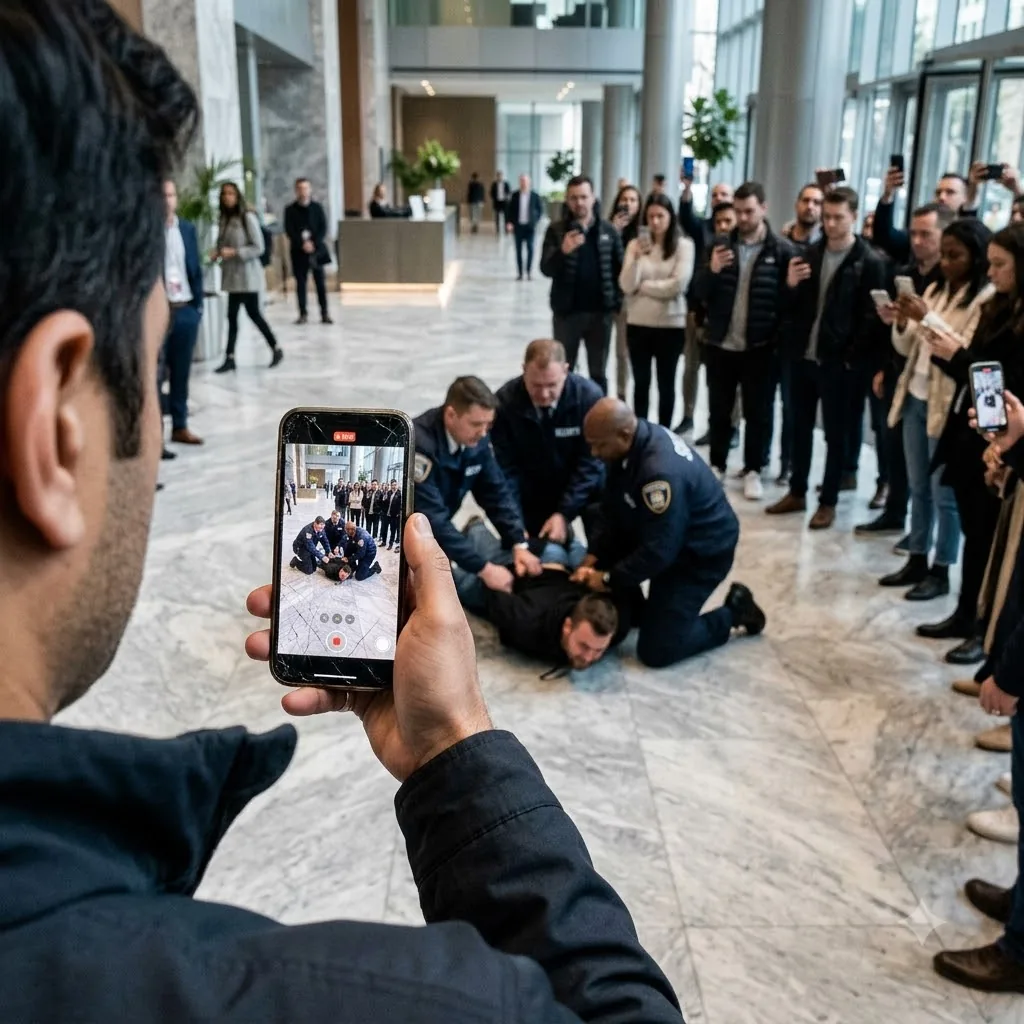
Eight months had passed since the violent struggle on the Carrara marble floor of the leasing office. Diane, the property manager, had threatened to ruin Elaine for taking the crumpled engineering report. Instead, Elaine had broken her lease, moved out before the building’s foundations officially fractured a week later, and formally retained Marcus as her client. She was no longer a silent bystander framing a shot through a six-inch screen. She was the architect of the civil suit currently dismantling the property management group and their security vendors piece by piece.
Elaine sat at the head of the long mahogany table. To her left sat Marcus. His right arm, the one the security guards had nearly snapped in half to retrieve the collapse warning, rested stiffly in a hinged carbon-fiber brace. Across the table sat Greg Vance, the lead software engineer for TenantSafe, flanked by three anxious defense attorneys in identical navy suits.
Elaine adjusted her posture, noting the legal videographer’s monitor out of the corner of her eye. Vance was framed perfectly in the center of the screen, looking small and deeply uncomfortable in his rumpled quarter-zip sweater.
“Let the record reflect we are resuming the deposition of Gregory Vance,” Elaine said, her voice cool and practiced, echoing slightly in the acoustic tiling of the room. “Mr. Vance, before the break, you were explaining how TenantSafe’s threat-detection software communicates with on-site security.”
“Right,” Vance said, clearing his throat and leaning toward the microphone. “When a visitor checks in at the front desk, the system pings our databases. If there’s a severe criminal hit, it pushes an automated ‘Code Red’ alert directly to the guards’ tactical radios. That’s what happened on October 12th.”
“Because your system identified my client, Marcus Wheeler, as a violent felon,” Elaine said.
“Objection, mischaracterizes his previous testimony,” the lead defense attorney drawled, not looking up from his notepad.
Elaine ignored him. She slid a crisp, perfectly flat sheet of paper across the polished mahogany. It was a stark contrast to the blood-stained, crumpled document Marcus had thrown at her shoes months ago.
“Mr. Vance, I’m handing you what has been marked as Exhibit 41. Can you identify this?”
Vance picked up the paper, his eyes darting across the page. “This is the system log for the alert generated on the morning of October 12th. It shows a positive match for Marcus Wheeler, flagging him for a history of armed robbery.”
“And based on this alert, building security tackled my client to the marble floor and suppressed his airway before he could even speak to the receptionist,” Elaine said. “Now, I am handing you Exhibit 42.”
She slid a thicker stack of stapled papers across the table. Vance took it, his brow furrowing as he read the cover page.
“This is a certified criminal court docket from the State of Ohio,” Elaine said. “The conviction record your system pulled to generate the ‘Code Red’ alert. Mr. Vance, could you read the name of the defendant in Exhibit 42?”
“Marcus Wheeler,” Vance said.
“And the date of birth?”
“August 14th, 1982.”
Elaine turned slightly, gesturing to the man sitting silently beside her. “My client was born in November of 1975. A seven-year difference. Why did your software flag this as a match?”
Vance shifted his weight, his chair squeaking loudly in the quiet room. He looked relieved, as if she had finally asked a question he was excited to answer. “Because of our proprietary fuzzy-matching algorithm. Criminals frequently use forged IDs with altered birth dates to bypass background checks. Our algorithm uses Levenshtein distance and probabilistic weighting to ensure we don’t miss a threat just because a couple of numbers are transposed. It’s designed for maximum safety. It casts a wide net.”
“I see,” Elaine said, keeping her expression entirely neutral. She reached into her legal accordion folder and pulled out the final document. “A wide net. Let’s look at Exhibit 43. This is the unredacted visitor log from the leasing office on October 12th, displaying the information my client entered into the iPad kiosk.”
She placed it precisely in front of Vance.
“Mr. Vance, did your fuzzy-matching algorithm compare the Social Security Numbers?”
“Of course,” Vance said, his confidence faltering slightly as he looked down at the new page. “The algorithm weighs all available data points to formulate a confidence score.”
“Great. Please look at the Ohio court docket in Exhibit 42. Read the Social Security Number of the convicted felon out loud for the record.”
“Objection,” the defense attorney snapped, finally looking up. “Irrelevant and highly prejudicial. The algorithm’s composite score is what matters, not individual data points.”
“You may answer the question, Mr. Vance,” Elaine said, keeping her eyes locked entirely on the engineer.
Vance swallowed hard. He looked at the Ohio docket. “Two-four-two… zero-one… nine-eight-seven-seven.”
“Thank you,” Elaine said softly. She tapped her polished fingernail against the visitor log sitting in front of him. “Now. Read the Social Security Number my client entered into your system ten seconds before your software told two armed guards he was a violent threat.”
The room went dead silent. The faint hum of the fluorescent lights suddenly seemed deafening. Vance stared at the paper. A thin sheen of sweat materialized on his forehead, catching the harsh glare of the overhead bulbs.
“Mr. Vance?” Elaine prompted.
“Four… four-one-two,” Vance started, his voice barely a whisper. He cleared his throat, the sound dry and scraping. “Six-six… zero-two-four-one.”
Elaine clasped her hands together on the table, holding his panicked gaze.
“Are any of those nine digits the same, Mr. Vance?”
Vance’s mouth opened, but no sound came out. He looked at his attorneys, but the three men in navy suits were entirely frozen, staring grimly at the mismatched numbers on the table.
“Let the record reflect the witness is silent,” Elaine said. “I’ll ask again, Mr. Vance. Did your software cast a wide net, or did you write an algorithm that deliberately ignores a zero-percent match on a federal identification number just to artificially inflate your company’s threat-detection statistics?”