Story code: ST-001365
Part 3: The Duty of Care
The heavy oak door buckled inward with a final, agonizing crack, the ruined brass lock shearing away completely. The door swung wide, banging violently against the stone wall. Cold morning air rushed into the damp basement, carrying the sharp scent of ozone from the angle grinder and the distinct metallic smell of gun oil.
The point man stepped through the threshold. He was a mountain of black Kevlar and ceramic plates, his suppressed automatic rifle sweeping the room with terrifying, practiced efficiency.
Elena stood beside the open electrical panel, her lungs burning. Her grip on the rubber-handled steel wrench was tight enough to make her knuckles ache. The exposed copper water main was inches away. One strike, one arc of raw municipal current, and the basement would ignite. The tactical team would retreat, the fire alarms would scream, and the real emergency services would swarm the alley.
But a single, cold realization paralyzed her arm.
Marcus hadn’t brought the local police. He hadn’t called federal immigration enforcement. He had brought private contractors, hiding an armed raid behind the sterile mask of a corporate “wellness intervention.”
Elena’s mind raced through the hundreds of pages of the NGO’s mandatory onboarding documents she had memorized over the years. She recalled Chapter 4, Section 12 of the Human Resources Compliance Manual: *The Leased Workspace Exemption.*
It was a notorious corporate loophole. Because the NGO subsidized the lease on the church basement to use as a temporary field office, it was legally classified as corporate workspace. Under the guise of a mental health crisis, HR retained the right to enter, inspect, and secure their “workspace” and any “assets” within it without a police warrant. Marcus wasn’t acting rogue. He was weaponizing the bureaucracy to conduct a black-bag extraction in broad daylight.
If Elena sparked a fire, the terrified family huddled behind the iron boiler might burn before the fire department arrived. And Marcus? Marcus would simply file a digitized incident report citing a tragic, accidental electrical failure during a routine safety check. Elena would be dead, the family would be gone, and Marcus would be entirely legally insulated by the corporate liability shield.
To beat the bureaucracy, she couldn’t burn it down. She had to use it against them.
Elena lowered her arm. She dropped the heavy steel wrench. It struck the concrete floor with a hollow, ringing clatter that echoed through the vaulted ceiling.
The point man snapped his rifle toward her, the black muzzle fixed directly on her chest.
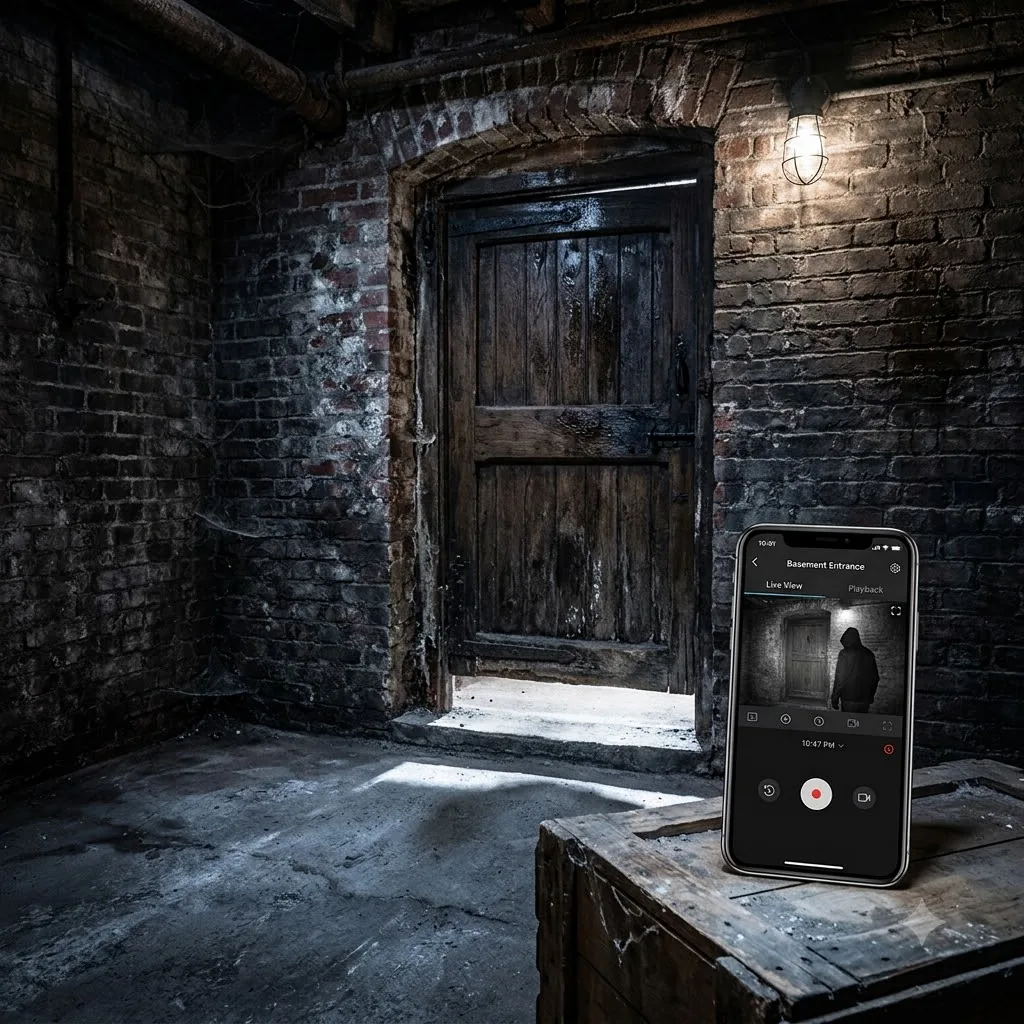
Elena didn’t raise her hands. Instead, she reached into her fleece jacket and pulled out her personal smartphone. The localized jammer attached to the doorframe had killed her cellular signal and the building’s Wi-Fi, but she didn’t need local towers. She tapped the emergency satellite SOS application she kept installed for remote field deployments in blackout zones.
She hit *Record and Broadcast*.
The screen flashed yellow as it hunted for a low-orbit connection, then burned a steady, brilliant red. The bandwidth was agonizingly narrow-barely enough for a grainy video feed-but it bypassed local frequencies entirely, transmitting data packets directly to an encrypted, unalterable offshore server.
Elena stepped away from the electrical panel, moving directly into the fatal funnel of the open doorway. She held the phone at eye level, the red recording light glaring like a beacon in the dim basement.
The point man froze. His polarized visor reflected the glowing screen. His trigger discipline was perfect, but his forward momentum died instantly.
Behind him, Marcus stepped into the doorway. The HR director’s tailored gray suit looked absurdly out of place next to the tactical armor. He frowned, the perfect symmetry of his customer-service mask slipping for a fraction of a second.
“What are you doing, Elena?” Marcus asked, his voice effortlessly returning to its smooth, modulated baseline. “Put the unauthorized device away. You are experiencing a severe paranoia episode. The care team is here to help you de-escalate.”
“I am formally acknowledging the wellness intervention,” Elena said. Her voice was remarkably steady, ringing with administrative authority. She didn’t look at the lethal weapon pointed at her heart. She looked directly into the camera lens, then shifted her gaze to Marcus. “I am recording this interaction for my personal medical records, as is explicitly permitted under the Global Data Privacy Regulation and Section 4 of the Employee Handbook.”
Marcus stepped sideways, attempting to block the phone’s camera from viewing the heavily armed men. “Internal policies strictly prohibit the unauthorized recording of proprietary company support procedures.”
“This isn’t a proprietary procedure,” Elena countered loudly, ensuring the phone’s microphone picked up every syllable over the hum of the boiler. “This is a medical intervention. You stated on the record that you are here to administer care and enforce a mental health off-boarding protocol.”
“We are,” Marcus said. His eyes darted to the glowing red icon on her screen. He recognized the satellite app interface. His jaw muscles tightened. The jammer was useless.
“Excellent,” Elena said. She sidestepped Marcus’s block, forcing the camera’s focus squarely back onto the massive point man in black armor. “Under the Duty of Care Act, and the NGO’s own third-party vendor guidelines, any physical contact or restraint during a mandatory wellness check must be initiated by a certified mental health professional.”
The basement fell entirely silent. The only sound was the ragged, terrified breathing of the mother hiding in the shadows.
Elena took a deliberate step closer to the armored man. He instinctively took a half-step back, the muzzle of his suppressed rifle dipping an inch toward the floor.
“I need you to state your full legal name and your National Provider Identifier number for the record,” Elena demanded, thrusting the phone closer to the man’s visor. “I require verbal confirmation on this broadcast that you are a licensed clinical psychologist or a certified psychiatric nurse. If you are not, your presence here is a gross violation of the mandate.”
“Elena, you are being deliberately obstructive,” Marcus snapped. The faux-concern finally shattered. His tone became sharp, brittle, and desperate. “Stand down immediately. Team, secure the employee.”
The point man did not move.
“If he touches me,” Elena said, her voice rising, echoing with absolute finality, “and he is not a licensed medical professional, this is no longer an HR wellness check. The corporate liability shield evaporates. It becomes a felony home invasion. It becomes armed kidnapping.”
She looked past the point man to the other three tactical operators stacked in the cold alleyway. “You are private contractors. You know exactly how this works. Marcus is using the HR handbook to keep you out of federal prison. But if you execute a kinetic entry without a medical professional present, the NGO will disavow you. They will burn you to save the board of directors. You will take the fall for an armed assault on a leased residential property.”
The tactical team remained completely motionless. They were highly paid professionals. They were paid to take calculated risks, but they were absolutely not paid to absorb corporate felonies on a live, unjammable satellite broadcast.
“Grab her!” Marcus barked, spittle flying from his lips. He pointed a manicured finger at Elena, stepping out from behind the operators. “She’s bluffing! The broadcast isn’t connecting! Confiscate the device!”
“My resting heart rate is sixty-five beats per minute, Marcus,” Elena said smoothly. She glanced at her smartwatch, then held her wrist up to the camera lens. “I am perfectly calm. I am fully compliant with the intervention. I am simply awaiting medical verification from your primary care provider.”
She turned the phone back to the point man. The massive operator stared at the glowing red recording light for a long, agonizing moment. Then, he slowly turned his heavily helmeted head to look at Marcus.
“Sir,” the operator’s voice was a distorted, electronic growl filtering through his external helmet speaker. “Are we covered under the mandate or not?”
Marcus stared at the mercenary, his mouth half-open, the sterile, corporate vocabulary utterly failing him.