Story code: ST-001583
Part 2: Cross-Protocol Interference
The wail of the external sirens was a physical weight, vibrating against the reinforced glass of the vestibule. Sarah watched the playground dissolve into absolute chaos. Thirty seconds ago, it had been a sea of brightly colored winter coats, second graders chasing each other across the frosted woodchips, desperate to burn off the suffocating anxiety of the morning’s coat closet ordeal. Now, little bodies scrambled frantically toward the chain-link fence or huddled instinctively beneath the open plastic slides, entirely exposed to whatever imaginary threat the siren promised.
The two yard-duty aides, Mrs. Higgins and Mr. Vance, were sprinting across the dying grass, frantically clicking the push-to-talk buttons on their district-issued walkie-talkies. Sarah could tell by their panicked expressions that the radios were dead. The man in the suit had likely jammed the local frequency. The aides were shouting instructions, but their voices were completely swallowed by the mechanical, predatory shriek of the alarms.
“They need to learn ingress under stress,” the man in the charcoal suit said calmly. He did not bother looking at Sarah. He had turned his back to her, raising a sleek digital tablet. His finger traced the screen, mapping the children’s erratic movements through a thermal or optical interface. “Response time is sluggish. Cluster behaviors forming at the primary egress point. Highly vulnerable.”
Sarah lunged past him, throwing her entire body weight against the red metal push-bar of the exterior doors. The heavy bar depressed, but the doors did not budge. Above her head, the industrial magnetic locks hummed with an angry, electrified current. She shoved again, the rubber soles of her shoes squeaking helplessly against the terrazzo tile.
“I’ve overridden the local access panel,” the man noted, still utterly absorbed by the data scrolling across his screen. “Standard procedure for a Stage Four ingress test. We need the raw analytics on how long it takes them to breach a secured perimeter while under auditory duress.”
“They are seven years old!” Sarah screamed, slamming her bare palms against the freezing glass.
Outside, she could see Leo, the frail boy who had wet himself in the dark. He wasn’t running. He was standing completely frozen by the tetherball pole, his hands clamped violently over his ears. His small shoulders were shaking with the exact same tremors she had spent forty-five minutes trying to soothe. He had absolutely zero emotional reserves left to process this manufactured terror. The trauma was compounding, embedding itself deep into his nervous system in real-time.
“Age is irrelevant to a kinetic event,” the consultant replied, his voice devoid of a single human inflection. “This is a necessary inoculation. You cannot optimize a defensive posture without first mapping the instinctual failure points. My sensors on the perimeter fencing are recording their biometric panic responses-heart rate escalation, cortisol markers relayed through the smart-watches the affluent students wear. The district wants federal grant money to purchase our predictive models. To justify the expense, we must document that the school is critically vulnerable. Now, take the clipboard and sign for the Phase Two ballistic blankets.”
He was generating the vulnerability. He was terrorizing second graders just to harvest the pilot data required to sell the school board a solution they couldn’t afford.
Sarah stepped back from the heavy glass doors. The administrative office behind her was locked down tight, the front desk abandoned by the secretary during the initial morning drill. She was trapped in the ten-by-ten glass box of the lobby with a sociopath and his metrics. She looked at the heavy metal clipboard dangling from his left hand, and then down at her own empty hands. She didn’t know how to fight. She was a counselor trained in de-escalation, restorative justice circles, and deep breathing exercises.
But she knew the building. She knew the physical reality of the school’s infrastructure better than any Silicon Valley algorithm.
The heavy magnetic locks above the doors were electronic. The main breaker box was in the basement, behind two locked utility doors. She couldn’t cut the power there. But municipal fire code was absolute, overriding every piece of proprietary security tech ever installed. Every electronic lock in the district was hardwired to a fail-safe relay. If the fire alarm was pulled, the circuits broke automatically to prevent students from burning to death in a locked corridor.
The nearest red pull station was mounted on the brick pillar just to the left of the security pedestal. The consultant was standing directly between her and the lever.
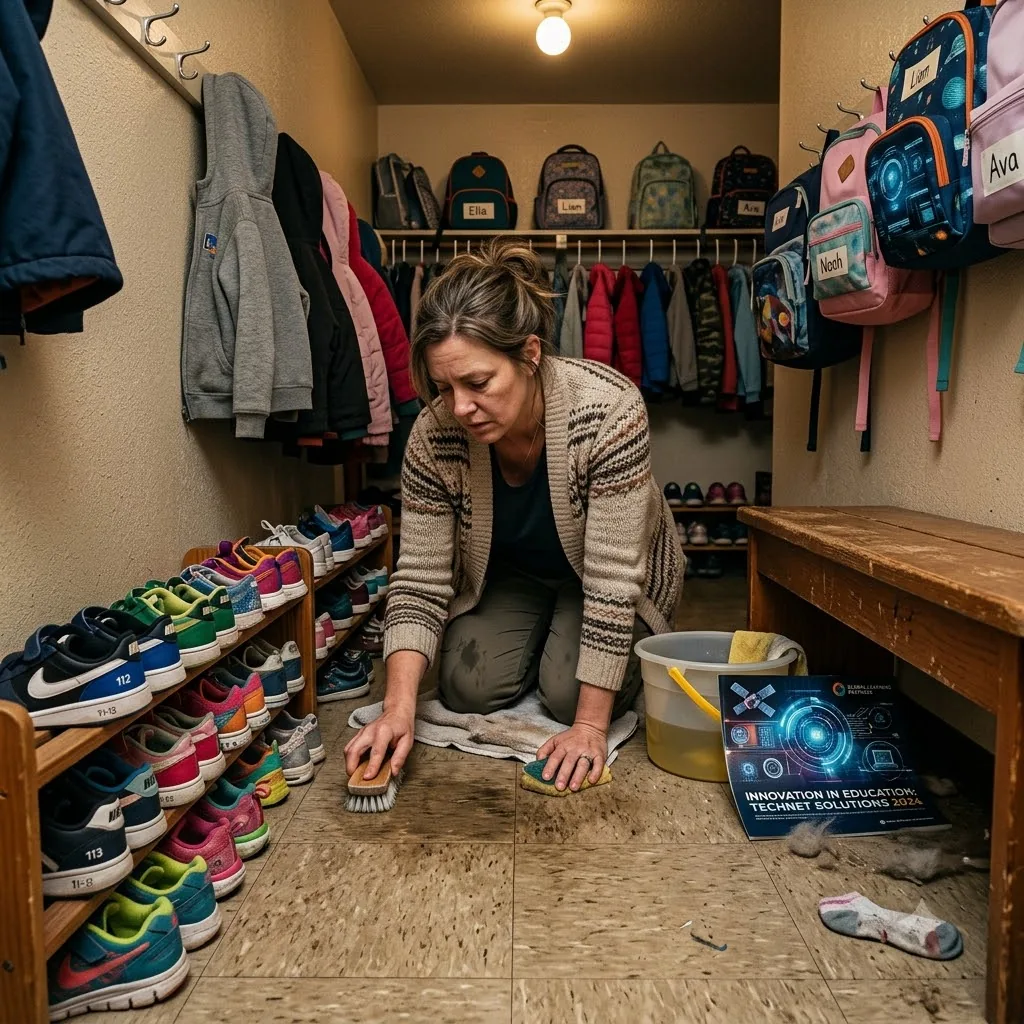
Sarah reached into her cardigan pocket and pulled out the glossy corporate brochure she had found near the Spiderman sneakers. She gripped it tightly, forcing her breathing to steady. “Guardian AI,” she said, holding the heavy cardstock out toward him. “Your predictive threat modeling.”
The consultant finally lowered his tablet, turning his mirrored aviator sunglasses toward her. “Correct. The future of educational environments.”
Sarah took a step forward, extending the brochure as if offering it back. When she was within arm’s reach, she didn’t stop. She dropped her shoulder, closed her eyes, and drove her entire body weight directly into his chest.
The man let out a sharp, surprised grunt. His expensive leather shoes skidded on the slick tile, and he stumbled backward into the security pedestal. The digital tablet flew from his grip, shattering face-down on the hard floor.
Before he could regain his balance, Sarah threw herself at the brick pillar. Her fingers desperately found the white lever of the fire alarm. She pulled it down hard until the plastic mechanism snapped into place.
The piercing, staccato blast of the indoor fire klaxon instantly joined the wail of the exterior lockdown sirens. The noise in the tiny vestibule became a deafening, disorienting wall of absolute chaos-the ultimate nightmare scenario in modern education protocol. A fire alarm during a lockdown. Run and expose yourself, or hide and burn.
But above the doors, the magnetic locks died with a heavy, metallic clunk.
Sarah slammed her hips into the push-bar. The glass doors flew open, biting winter wind rushing over her face. “Inside!” she screamed to the playground, waving her arms wildly toward the aides. “Bring everyone inside now!”
The conflicting alarms broke the children’s paralysis. They flooded toward the open doors in a frantic wave of tears, snot, and panic. Sarah waded into the freezing air, catching Leo by his coat sleeve as he stumbled, practically dragging him into the warmth of the hallway.
She turned back to the vestibule, expecting the consultant to physically retaliate. Instead, he was standing perfectly still amidst the blaring alarms, ignoring his shattered tablet on the floor. He was holding his heavy black cellular device to his ear.
“Subject has initiated cross-protocol interference,” the man shouted into the phone, his cold eyes locked onto Sarah as she shielded the children. “The physical environment is compromised. Release the corridor drones for internal assessment. Let’s see how she handles Phase Three.”