Story code: ST-000088
Part 2: The Betrayal Algorithm
Chloe stepped into the blinding wash of the stage lights, wearing the exact same olive-green jacket she had worn during their late-night planning sessions. Maya’s breath caught in her throat, a sharp, ragged sound that was swallowed by the roar of the applause. Chloe walked with a confident, measured stride, her face stretched into a bright, camera-ready smile that Maya had never seen before. She shook Vance’s hand, the gesture so firm and practiced it made Maya’s stomach lurch violently against her ribs.
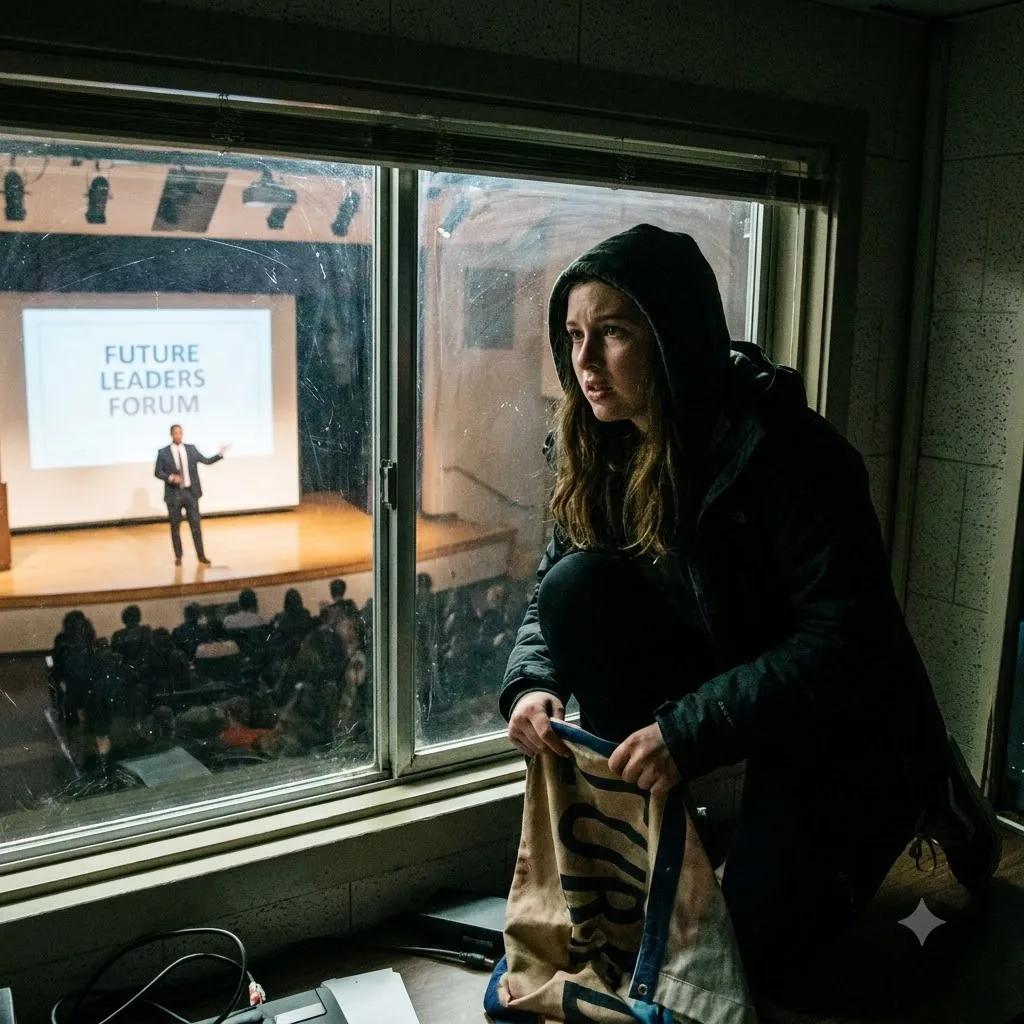
Maya’s hands trembled against the scratched plexiglass, leaving damp, smeared handprints on the surface. Her brain misfired, struggling to stitch the impossible image below into any kind of logical sense. Chloe was supposed to be by the back exit, ready to trigger the blackout. Instead, she stood center stage, adjusting the height of the podium microphone. That olive-green jacket was the very one she had worn when they sat on Maya’s bedroom floor, crying together over the bruises Maya had sustained during the downtown precinct protests.
“Thank you, Director Vance,” Chloe’s voice echoed through the A/V booth’s monitor speakers, crisp and utterly devoid of her usual cynical drawl. “When we look at the rising tide of campus disruptions, we have to acknowledge that traditional security isn’t enough. We need predictive solutions.”
Maya sank back onto her heels, her knees protesting against the hard linoleum. The rolled-up canvas banner, thick with the words *STUDENT PRIVACY OVER PROFIT*, suddenly felt like a dead weight in her arms. She let it drop to the floor.
Chloe pressed a button on the podium’s remote. The massive projector screen behind her flickered to life, displaying a sleek, dark-mode software interface. The logo for SecureYouth Analytics rotated in the corner-a stylized shield built from intersecting data nodes.
“For the past year, my team has been conducting deep, on-the-ground research into the psychology of student dissent,” Chloe explained, gesturing smoothly to a series of heat maps appearing on the screen. “We realized that the best way to predict a threat isn’t from the top down. It’s from the inside out.”
Maya crawled back to the window, her pulse hammering a frantic rhythm in her ears. The heat maps on the screen weren’t generic graphics. Maya recognized the layout immediately. It was the exact architectural schematic of their own high school. And the data points-clusters of red and orange dots congregating near the cafeteria and the quad-corresponded perfectly to the underground grievance circles Maya had personally organized.
“By utilizing peer-level intelligence, we’ve developed an algorithm that maps emotional volatility and anti-compliance indicators,” Chloe continued, her voice echoing over the silent, enraptured crowd of donors and politicians. “We take the raw, unfiltered data of student grievances-their triggers, their trauma, their organizational habits-and we monetize… excuse me, we *mobilize* it into a proactive threat-assessment matrix.”
A cold sweat broke out across the back of Maya’s neck. The grievance forms. The confidential surveys they had handed out to hundreds of marginalized students, begging them to share their stories of harassment by school security so they could build a case for reform. Maya had spent weeks digitizing those painful, intimate confessions on Chloe’s laptop. Now, she was staring at them projected as ‘anti-compliance indicators’ on a multi-million-dollar sales deck.
Chloe hadn’t just abandoned the protest. She had packaged the pain and trauma of every student who trusted Maya, transforming their vulnerability into a proprietary algorithm to sell to the very people terrorizing them. The sheer scale of the betrayal sucked the oxygen right out of the stifling booth. Maya clamped a hand over her mouth to muffle a panicked sob. This polished corporate hustle was built entirely on the bones of their activism.
Fury, hot and blinding, surged through Maya’s veins, momentarily overriding the paralyzing shock. She scrambled up from the floor, lunging toward the massive lighting control desk. Chloe’s betrayal didn’t mean the protest had to die. Maya could still ruin this pitch. She could slam the master faders, plunge the room into absolute darkness, and hurl the banner over the edge of the balcony. It wouldn’t be coordinated, and she would almost certainly be caught, but it would shatter the polished illusion of Chloe’s presentation.
Maya’s hand hovered over the heavy black slider marked *MASTER HOUSE*.
Before her fingers could make contact, her phone vibrated violently against her thigh.
Maya flinched, pulling the device from her pocket. The screen, dark for the last twenty minutes, was now glowing with a single text message from an encrypted number.
*Look at monitor four, Maya. Don’t touch the lights.*
Maya’s blood ran cold. She slowly lifted her head, her eyes tracing the cables running from the soundboard to a bank of small, square security monitors mounted above the desk. Monitor four was tied to the new camera feeds Vance had proudly installed last week.
On the small screen, Maya saw a high-definition, infrared view of the A/V booth. She saw herself, glowing in stark black and white, standing frozen with her hand hovering over the lighting desk. But it wasn’t just a raw video feed.
A green targeting box was locked onto her face. Next to the box, a scrolling side-panel displayed her full legal name, her student ID number, her attendance record, and a rapidly climbing ‘Threat Probability’ percentage that was currently flashing in yellow at 87%.
“To demonstrate the efficiency of SecureYouth Analytics,” Chloe’s voice boomed through the speakers, carrying a chilling undercurrent of absolute control, “we have integrated our software with the auditorium’s active surveillance grid. The system is currently running a live sweep of this very room, scanning for anyone exhibiting anomalous, high-stress behavior.”
Maya stared in horror at the monitor as her ‘Threat Probability’ number ticked up to 91%. The system wasn’t just passively active; Chloe had specifically trained it on her.
“If an unauthorized individual attempts to disrupt this assembly, or tamper with the facility’s infrastructure,” Chloe said, her eyes scanning the dark balcony, “the system will automatically lock down the perimeter and dispatch Director Vance’s security personnel directly to the anomaly’s location.”
On the massive projector screen down on the stage, the main user interface shifted. A wireframe rendering of the auditorium appeared, and a single, pulsing red dot illuminated on the second-floor mezzanine. The exact location of the A/V booth.
Maya yanked her hand away from the lighting board as if the plastic sliders were laced with acid. The heavy metal door of the booth was her only exit, but opening it meant stepping out into the brightly lit mezzanine hallway, right where Vance’s security guards were stationed. The digital clock on the desk ticked forward. The red dot on the giant screen below began to blink faster, and a hushed, collective murmur rippled through the audience of wealthy donors as they watched the software hunt its prey in real-time.