Story code: ST-001113
Part 4: The Void
The silence in the cavernous kitchen solidified, heavy and suffocating, acting as the final confirmation to his father’s unspoken admission. There was no police car to call, no legal loophole to exploit. The extraction van was already navigating the quiet, dew-covered streets of their subdivision, coming to take him away.
Leo took a slow step backward, putting distance between himself and the granite island. His hands dropped to his sides. He slid his left hand past the pocket of his denim jacket, reaching blindly beneath the hem of his shirt to the waistband of his jeans. His fingers brushed against the rough plastic of the secondary burner phone he had taped to his lower back-a cheap, ten-dollar prepaid keypad model he had bought at a gas station and hidden specifically for a worst-case scenario.
He ripped the phone free from the tape, pulling it forward. His thumb hammered the power button, the small, pixelated screen flaring to life with a harsh white glow. He didn’t have time to dial the offshore courier, nor did he have his account numbers. He just needed to dial three digits to get a uniformed officer to the house, someone who could at least delay the private transport team.
He pressed the nine.
His mother moved with a sudden, feral speed that entirely shattered her perfectly tailored, clinical facade. She lunged across the wide expanse of the granite island, her manicured hands hooked into desperate claws. She didn’t just grab for the phone; she slammed her entire upper body across the counter, knocking her ceramic mug aside. Hot, dark coffee exploded in a violent arc across the stone, splashing directly over the pristine yellow court documents and soaking into the heavy legal stock.
Her fingers closed over Leo’s wrist with bruising force. She yanked his arm forward, ripping the small plastic phone from his grip. Before Leo could react, she hurled the device downward with vicious, uncharacteristic rage. The phone struck the hardwood floor with a sharp crack, the plastic casing splintering, but it remained whole.
She vaulted around the edge of the island, her dark charcoal blouse wrinkling as she descended on the device. She brought her heavy, hard-soled heel down directly on the center of the screen. The glass shattered with a sickening crunch. She stomped again, and then a third time, grinding her heel into the electronics until the battery popped free and skittered uselessly under the stainless-steel refrigerator.
She stood over the plastic shards, her chest heaving, her breathing ragged and loud in the otherwise silent room. A lock of hair had fallen across her face, completely ruining her immaculate morning presentation.
“Eleanor,” his father said. The older man’s voice was remarkably tight, entirely stripped of its rehearsed, conversational polish. He stared at the dark coffee rapidly staining the conversion therapy orders. “That was unnecessary.”
Leo looked down at the ruined pieces of plastic near his mother’s expensive shoes. The final tether to the outside world was severed. The steel plates bolted into the doorframe behind him were absolute. His offshore funds and his forged passport were sitting uselessly inside his father’s breast pocket. There was no escape. The physical war was entirely, irrevocably lost.
He watched his mother slowly straighten her posture. She reached up with a trembling hand, attempting to tuck the loose strand of hair back behind her ear, desperately trying to reassemble the mask of a caring, concerned parent.
“I’ll go pack a bag for you, Leo,” she whispered, her voice wavering as she refused to look down at the destroyed phone. “Just some comfortable clothes. Sweatpants. The brochure said you can wear your own clothes during the day.”
Leo felt the frantic, rabbit-like hammering in his chest begin to slow. The icy terror that had gripped his throat for the last ten minutes dissolved, leaving behind a cold, hollow expanse. He looked at his mother’s trembling hands, and then at his father, who was carefully dabbing a paper towel against the soaked court order, trying to salvage the ruined paperwork.
They had built a flawless physical prison. They had trapped him, outsmarted his six months of planning, and successfully contracted strangers to haul him away to a facility that would try to break his mind. But as Leo looked at their desperate attempts to normalize the morning, he realized the singular, glaring weakness in their design. They still needed him to be their son. They needed his tears, his anger, his eventual submission. They needed him to engage with them, to argue, so they could justify their cruelty as necessary tough love.
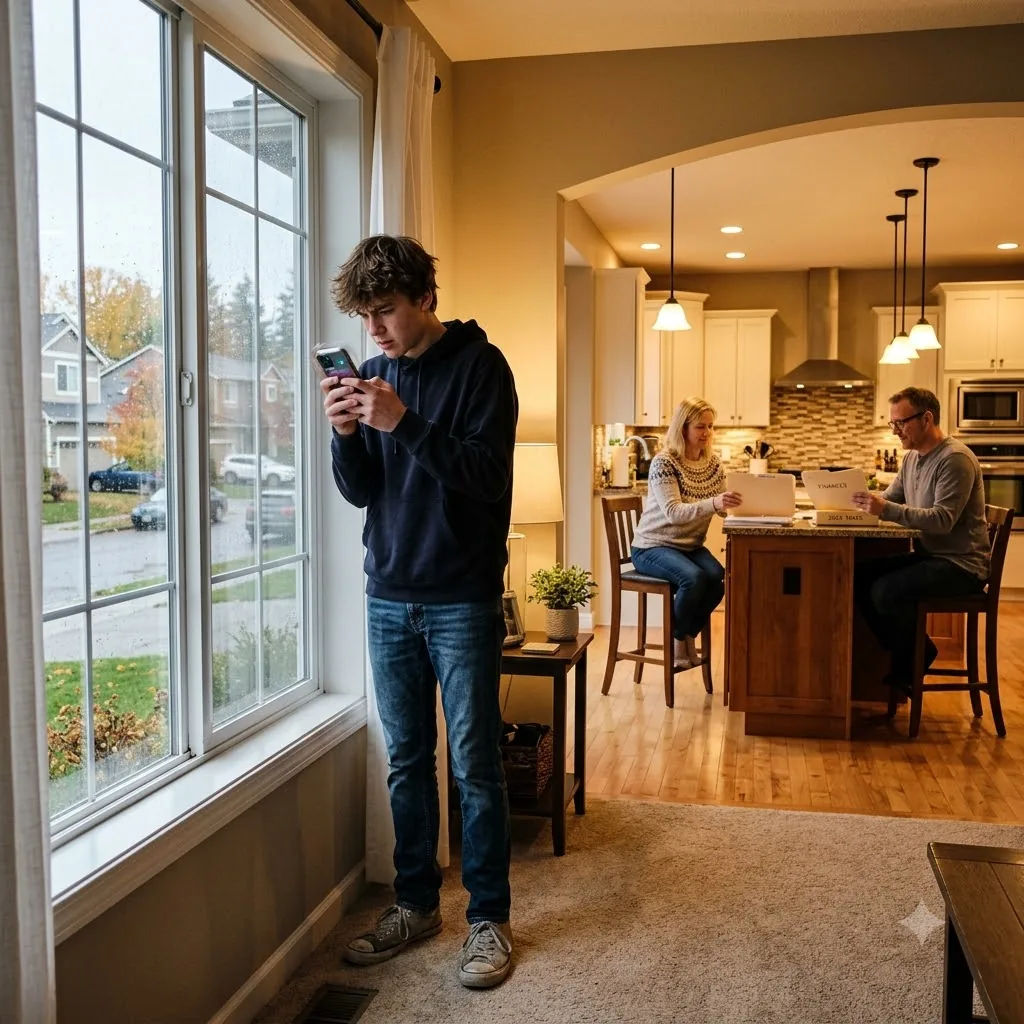
Leo turned his back on them. He walked slowly to the small breakfast nook by the bay window and sat down in the wooden chair. He placed his hands flat on his knees, straightened his spine, and looked out through the hurricane-grade glass at the empty suburban street.
“Leo?” his mother asked, her voice cracking slightly as she took a tentative step toward him. “Did you hear me, sweetheart? Do you want your gray sweater?”
Leo did not turn his head. He didn’t blink. He simply let the muscles in his jaw relax, consciously and permanently sealing his lips. He severed the emotional connection with the swiftness of a guillotine. He would not scream when the transport team arrived. He would not fight the restraints. And he would never, for as long as he lived, speak another word to the two strangers standing in the kitchen.
“Don’t do this, Leo,” his father said, abandoning the wet paper towel on the granite. “The silent treatment is childish. It isn’t going to stop the van from arriving.”
Leo stared at the morning mist rolling across the front lawn, offering them nothing but an absolute, impenetrable void. The house was a fortified cage, but as the agonizing silence stretched over the kitchen, it became clear who was truly trapped. His parents would have to live in this silent, suffocating fortress for the rest of their lives, forever isolated with the ghost of a child they had legally captured, but permanently lost.